Meta’s Favorite Product Isn’t AI. It’s the Copy Button.

An hour after I posted my piece about Meta’s Super Intelligence memo, a friend pinged me and pointed out that once again, Mark Zuckerberg has subsumed someone’s idea and phrase and presented it as his own: personal super intelligence. Not surprising, given that “copy” and “subsume” are on-brand for Zuck, who historically has not been shy about taking ideas and presenting them as his own.

The phrase “personal super intelligence” was coined by Character.AI CEO and co-founder Noam Shazeer, who was also one of the authors of the seminal paper, “Attention Is All You Need.” This paper is widely regarded as the work that inspired today’s AI chatbots. When the company announced its Series A funding, in their press release, they noted:

We understand the importance of providing an AI that truly feels like your own, and that’s why our AI is customizable. From personality to values, you can customize your AI to suit your needs


Snap’s Silver Lining

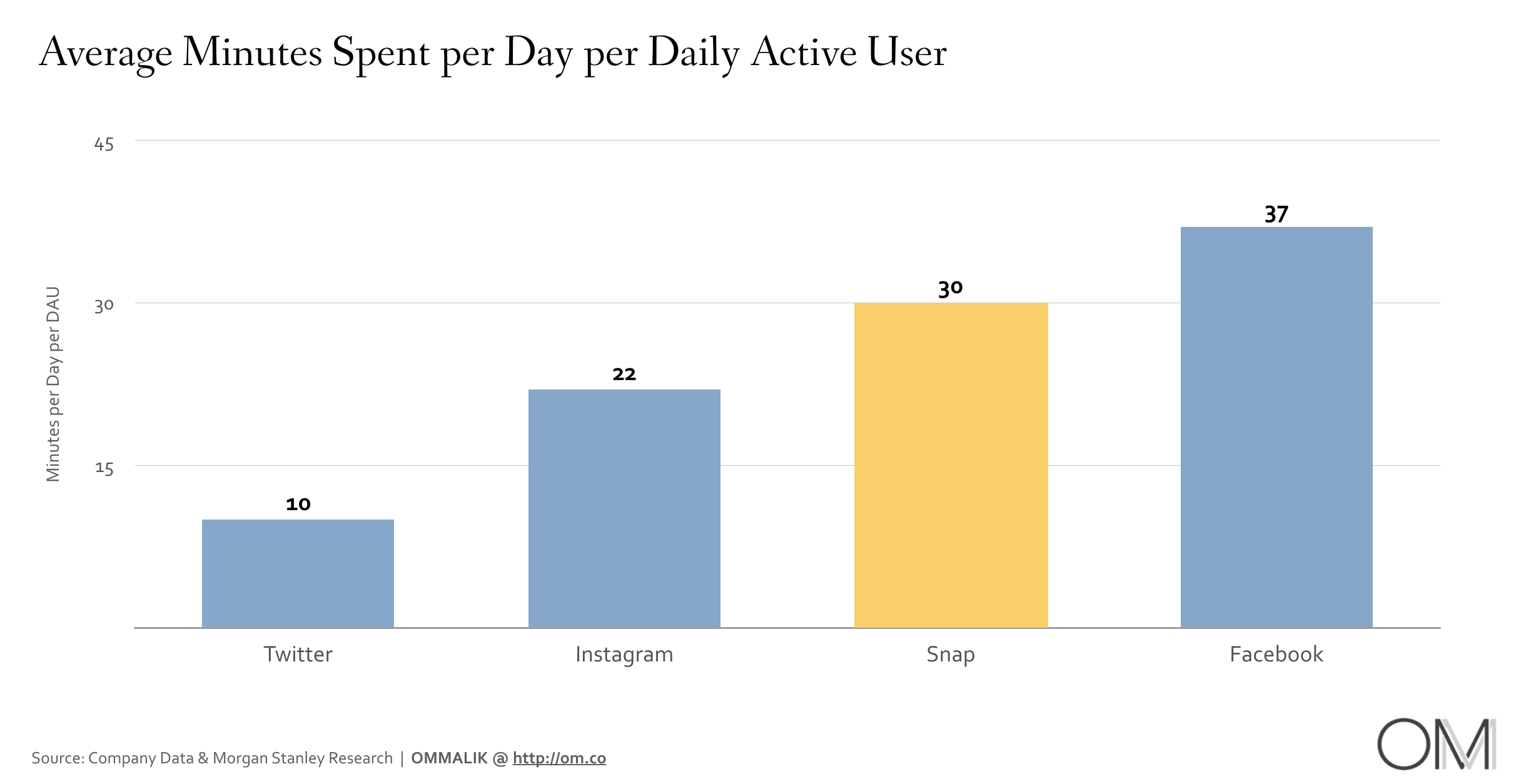
Time Spent per DAU.pngSnap’s first quarterly earnings has taken a toll on the stock, thanks to Facebook and it’s all out assault on the company. User growth was more modest than expected. The company reported an adjusted EBITDA loss of about $188 million during the quarter, a number you find out if you look past the $2.4 billion loss headline.

However, there are some silver linings on these dark clouds: the company is still second to Facebook in terms of time spent in app by its 166 million daily active users — at more than 30 minutes per day. It used to be about 25 minutes. Facebook users spend around 37 minutes on the service, according to Morgan Stanley data, though Facebook itself doesn’t reveal those numbers. Instagram daily active usage is about 22 minutes. Twitter is ten minutes!

It might not be enough to stop the bleeding, but it shows for now


Instagram & Facebook: 5 years later

It has been five years since Facebook got the bargain of the century — Instagram for roughly $750 million. The mobile photo sharing service at that time had mere 35 million monthly active users. It has since added more than 600 million monthly active users. In comparison, Facebook added over 800 million monthly active users. Instagram has changed since — it has shamelessly imitated SnapChat and added many features that have kept the service fresh and interesting to its ever-increasing number of users. I look at Instagram and the growth of mobile photo sharing and wonder if Twitter really blew an opportunity. Instead of trying to do too many things, it should have made photo-sharing on Twitter better, simpler and more fun. I don’t think it is too late — but in case of Twitter, everything moves in mysterious ways. SnapChat, Instagram and Facebook will be part of my forthcoming book, The


I Don’t Want My MTV

Who needs MTV when we have Snapchat and YouTube? That’s what I wondered when I read Viacom CEO Philippe Dauman’s comments regarding the impact of digital on his entertainment conglomerate, which includes entertainment channels such as MTV. “That transition has now taken hold across the industry, creating disruption, but also spurring action and real momentum towards solution,” he said. He was referring to the negative impacts on his company related to its younger audiences.

“Real momentum towards solution” is an interesting choice of words, especially when you juxtapose it against the current media reality: the fight for attention. Instead of lavishing MTV and its siblings all of their attention, the youth of today, who have grown up with the omnipresence of the other network — the internet, both wired and wireless — are faced with a cornucopia of choices on how to spend their time. Snapchat and Instagram are two