
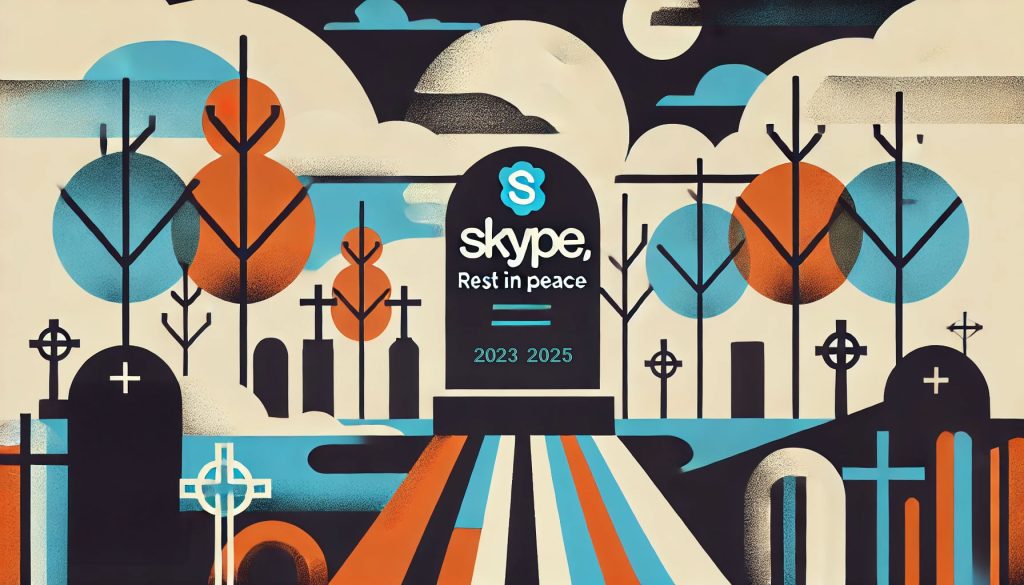
R.I.P. Skype!

On May 5, Microsoft retired Skype, the startup that sparked a communication revolution. I won’t repeat myself, as I’ve already published a postmortem analyzing Skype’s decline under Microsoft’s 14-year ownership of the platform, for which it paid $8.5 billion.

Just like Nokia, Skype created one of the most iconic internet ringtones, and it will likely exist in archives. At its peak in 2009, Skype had 405 million users. They all probably heard it. To me, it will always represent what the internet sounded like in the 2000s.

Having covered Skype since its early days, it’s striking how the platform predicted nearly everything about modern digital communication but ultimately became irrelevant amidst the greatest communication boom.

Skype’s peer-to-peer architecture, adapted from Kazaa, proved to be both its greatest asset and fatal flaw. While revolutionary when introduced, the system struggled to adapt to mobile computing, where battery life and constant connectivity demanded


Skype is dead. What happened?

Microsoft is shutting down Skype. It will go offline in May 2025.

“We’ve learned a lot from Skype over the years that we’ve put into Teams as we’ve evolved teams over the last seven to eight years,” Jeff Teper, president of Microsoft 365 collaborative apps and platforms, said in an interview with CNBC. “But we felt like now is the time because we can be simpler for the market, for our customer base, and we can deliver more innovation faster just by being focused on Teams.” (CNBC)

It makes me incredibly sad, but I am not surprised. The writing was on the wall. Skype has been dying a slow death for a long time. As far back as 2018, it was obvious what lay in store. At the time, I wrote about the great Skype vanishing.

Skype, was once a beloved product, one that I loved using every day. It


China vs US: Social Media Edition


There is a good chance that you might have missed the most important technology news of the day — at least in my opinion. China has asked Apple to remove WhatsApp, Threads, Telegram and Signal from its app store in the country. 

The Wall Street Journal, which has the exclusive, reports

Apple said it was told to remove certain apps because of national security concerns, without specifying which. “We are obligated to follow the laws in the countries where we operate, even when we disagree,” an Apple spokesperson said.

The Cyberspace Administration of China asked Apple to remove WhatsApp and Threads from the App Store because both contain political content that includes problematic mentions of the Chinese president, according to a person familiar with the matter. The Apple spokesperson said that wasn’t part of the reasoning.

The move shrinks the number of foreign chat apps Chinese internet users can use to communicate with those outside of


Is Optimism Wired or Tired?

Wired book by Stephen King
Photo by James Bold on Unsplash

On January 2nd, 1993, Wired burst onto the scene, and let me tell you, it transformed the way many of us looked at technology and its impact on our future. It was like part field notes, part research lab, and a whole lot of fantastic storytelling. That magazine infused us with the kind of wild excitement that only comes from endless possibilities. It was like throwing gasoline on the fires of our imagination and lighting up our optimism. 

In 2017, when chatting with Louis Rossetto, one of the co-founders of Wired, along with Jane Metcalfe, I told him, “Discovering Wired was like stumbling upon my Rolling Stone. It gave me my cultural context more than anything else. I didn’t even think of myself as a nerd back then. I wasn’t. I was just genuinely interested in the future.”


The Pain of Distance

I have made a career out of extolling the virtues of networks — how they make the very notion of time, location, and geography less relevant. The power of optics has flexed its muscles during the time of the pandemic. The wireless networks have kept us engaged, amused, and even productive during a scary time. You can see the world finally growing up to the irrelevance of distance — even big banks, accounting firms and not just technology companies are embracing the idea of remote work. It should give great satisfaction that this future which I have written about is finally here.

And yet I don’t feel any of that satisfaction. Instead, all I feel the distance.

The distance between two humans. I feel the distance between us as a society. And more selfishly, I feel that distance when it comes to those I love—my family. The tyranny of distance


FaceTime with Tech’s Dual Reality

Whenever I am anxious, I have trouble sleeping. I find myself tossing, turning, and waking up in the middle of the night just to sit and stare into the dark. Over the holidays, I had one of those phases again. I felt nervous and worried — specifically, about my parents, who live in Delhi.

My father, who is almost 80 years old, was in the hospital. He suffered heart failure and had pneumonia. My brother had flown to Delhi and was with him, taking care of all the stuff. But I was stuck in San Francisco, anxious, restless, and overcome with the negativity that any immigrant feels when they are far away from aging parents.

My entire family was using WhatsApp to coordinate everything. My mother loves WhatsApp phone calls, so she had been burning up the fiber cables with my sister. My brother knows me well, so he would


10 Tech Reads Today

Due to prior work commitments, I have not had much time to write or journal this week. Nevertheless, I have been reading in-between meetings and jotting down notes on why I liked the following stories:

Why you should not download video files on WhatsApp: Motherboard by Vice has a story that outlines how Jeff Bezos’ phone was hacked by a Saudi Arabian group. The sheer sophistication with which Bezos’ phone got compromised is astounding. My one big take away: avoid any and all downloads on these messaging apps, especially these so-called meme videos and seemingly personal looking videos. Read

Is it too late for Apple TV+?: Having watched some of its shows, I am not that impressed. I don’t believe Apple has what it takes to win against the likes of Netflix. Plus, the numbers don’t look too good in early returns, especially compared to Disney+. By the way, I


Skype, redesigned (again)

Microsoft is once again redesigning Skype — in order to make Skype great again. Or as a Microsoft executive puts it too “focus on simplicity* to provide an overall better experience for you by making Skype faster to learn and easier to use.” What he is not saying — Microsoft messed up Skype so bad that what was a market leading product is now an afterthought in modern daily communication flow.


Facts about GDPR & Instagram’s Data Downloads

The specter of general data protection regime aka GDPR (learn more about it here) looms large for American companies and many of them are working hard to comply with the letter of the law, if not its spirit. I got an email from Sonos about privacy, but couldn’t make much sense of the email. Others are worse: the explanations around data and privacy are written by lawyers, not actual humans.