
Subscribe to discover Om’s fresh perspectives on the present and future.

First Huawei, then TikTok and last week, WeChat: we are navigating stormy seas when it comes to the US-China relationship. It all seems very arcane to an average person. After all, it is easy to find a replacement for TikTok. We don’t use Huawei and WeChat as ordinary Americans. But when the blowback comes, it is going to be against a company whose influence in our lives goes beyond its products.
And that company is iPhone maker, Apple.
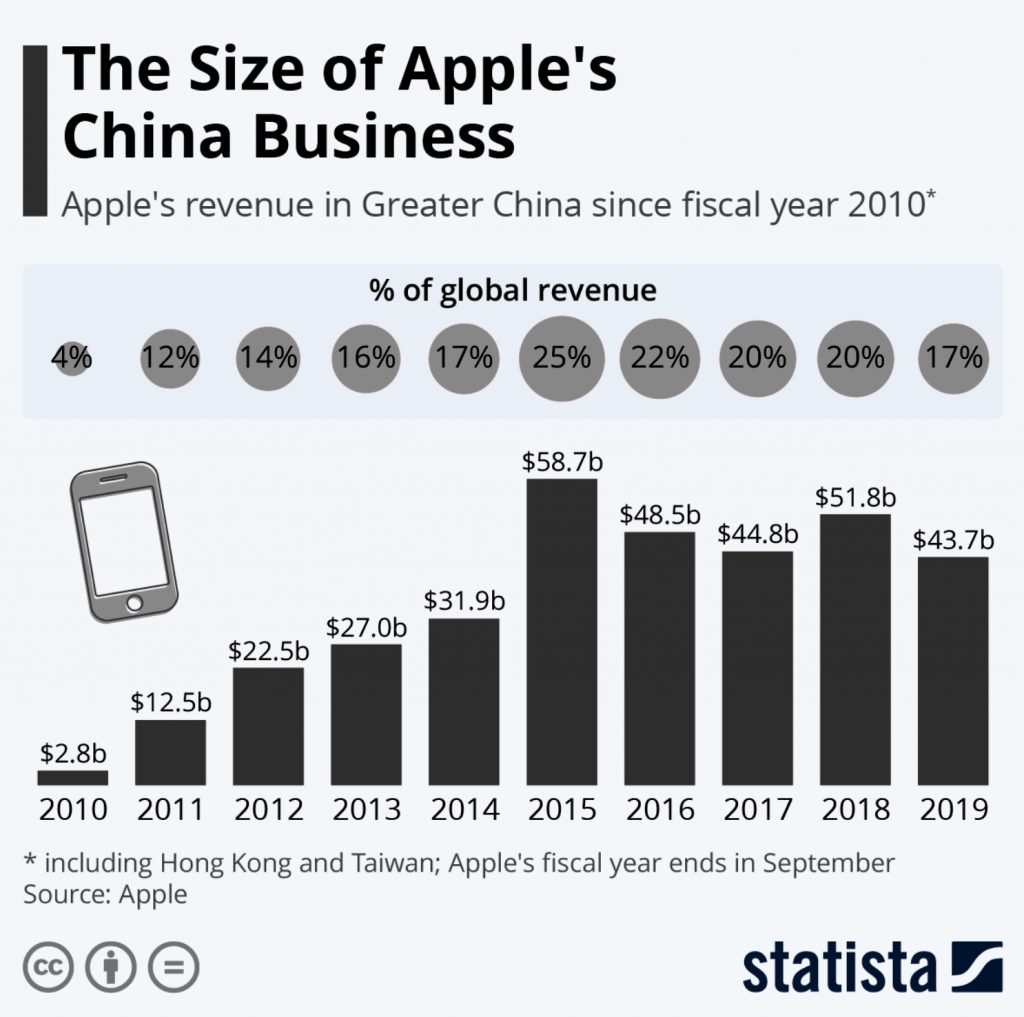
China accounts for about 20 percent of Apple’s iPhone sales. The Chinese App Store is another vital source of revenue for Apple. At last count, the company clocked revenues of $43.7 billion from China in 2019— roughly 17 percent of its 2019 sales. That makes it Apple’s third-largest market. More recently, Apple brought in $9.33 billion during its fiscal third-quarter ending in June 2020 and allowed it to post its best quarter in history — in the middle of a pandemic. More importantly, it manufactures the vast majority of its products in China. Sure it is trying to make products in India. It is using Taiwan and other countries. It will be a long time before Apple can even dream of decoupling its production from China.
Barry Ritholtz, recently noted that “Four industry groups — internet content, software infrastructure, consumer electronics, and internet retailers — account for more than $8 trillion in market value, about a third of the S&P500 and a quarter of total U.S. stock market value of about $35 trillion.” Apple’s market capitalization, which was just shy of $2 trillion last week, is roughly a quarter of that $8 trillion in market value.
Let that sink in!
Suppose this is a reason for celebration — after all, the market says that the future is the technology and not the old industrial complex. In that case, it is hard to ignore that such a massive concentration of the market’s good fortunes is also its Achilles heel, as noted by Matthew Pipenberg, another friend and investor I follow.” When (not if) even the big boys of the S&P see a sharp decline in price, the S&P, based on the very concentrated nature of its market cap weightings, is in fact, more dangerous, rather than safe,” he writes.
It is also important to note that Google, Facebook, and Netflix, three of the most significant tech stocks don’t have that much China exposure. Apple is the one with the highest China-risk. The Verge quoting analyst Ming-Chi Kuo pointed out that if Apple had to remove WeChat from its AppStores around the world, Apple’s annual iPhone shipments in China could fall between 25 to 30 percent and sales of other hardware could fall between 15 to 25 percent. And that’s before the Chinese government starts to act against Apple in a hostile manner.
Any disruption in Apple’s operations is going to have an impact on its market capitalization. And very quickly, Apple’s misfortunes are going to become America’s misfortunes quickly.
Apple’s become such a favorite stock that it is owned by mutual funds, pension funds, and other long term investors who love the company’s ability to make profits. Like many of its big-tech peers, Apple makes up a much larger part of stock indices. It has increased the technology stock’s presence in the index funds.
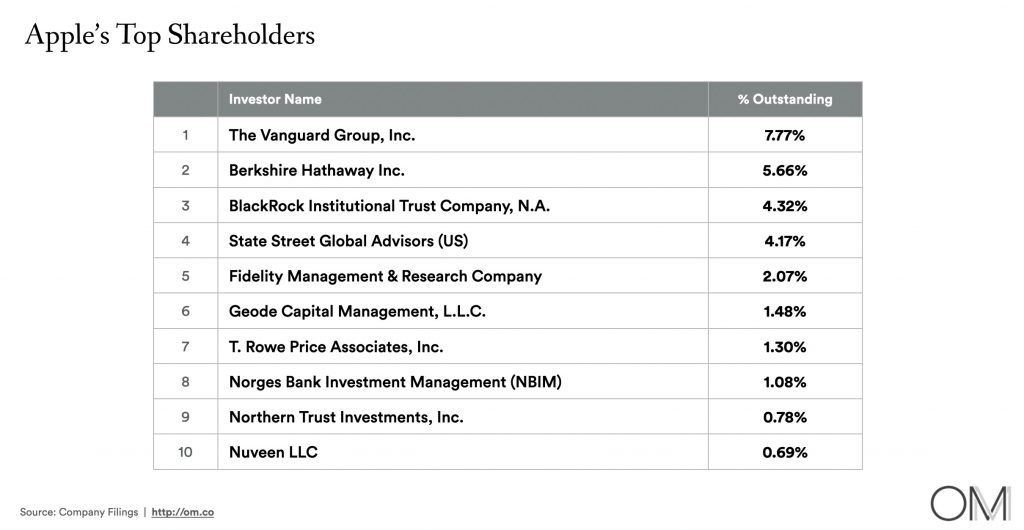
Even more conservative investors such as Warren Buffett’s Berkshire Hathaway have become an Apple believer. Why not, they got $800 million in dividends from Apple last year. And a lot of pension funds, mutual funds, and other such institutions own the gilt-plated Berkshire Hathaway stock. Of the top 10 companies that make up the S&P 500, Berkshire Hathaway is the seventh-largest stock, in which Apple is number one.
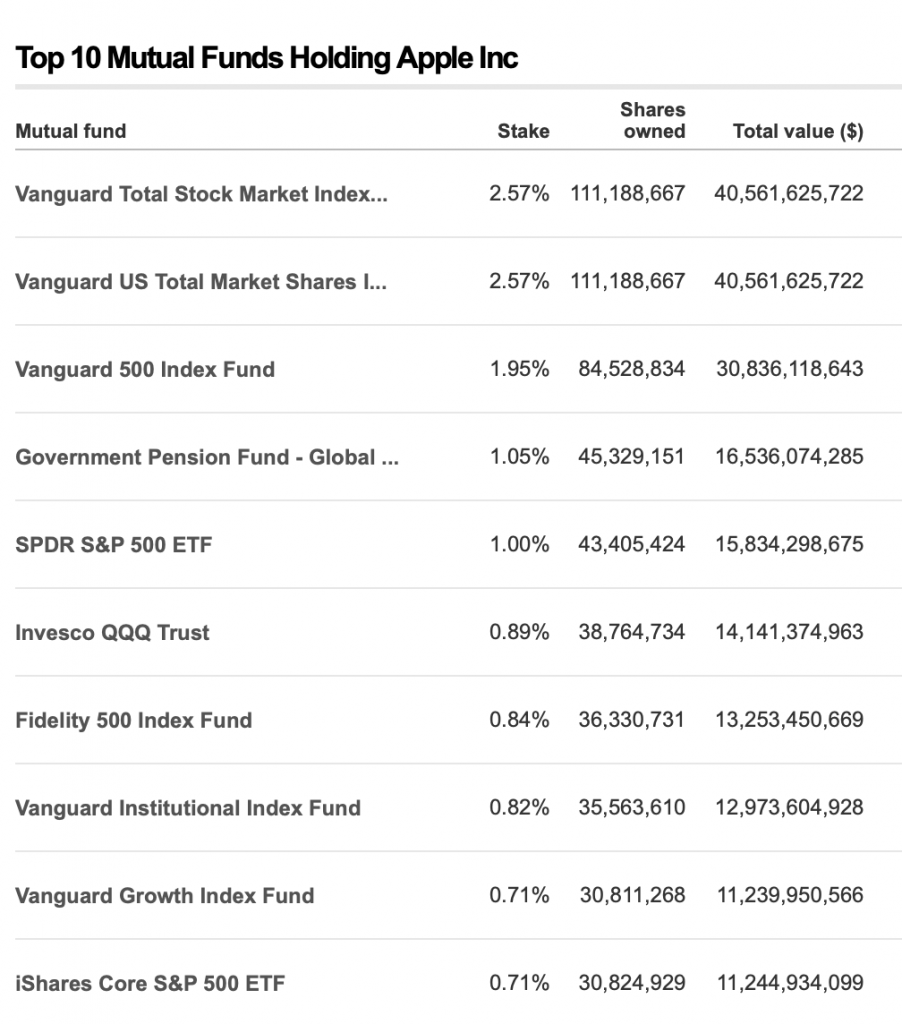
Former Buzzfeed writer Alex Kantrowitz recently wrote that “New York State’s Common Retirement Fund invests in Apple’s small country’s GDP worth. “The top owners of Apple include The Vanguard Group, Berkshire Hathaway, Blackrock Fund Advisors, SSgA, Fidelity, T-Rowe Price, Northern Trust. Of the top ten mutual funds holding Apple, nine are index funds. There are over 225 Exchange-traded Funds (ETF) that count Apple among their top 15 holdings.
Start doing the math — Apple’s China misery becomes a problem for many individuals whose 401k and retirement nest eggs are tied to Apple. As noted earlier, Apple and the stock market are intertwined. Apple’s outsized presence in the market, and by extension index funds and ETFs means that it will have an outside impact on the stock market and that will echo across other stocks as well. And that means other technology stocks — many who have defied gravity for months.
What seems like an arcane battle over TikTok and WeChat, will become an American problem.
August 10, 2020. San Francisco