
Subscribe to discover Om’s fresh perspectives on the present and future.

One of the biggest problems with old people is that they forget that they were young once, or that they were easily bored and did things that annoyed their parents, or that they had their own creative ways to deal with boredom and wasting time. And that is why I am a bit sanguine about how the young and the restless use the Internet and social media.
What triggered this chain reaction of thoughts were the results of a recent survey of 1,500 adolescents by The Gallup Group, which pointed out that, on average, they spend 4.8 hours on social media. But not all social media is created equal.
When you parse the numbers, these teenagers spend 39.6 percent of their time on YouTube and 31 percent on TikTok. They spend about 18 percent of their time on Instagram. However, when it comes to Facebook and Twitter, the numbers decline sharply — 6.25 percent and 4.2 percent.
Yes, teenagers are spending a lot more time on social media — just not as much on what we old-timers call social media. The big takeaway from this survey is that both Facebook and Twitter have aged out. They are as relevant to this generation as Fox and CBS are to the youth.
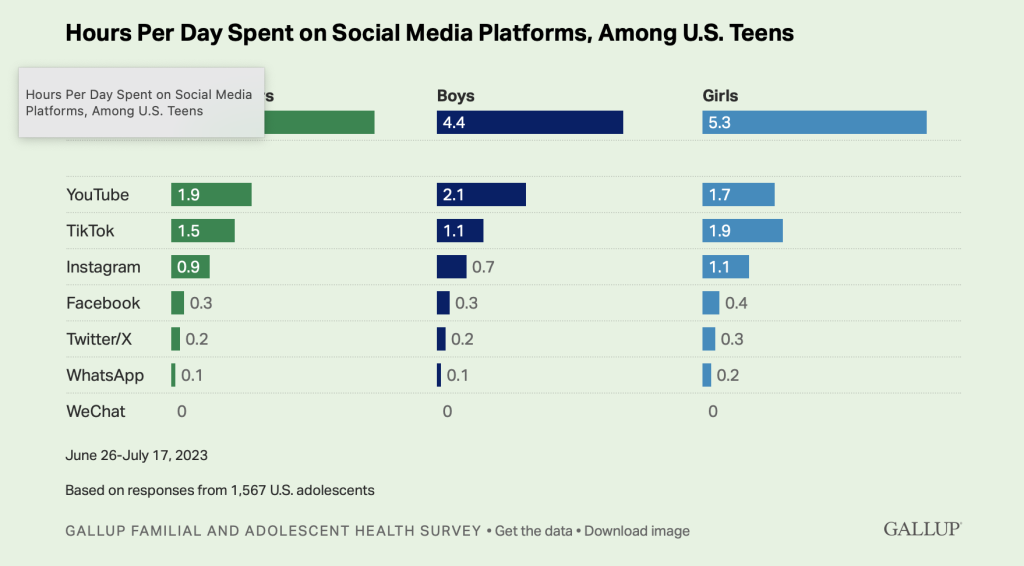
More importantly, both YouTube and TikTok have one thing in common — they are very visual mediums. More importantly, those numbers tell me that the teens are watching “videos” on these networks, not “social networking” in a classic sense. It is easy to conclude that young people are “social networking” when in reality, they are using the Internet through two portals: YouTube and TikTok.
“In our studies, something like almost 40 percent of young people, when they’re looking for a place for lunch, they don’t go to Google Maps or Search. They go to TikTok or Instagram,” Prabhakar Raghavan, a Google executive said at Fortune’s Brainstorm 2022 event. “TikTok “is becoming a one-stop shop for content in a way that it wasn’t in its earlier days,” Lee Rainie, of Pew Research Center told the New York Times.
YouTube is more than just a social networking site. It serves as a source for music videos and streams, a learning hub, a helper for homework, and a platform to pass the time. Much like TikTok, YouTube is where the new internet generation seeks the information they need in a format tailored to them. It’s not social networking in the classic sense that an older generation envisions. Perhaps this is just how the youth use the internet nowadays.
No one should be surprised. The iPad was introduced in 2010. Since then, many parents have handed iPads or iPhones to their children for entertainment. Those same children have grown accustomed to turning to YouTube. This generation has also predominantly used TikTok as its main entertainment source for the past six years.
Institute of Family Studies, which co-sponsored the report, notes that “YouTube and TikTok, two of 7 platforms examined in this report, account for most of the teens’ time on social media, and their use is highest among those motivated by boredom.”
Teens who spend more than 5 hours a day on social media were 60% more likely to express suicidal thoughts or harm themselves, 2.8 times more likely to hold a negative view of their body, and 30% more likely to report a lot of sadness the day before. In this study, these mental health problems were only associated with YouTube and TikTok. Body image problems show significant effects associated with time spent on YouTube, TikTok, Instagram, and WhatsApp, but not the other platforms studied here.….Children who exhibit greater self-control and/or live with parents who restrict screen time, supervise them, and sustain a strong relationship spend much less time on social media than those without these characteristics.
The kids have moved on from the “social media” as we know it. They have their own platforms and their own behaviors. And (not) surprisingly, a large number of them have grown up being savvy about what’s on the Internet. As I said, we all forget how we were when we were younger – listening to records (or radio), hanging out at the mall, watching MTV, and later reality shows.
These were all ways we, as young people, handled the time we had on our hands. If our parents were not around, we saw a lot of movies (on VCRs) or binged on television. When cable came around, it was all MTV all the time. Today, the same kids are on the “medium” of their generation – the Internet and its many forms. First, it was Facebook, then Instagram; now they are on TikTok, and tomorrow it will be something else. That’s how media and the medium change with the changing demographics.
PS: For more context, read my recent essay: Social Internet is dead. I will be following this theme over the next few months as I explore the topic deeper.
October 19, 2023. San Francisco