
Subscribe to discover Om’s fresh perspectives on the present and future.

Sam Altman, CEO of OpenAI, was abruptly fired, causing chaos akin to a reality TV show with drama and theater. This spectacle is unfolding in real-time on Twitter, with the intensity of a video game. Amid the shifting ambitions, desires, and recriminations of all involved, one man stands out — Microsoft CEO Satya Nadella.
He has been in the news as much as the OpenAI board, OpenAI co-founders, and Sam himself. Satya has been part of all options. Sam and OpenAI’s former CTO, Greg Brockman, could join Microsoft to run an AI research lab. Microsoft could hire all those employees who want to leave OpenAI. Microsoft and Satya would support OpenAI in putting Humpty Dumpty together and pretending that the past few days didn’t happen.
This man is central to all conversations. What makes untying this Gordian knot his problem? This is the central and perhaps the most pertinent question. While watching CNBC and Bloomberg, what stood out was that not a single host asked him why this problem was his problem.
Microsoft CEO playing the peacemaker, but why? It would be easy to point to the big bet Microsoft made on OpenAI (and Sam Altman) without any real controls as a clear reason. As I wrote in my post, Foundational Risks of OpenAI,
It’s likely that Satya Nadella and his team at Microsoft didn’t expect Sam Altman’s firing and the subsequent upheaval at OpenAI in their AI future plans. One has to wonder if this was even considered as a foundational risk. I understand that investing billions in OpenAI, partly for Azure’s Cloud use and access to top AI research, was attractive, but one has to wonder if the ambition to outperform Google and Amazon Web Services overshadowed these risks?
Satya is putting in a significant effort, so there has to be more than that. Microsoft was clearly facing a substantial (reputational) risk with the unraveling of OpenAI, and they had to not only mitigate the problem but also somehow not come off as losers.
OpenAI has become crucial for Microsoft’s future and a key showcase for the company to expand its cloud and AI operations. Microsoft wants to sell itself as the perfect partner for anyone wanting an AI enterprise.
By being besties with OpenAI, what Microsoft is saying is that if Microsoft’s Azure is good enough for OpenAI, the best-and-the-baddest AI platform on the planet, then it is definitely good enough for any Fortune 500 company. Microsoft has OpenAI. Amazon Web Services has bupkis. If you want ChatGPT with safety — come to Azure.
It is not just Microsoft, but other cloud computing companies, and Nvidia, a prominent player in GPU technology, are investing billions of dollars in AI startups. Most of the money they invest comes back as spending on cloud services and chips. The number of companies receiving AI funding from them only continues to grow. For instance, in 2023, Nvidia has invested in approximately 15 companies. Even Oracle, a less prominent player in the cloud industry, is getting into the game.
This reminds me of the late 1990s style playbook where off-balance sheet financing came back as revenues for companies like Cisco, Lucent, and Nortel. They and others played that game, and for a while, it was successful until it wasn’t.
Making Google dance by using OpenAI to throw them off their main (search) game, Satya and co. were ensuring that Google Cloud could never catch up — not today, not ever. This win-win-win situation is perhaps why Microsoft skipped asking for a modicum of control over OpenAI. Sometimes you have to move fast and sign deals.
If you want to win in the “artificial intelligence” game today, you need to have three things: Compute, Researchers, and capital to pay for it all. You can hire hundreds of researchers — the going rate is about $5 million in cash and stock per AI researcher — but you still need to provide them with robust compute infrastructure to build, fine-tune, and run their models.
Compute infrastructure doesn’t come cheap — and as I explained above, you have to pay for that with large chunks of your equity. And it is not just any compute — you need compute infrastructure that is not only packed with GPUs but is built to scale, is energy-efficient, and has the low latency necessary for AI systems to not come off looking like a dumber cousin of Siri.
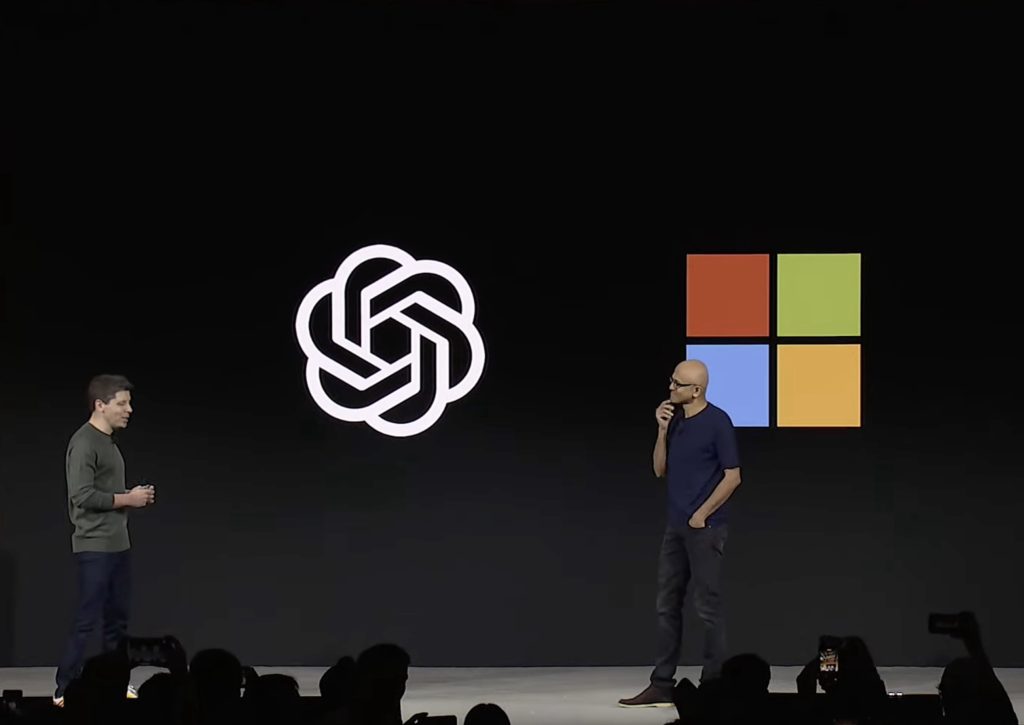
Everything is good and dandy up until Freaky Friday happens. Panic stations? Not really! Satya, as the central figure in a fast-changing scenario, has kept the financial media from asking the pertinent question — how did you invest $13 billion in OpenAI without any significant downside protection? Instead of asking those nasty questions, we are left with a narrative — Microsoft wins, no matter what.
Microsoft achieved a perfect outcome. Satya was following a playbook called TTX, which is a tabletop exercise. This exercise simulates an organization’s risk management and response procedures to emergencies and crises. Any company as large as Microsoft has something similar in place.
The more Satya speaks, the more Microsoft seems to say that OpenAI’s fate is inconsequential to its future. Here’s a theoretical scenario — let’s say Sam and Greg decide to take their researchers and start a rival to OpenAI. They would still need a lot of capital to pay them. And when they are ready, there are three cloud providers to work with, and one of them is Azure. Whatever is left of OpenAI doesn’t have many options either. After the Freaky Friday, everyone will think twice about working with them. The third option is Sam and Co joining Microsoft, which is not bad in the short term.
If everything related to OpenAI burns down, Satya has put a risk mitigation strategy in place in the worst-case scenario. By repeating “Microsoft has everything it needs” and by co-opting Sam Altman completely regardless of the outcome, Satya’s message to the market and the wider world is: we got this!