
Subscribe to discover Om’s fresh perspectives on the present and future.


It is not uncommon to hear the question: what is 5G really good for? After all, it doesn’t change the current applications, it doesn’t change our mobile experience too much from the more advanced version of LTE mobile broadband that is widely available around the world. So, again, what is 5G good for?
How about broadband access to the home? The 5G Fixed Wireless Access has become increasingly popular — as I explained in this article last year. Most of this growth is coming at the expense of traditional broadband providers. Initially, the traditional landline companies lost subscribers. And now the cable-based broadband providers are coming under pressure. And they are worried. Peter Kafka points out that they are responding with Super Bowl ads.
The broadband guys are happy to tell you why they think their internet is better than the wireless internet the telco guys are selling. But spending Super Bowl ad money to do that? That’s pretty telling.
Kafka in Business Insider
The cable broadband providers have gone from dominating the “net new subscribers” category to getting demolished at the hands of 5G Fixed Wireless providers, primarily T-Mobile and Verizon in fourteen quarters.
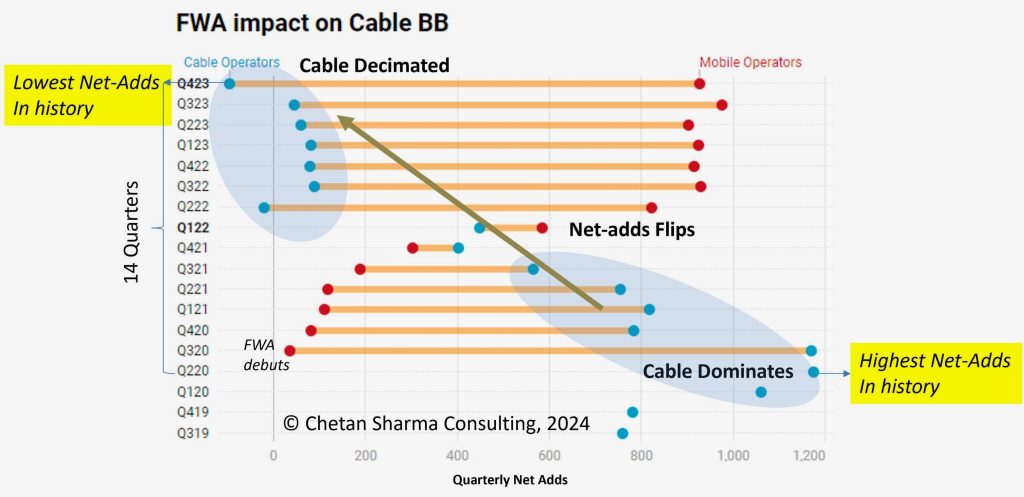
Chetan Sharma (of Chetan Sharma Consulting) pointed out that during the fourth quarter of 2023, Comcast and Charter, two major cable providers, lost 96,000 subscribers. Meanwhile, the two major 5G fixed wireless broadband providers, T-Mobile and Verizon, added 916,000 net new broadband subscribers, bringing their total for 2023 to about 3.75 million.
According to Bruce Leichtman, president and principal analyst for Leichtman Research Group, fixed wireless services have accounted for 101% of the approximately 3,625,000 net broadband additions over the past year. It would be very interesting to see how the cable companies counteract this threat of the decoupling of content and the connection.
February 20, 2024. San Francisco
Comments are closed.
Yes, but the people I know who’ve bought 5G-to-home tell me it’s not nearly as fast as cable at this time. Not to say it can’t improve over time like all technologies, but at the moment, are customers reverting back to cable because they are disappointed in the quality of the service? Hard to say…
Michael
It is pretty likely that is true, however, it is a different kind of a buyer for these connections.
For instance, if you live in a house with roommates, and want your own connection, this is much easier to set-up and use. It also means less interactions with the cable company and installations.
I suspect the biggest growth is coming from places where the cable doesn’t do such a good job, and as a result people feel that it is worth switching or buying these connections. Clearly, millions are opting for this — and cable cos are worried. Something must be working.
True, true. Will be fun watching the 5G companies do to the cable companies what the cable companies did to the phone companies…
I am all for these guys fighting it out, though in the end, we don’t have real competition, just one segment more desperate than the others.
I recently switched to T-Mobile 5G wireless after 9 years of getting my internet from Comcast.
While rated download speeds are (significantly) lower than cable, I find no noticeable difference in day to day usage. Only way I can tell is who I pay my bill to and if I use a speedtest app.
I suspect for most customers, it is all about the price.