
Subscribe to discover Om’s fresh perspectives on the present and future.

Apple’s launch week was lost to the brouhaha over the “Crush” ad. As I explained last week, the real cause of this ad with poor taste is an outcome of the tyranny of large numbers, which is also not just an Apple problem. During Apple’s Lost Week, there was an announcement that was of primary interest to me — the new M4 chip. Apple announced a new iPad Pro with an M4 chip.
I have been following the M-chips since the day they were announced. While they seem routine now, they were revolutionary and brought a new approach to computing chips when they were launched. Even their rivals have joined the party since then — just look at the press releases from Intel, Qualcomm, and Microsoft. Here are quick highlights about the M4 chip:
This is amazing progress in four years for the M-platform. In November 2020, Apple launched the M1, which replaced Intel chips. What made M chips different from the past, and exceptional, was a new architectural approach around the unified memory architecture, where the CPU, GPU, and other components shared the same pool of memory.

What sets the M chips apart from conventional chips is their system-level integration. Unlike traditional setups where components like CPU, GPU, and memory are separate, Apple’s SoCs integrate everything onto a single chip. This made data transfer faster, and computing became more efficient. It allowed for a big jump in performance-per-watt.
Less than a year later, Apple launched the M1 Pro and M1 Max in October 2021. The M2 chip was launched in June 2022, and the M2 Pro and M2 Max in January 2023, offering even greater performance for professionals. Last October they launched a more powerful M3 chip, and seven months later, the M4 chip.
Apple Silicon Chips Comparison: M1, M2, M3, and M4
| Feature | M1 | M2 | M3 | M4 |
| Architecture | 5nm | 5nm | 3nm | 3nm |
| CPU Cores | 8 (4+4) | 8 (4+4) | 8 (4+4) | 10 (4+6) |
| GPU Cores | 7 or 8 | 10 or 12 | 10 | 10 |
| Memory Bandwidth | 68.25 GB/s | 100 GB/s | 100 GB/s+ | 120 GB/s+ |
| Max Memory | 16GB | 24GB | 24GB+ | 24GB+ |
| Neural Engine | 16 cores (11 TOPS*) | 16 cores (15.8 TOPS) | 16 cores (19 TOPS) | 16 cores (38TOPS) |
| Transistor Count | 16 Billion | 20 Billion | 25 Billion+ | 28 Billion+ |
| Release Date | November 2020 | June 2022 | October 2023 | May 2024 |
I found one bit very interesting in John Gruber’s recap of the iPad launch:
“these new iPad Pros could not have been built without the M4. The efficiency gains allowed Apple to make them remarkably thin and light, and more essentially, only the M4 has a display engine that can drive the new tandem OLED displays. This truly is one of those examples where Apple controlling the entire stack — their own silicon driving their own display design — puts their products in a league of their own. They couldn’t drive the new displays without the M4’s display controller and they wouldn’t have engineered that display controller if they hadn’t had these tandem OLED displays in mind.”
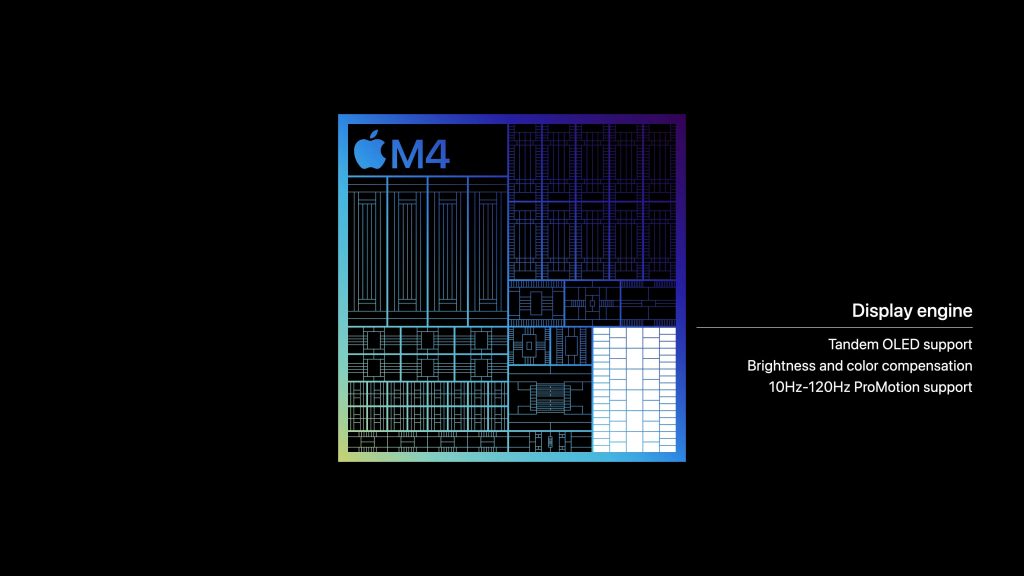
This shouldn’t come as a surprise — at least not to me. Apple folks have told me time and again that it is not just about speeds and feeds when it comes to their own silicon. The features, the user behavior, and future roadmap of software and hardware all work hand in hand. In other words, compared to similar new chips from Qualcomm or Intel, Apple’s advantage will be the ability to integrate and extract more and more from their silicon.
If you take what John wrote at face value, it is clear that we might expect a better, thinner, and more efficient class of MacBooks in the months, if not years, to come. The reason is that the new M4 display engine allows them to use a new two-stack tandem structure OLED display, previously used on some mobile phones and high-end automobiles. These two-stack displays are necessary for larger screens that need to be more durable for a lot longer. Also, these devices with large screens are used for longer periods, pushing the display.
OLED screens have better contrast, perfect black, and are thinner compared to LCD screens. The OLED screen is why the iPad Pro is the thinnest device Apple has ever made. The iPad Pro now matches some of the most premium phones with 1,600 nits. In the past, OLED has been hard to use on portable devices like tablets because they are mostly used in bright environments. That means the display has to work at its optimum for longer. The OLED displays also need a constant power source. The device can overcome those challenges with two layers — pixels can be turned on and off to boost power consumption and dynamic range. The M4 display driver probably helps push this into the real world. The M4 chip is more energy efficient, so that helps use the new display technology.
One of the two major suppliers of tandem displays, LG, recently announced a 17-inch foldable OLED panel for laptops.
17-inch Foldable OLED features an ‘in-folding’ design, allowing it to fold inwards with ease. The curvature of the folding portion is reduced to 3R (radius of curvature 3mm), resulting in a slim and seamless screen design that closely fits together when folded in half. The panel incorporates QHD+ resolution (2560 X 1920) on its 17-inch large screen and boasts an infinite contrast ratio unique to OLED technology, ensuring high-definition content can be enjoyed anytime and anywhere. When fully unfolded, the screen functions as a 17-inch portable monitor or tablet with a 4:3 ratio to maximize the ultimate immersion. By adjusting the angle, it transforms into a 12.3-inch laptop with a 3:2 ratio, breaking down the boundaries of a device to adapt to customers’ individual needs.
I will let you imagine the rest.
May 13, 2024. San Francisco