
Subscribe to discover Om’s fresh perspectives on the present and future.

When I visited the Palouse earlier this month, I spent a lot of time driving around the backroads, traveling through many small towns and communities. These towns were no bigger than a few hundred people. I kept coming across signs for “WiFiber.” As an ex-broadband reporter, I looked into the company and found out that they offer everything from fiber-to-the-home connections to wireless connections. The speeds aren’t the best, but they are more than what I used to get a decade ago. This momentary blast to the past stands in sharp contrast to what is happening across the U.S. broadband landscape.
In about three years, fixed wireless access (FWA) has become a viable broadband option and is beginning to steal growth from both telecom and cable providers. FWA is primarily offered by T-Mobile and Verizon, with AT&T a distant third.
FWA is a prime example of competition emerging from an unexpected quarter. It’s less about eliminating something and more about stealing away net growth. If the market is growing, no one seems to really care. But when the market reaches a mature state, lack of growth opportunities can prove challenging.
Nowhere is it more evident than in the technology arena. Internet Explorer took market share from Netscape, and Firefox did the same to IE. Open-source software took away unfettered opportunities in web server and database markets from Microsoft. Mobile made desktop less relevant. The internet did that to traditional publishing, streaming to television and radio. Fixed wireless is taking growth opportunities from telecom and cable companies.
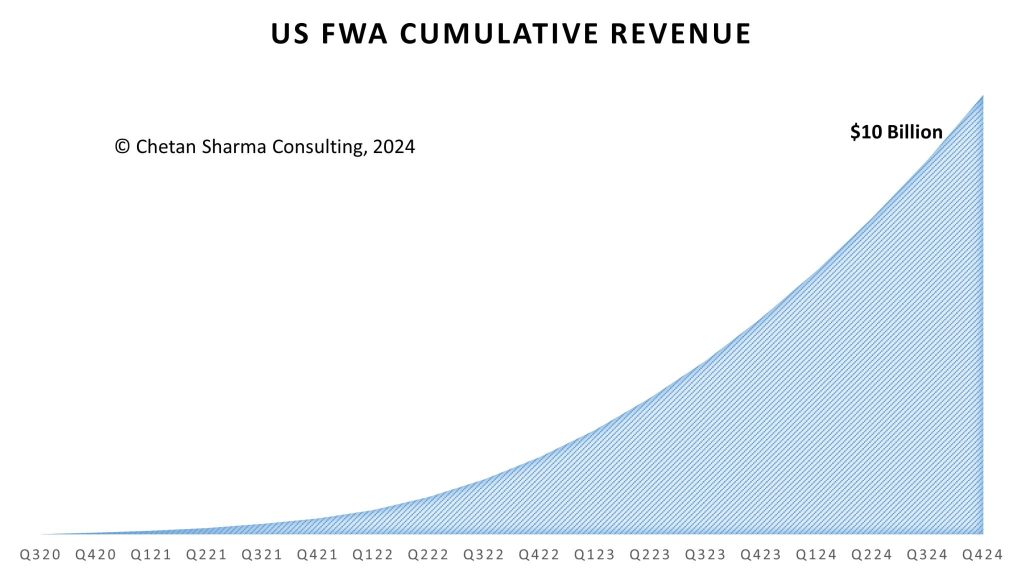
Here are some interesting statistics:
If you’ve been paying attention to what I’ve been writing for the past few years, you could see this proverbial tornado coming from a mile away. The reason FWA is able to capture market share is because at present the bulk of cable and telecom customers are getting 100 Mbps (or thereabouts). FWA sellers are offering 100-to-300 Mbps connections for less than what cable companies charge. T-Mobile recently offered to bundle an FWA connection for $20 a month with my wireless plan — I don’t need it, but it was a heck of an offer, if I did.
And it seems the mobile providers aren’t done yet. Why?
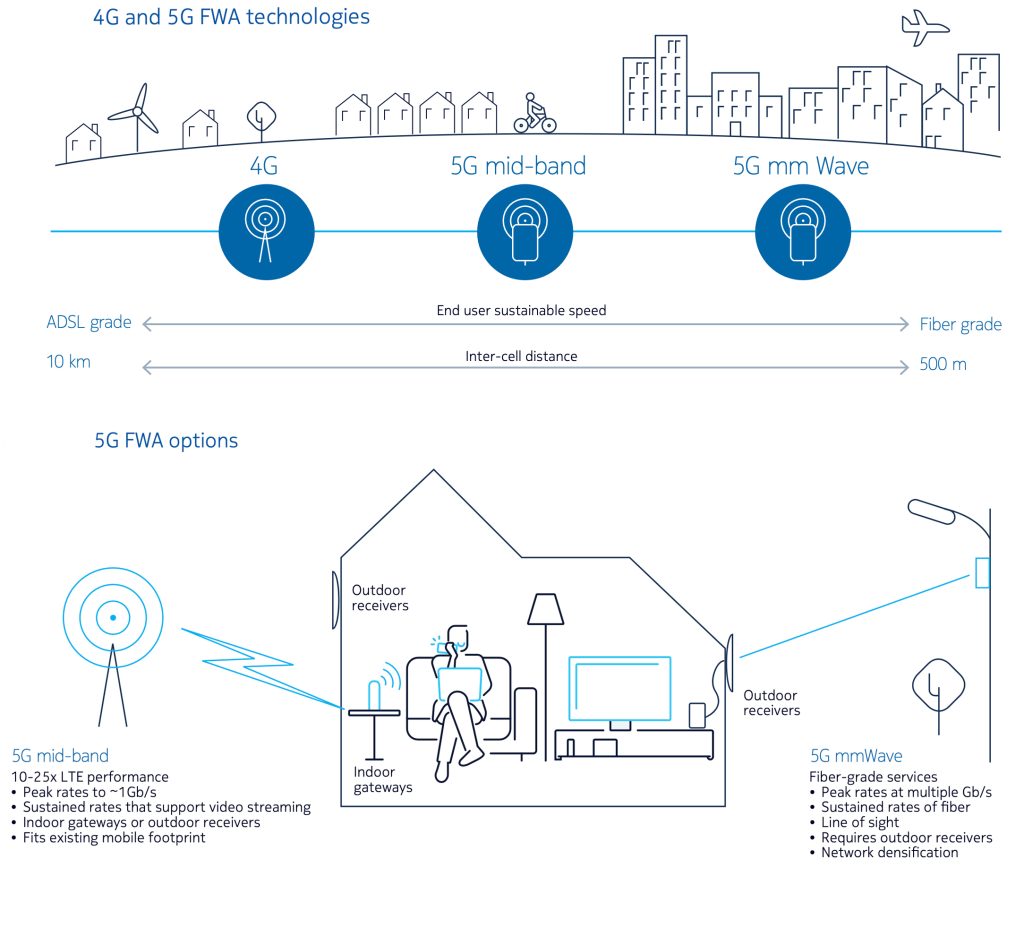
FWA companies are starting to deploy the C-band and midband spectrum they have on hand. This is a significant amount of spectrum, giving fixed wireless providers enough headroom to not only keep adding more customers but also boost speeds. Verizon alone has between 100 MHz and 200 MHz of spectrum. According to Verizon CEO Hans Vestberg, this will allow the company to boost speeds to between 900 Mbps and 2.4 Gbps. Even if you heavily discount his boosterism, the idea of 400 to 600 Mbps is enough for many cable customers to cut the cord.
A lot is related to constant improvements in technology. Today’s technology can handle 80 users (using 100 MHz swath of spectrum) and deliver 200 GB of data per site per hour. For instance, Nokia is working on ways to double the capacity per site by the end of 2025. Much of that will come from new wireless antenna technologies — MIMO antennas going to 16 layers of data transmission versus four layers at present. Then there are beamforming technologies. The final upgrade will be in customer equipment. Nokia has already announced these products.
The challenge for FWA providers is the limitation on how many customers they can serve per transmitter. If history is any indication, technology will solve this quandary sooner rather than later — as long as the money keeps flowing.
The U.S. government recently ended its Affordable Connectivity Program (ACP), and the biggest beneficiaries were large cable companies. If fixed wireless access (FWA) can approach cable broadband speeds at a discount, it will prove extremely attractive for many customers. This is the right kind of opening for FWA to steal customers.
The FWA boom offers a significant lesson: the unpredictable and often arduous journey of technology breakthroughs. And as my trip to the Palouse reminded me, technology always finds a way to improve, even if it might take a long time.
August 9, 2024. San Francisco