
Subscribe to discover Om’s fresh perspectives on the present and future.

Given how much I have been using my iPhone as my everyday camera, I decided to put together this blog post to show how far Apple’s smartphone camera technology has come. With WWDC 2025 coming up later this summer, I am interested in how much more Apple and its chip-wizards can cram into my daily device.
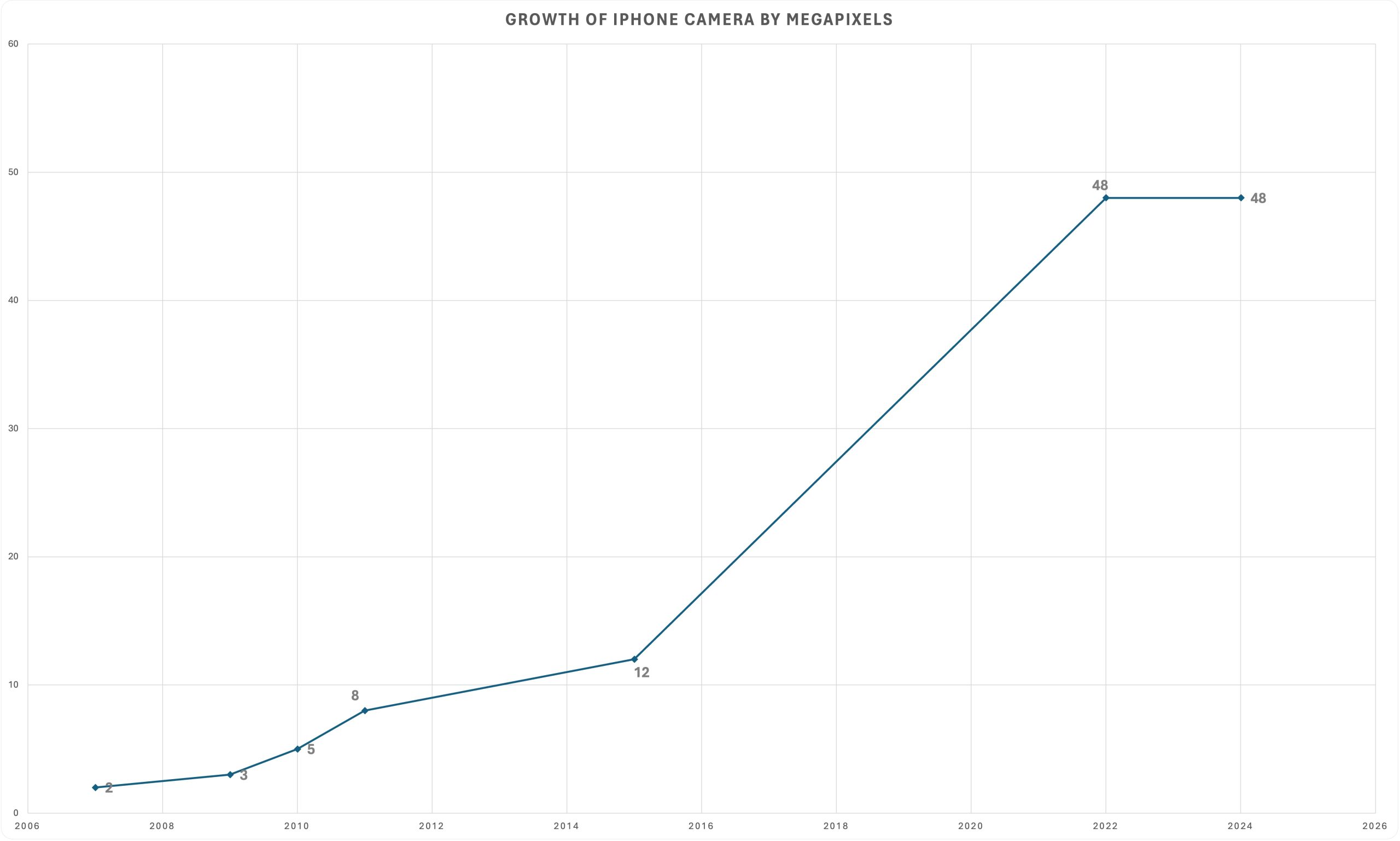
| iPhone Model (Year) | Camera Specs | Focal Lengths (35mm equiv.) | Key Features |
|---|---|---|---|
| iPhone (2007) | 2MP rear camera | ~28-35mm | Fixed focus, No flash |
| iPhone 4 (2010) | 5MP rear, VGA front | ~30-33mm | LED flash, 720p video |
| iPhone 4S (2011) | 8MP rear | ~30-33mm | 1080p video, Improved optics |
| iPhone 5S (2013) | 8MP rear (1.5µm pixels) | ~30-33mm | Dual-LED flash, Burst mode, Slo-mo video |
| iPhone 6 (2014) | 8MP rear | 29mm | Phase-detection autofocus, 1080p/60fps video |
| iPhone 6S (2015) | 12MP rear | 29mm | 4K video, Live Photos |
| iPhone 7 Plus (2016) | Dual 12MP rear | 28mm (wide), 56mm (tele) | 2x optical zoom, Portrait mode |
| iPhone X (2017) | Dual 12MP rear | 28mm (wide), 56mm (tele) | Portrait Lighting, Improved HDR |
| iPhone XS (2018) | Dual 12MP rear | 26mm (wide), 52mm (tele) | Smart HDR, Adjustable bokeh |
| iPhone 11 Pro (2019) | Triple 12MP rear | 13mm, 26mm, 52mm | Night mode, Ultra-wide lens, Deep Fusion |
| iPhone 12 Pro (2020) | Triple 12MP rear, LiDAR | 13mm, 26mm, 52mm | ProRAW, Dolby Vision HDR video |
| iPhone 13 Pro (2021) | Triple 12MP rear, LiDAR | 13mm, 26mm, 77mm | Macro photography, Cinematic mode, ProRes video |
| iPhone 14 Pro (2022) | 48MP main, 12MP ultra-wide & tele | 13mm, 24mm, 77mm | 48MP ProRAW, Action mode, Photonic Engine |
| iPhone 15 Pro (2023) | 48MP main, 12MP ultra-wide & tele | 13mm, 24mm, 77mm | Log video recording, Enhanced computational photography |
| iPhone 15 Pro Max (2023) | 48MP main, 12MP ultra-wide & periscope tele | 13mm, 24mm, 120mm | 5x optical zoom, Log video, Improved low-light performance |
| iPhone 16 (2024) | 48MP Fusion main, 12MP Ultra Wide | 13mm, 26mm, 52mm (2x digital) | 4x optical zoom range, Camera Control, 24MP and 48MP high-res photos |
| iPhone 16 Pro (2024) | 48MP Fusion main, 48MP Ultra Wide, 12MP 5x Telephoto | 13mm, 24mm, 52mm (2x digital), 120mm | 10x optical zoom range, Camera Control, Customizable default lens, 48MP Ultra Wide |
| iPhone 16 Pro Max (2024) | 48MP Fusion main, 48MP Ultra Wide, 12MP 5x Telephoto | 13mm, 24mm, 52mm (2x digital), 120mm | 4x optical zoom range, Camera Control, 24MP, and 48MP high-res photos |
Here are links to some of my features articles and essays about how the iPhone has changed the dynamics of the camera industry.
Comments are closed.
It’s a nice convenient platform to take pictures with but it still does not come close to even my smallest Cannon EOS R50 simply in lenses, let alone low light settings. I do take a bunch of phone pictures but they are not usually the keep long term type, usually just to send to different message groups or work stuff.
The R50 or any dedicated semi to professional camera sensor is also gigantic verses any phone with it’s far better composing, focusing and tracking. The newer mirrorless camera autofocus is also light years ahead of any phone.
I prefer shooting in RAW mode to get unmodified images so I’m not a huge fan of all of the corrections a phone (Apple or Android) makes to the jpegs. I can make my own jpegs in batch with open source free software (darktable for starters).
It just comes down to what type of pictures your taking. If convenience beats quality for someone yes the iPhone is probably perfect. But I’ve always tended to use the best tool for the job and a modern phone is never going to be that.