
Subscribe to discover Om’s fresh perspectives on the present and future.

Mark Zuckerberg, the chief executive of Meta (aka the company formerly known as Facebook), has published a memorandum about “superintelligence” and what it will mean not only for his company but for the world and society at large. It has had a wide variety of reactions ranging from delight to derision. As is normally the case, every single time I come across a memo such as one published by any chief executive (or a founder), I ask myself a few simple questions:
I am in the unique position to dig into Zuck’s words — I was one of the earliest reporters to write about a nascent and burgeoning Facebook (when it was called TheFacebook) and was a campus-only phenomenon. I have followed Facebook (now Meta) long enough to distinguish between what the company says and what it really means.
And over almost two decades of following the company, I have come to a conclusion that Zuck is one of the best “chief executives” to come out of Silicon Valley. And this is coming from someone who has no qualms about viewing him with moral disdain. In the past, I have referred to the company as “amoral” for a reason. Not only is Zuckerberg paranoid and Machiavellian, he is also willing to go to any extreme to survive and thrive.
The newest memo is very much on point for Zuck and in keeping with every single time his company has faced an existential crisis.
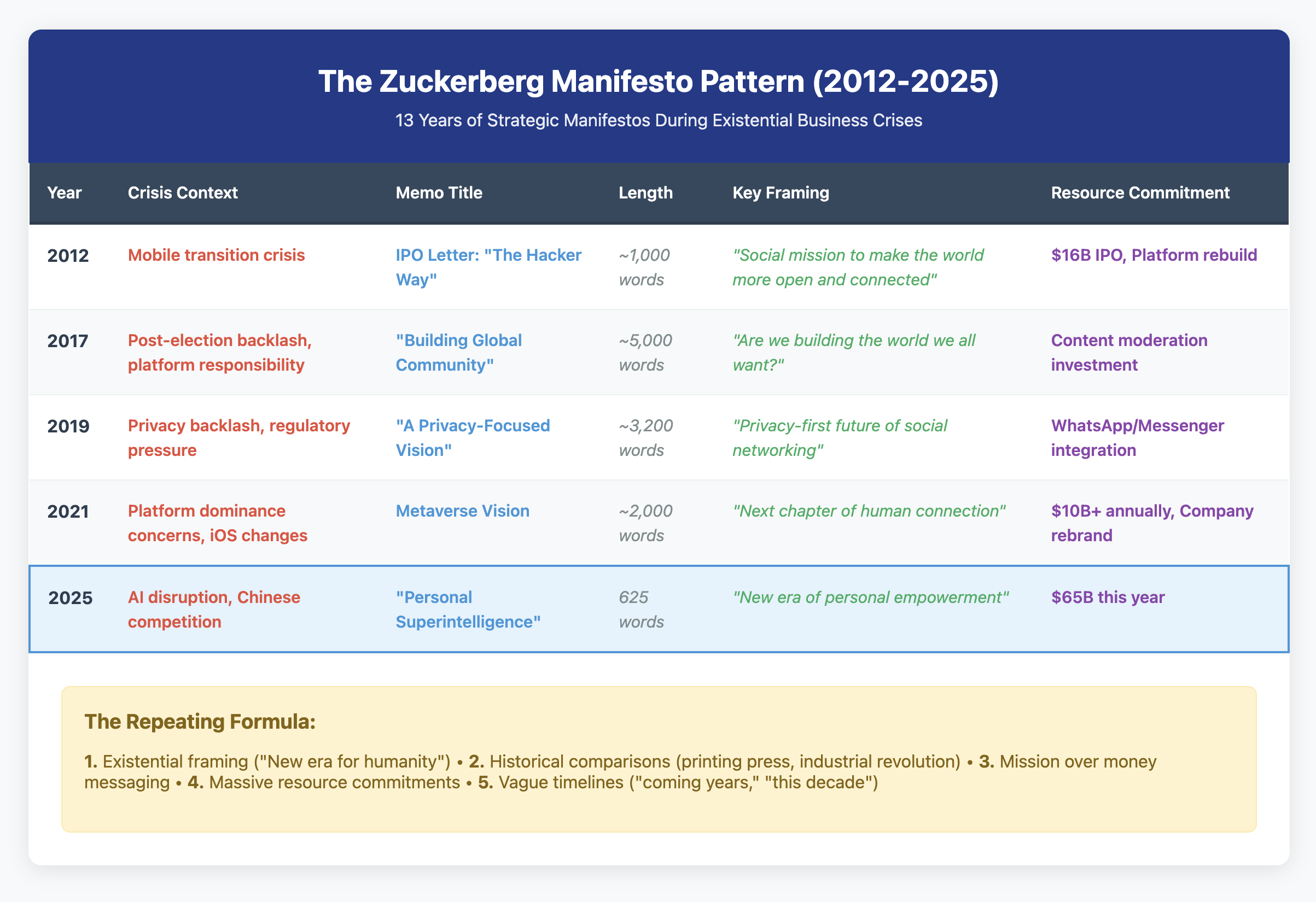
• 2012 IPO Letter: “Facebook was not originally created to be a company. It was built to accomplish a social mission” Zuck compared Facebook to “the printing press and television.”
• 2017 “Building Global Community”: In a 5,000-word letter, he talked about “building the world we all want” and outlined Facebook’s mission to “develop the social infrastructure to give people the power to build a global community.” This was on the heels of a historic election and questions about how social platforms were undermining society.
• 2019 “Privacy-Focused” Vision: 3,200-word memo outlining a vision for messaging and privacy, where Mark wanted Facebook to be more integrated into our lives.
• 2021 Metaverse Memo: Company rebranded to Meta, massive investment promises
• 2025 “Personal Superintelligence” Memo: At 625 words, much more concise than previous manifestos.
***
The formula in all these memos is exactly the same:
There is even a pattern to the context. Each memo coincides with major competitive threats:
Compared to all founders and CEOs, Zuck does seem to have a great understanding of when he needs to bet the farm on an idea and a behavioral shift. Each time he does that, it is because he sees very clearly Facebook is at the end of the product life and the only real value in the company is the attention of his audience. If that attention declines, it takes away the ability to really extend the company’s life into the next cycle.
Let’s look back at the company’s history.
In 2012, when Zuck saw “the stunning, hard shift of users from desktop to mobile,” Facebook went into “lockdown” mode to shift from desktop to mobile. Zuck was willing to sacrifice short-term profits and rebuild the entire platform.
A few years later, when Instagram and WhatsApp threatened to undermine its social platforms with visual social networks and comms-first network effects, it went ahead and bought those two companies.
In 2021, when the Facebook brand was at its nadir, he came up with the Metaverse strategy and renamed the company Meta. An expensive way to reinvent a tarnished brand, but nonetheless, it allowed him to talk about the future instead of being constantly on the defensive. Giving Zuck the benefit of the doubt, I am okay with companies with insane profits experimenting with insane ideas. I mean, unless we had that approach, we wouldn’t have Waymo.
And now Super Intelligence. I mean, what’s $65 billion if you can reinvent society itself?
Most CEOs defend their existing moats. Zuckerberg systematically abandons them. He understands that Facebook’s real asset isn’t the blue app. Instead, it is the graph of human attention and relationships. Each pivot is about preserving that graph while migrating it to new interfaces.
When viewed through that framework, here is how I have attempted to decode Zuckerberg’s 625-word corporate speak.
There is about 25 percent genuine strategic content, the rest is aspirational marketing and corporate positioning. For instance, infrastructure commitments and device strategy show the seriousness of the effort. However, claims about superintelligence being “in sight” are inflated for competitive reasons.
More than anything, this is a positioning document in the AI arms race. By using “super intelligence” as a marketing phrase, Zuck is making his efforts feel superior to the mere “Artificial Intelligence” of OpenAI, Anthropic, and Google. It is him saying we will empower individuals, a remarkably positive message compared to the “AI will replace jobs” narrative that competitors like OpenAI have been painted with.
Zuck has competitive anxiety. By repeatedly talking about being “distinct from others in the industry” he is tipping his hand. He is worried that Meta is being seen as a follower rather than leader. Young people are flocking to ChatGPT. Programmers are flocking to Claude Code.
What does Meta AI do? Bupkiss. And Zuck knows that very well. You don’t do a company makeover if things are working well.
He is also trying to frame his competitors as un-American. He paints centralized AI as creating a “dole” system. Is he trying to appeal to American individualist values while making competitors sound authoritarian and dystopian? By talking about the transition from farmers to modern times, he says he knows how to free humanity to be bigger than itself.
It would be easier to believe him if his three vectors of influence — Instagram, WhatsApp, and increasingly aging Facebook — were anything more than vehicles for an advertising-based attention economy.
With a broader AI context, despite some notable successes, Meta’s efforts to spearhead open-source AI have been unsuccessful in positioning it ahead of rivals such as OpenAI. I would argue that they have been so unsuccessful that they have inspired others, particularly from China, to aggressively pursue the same open-source path and take the mantle of leadership away from Meta. And they are doing it cheaper, faster, and some experts think, better.
A less cynical way of looking at Meta’s open source efforts is that LLaMA succeeded too well at being open source. It created a vibrant ecosystem but struggled to capture value from it. The open source AI model presents inherent business model challenges for the company.
Meanwhile, OpenAI and others were building billion-dollar businesses with closed models. Meta has to somehow justify that $65 billion spending on “AI,” especially to the Wall Street community. They’re playing catch-up after ChatGPT. Anyone who has used either ChatGPT, Claude, or Gemini knows that Meta AI is lacking.
Meta’s AI efforts, despite some notable wins with LLaMA, are not enough. And Zuck knows it. If this was not the case, he wouldn’t be dangling hundreds of millions in front of AI researchers. His decision to buy Scale AI was as much for Meta as it was for delaying the efforts of its AI rivals.
With that said, in the new post-ChatGPT era, attention and relationships are redefined. On the positive side, since Meta has the richest dataset of human preferences, relationships, and behavioral patterns, it can help craft a “personal intelligence” system with an individual’s social context. AI assistants require unprecedented personal access, and Meta has that. There is a reason why Zuck was going on and on about “personal superintelligence.”
The memo’s emphasis on “personal empowerment” suggests Zuckerberg understands this distinction. However, in this new AI-first internet era, AI is your attention manager. So how does Meta translate its past business model of “capture and monetize attention” to “optimize and enhance attention?” The attention economy business model of “endless scroll for ad revenue” fundamentally breaks in the new AI reality.
What’s interesting is what is omitted in the memo. All the talk about personal AI assistants is in sharp contrast to the lack of any conversation about socially-aware AI. I mean, if anything, that has been Meta’s historical competitive advantage.
I am not sure why the relationship aspect is intentionally understated. Does this reflect concerns about privacy backlash or regulatory scrutiny? Or does it portend a society that is going to be increasingly singular, interacting with machines rather than humans?
So what do I think about this memo, and all the efforts of Meta? I remain skeptical of his ability to invent a new future for his company. In the past, he has been able to buy, snoop, or steal other people’s ideas. It has been hard for him and his company to actually develop a new market opportunity.
Zuckerberg also tends to overpromise on timelines and underestimate execution challenges. The metaverse is strugglingafter over $50 billion in investments. This “superintelligence” memo has the same breathless, reality-distorting tone. It would be interesting to see how Meta can avoid the metaverse’s fate of burning massive resources while competitors (Chinese models) deliver equivalent value far more efficiently.
The memo reads like someone trying to convince shareholders that this time the moonshot will work. However, I have learned not to underestimate Zuckerberg and his CEO skills.
July 30, 2025. San Francisco.
Comments are closed.
IBM failed to cross the technology chasm into the Internet era. Zuck knows how tough crossing to the AI era will be. But he still has time, evidenced by after-hours trading in Meta stock
If a Meta AI is going to make sense, you are correct in that it will be based on the data Meta already has in hand, placed under user control. LLaMa isn’t any of that.. LLaMa was for programmers. Meta AI has to be for users.
I’ll agree to disagree on whether LLaMa is open source. I don’t think it is, when I look at the license.
I am very interested in seeing how it plays out because I don’t think it will be easy. I think the customer base is aging out and frankly they will be left competing for a smaller market. I do like his aggressive approach for sure 🙂
So let me get this straight:
The Z person is “bad” but he is a good “CEO”.
The company is dying due to Chinese competition?
AI is the thing that will resurrect the company to ? What?
All I hear about is this AI slop on all the “platforms”. When I try to learn something new or expand my knowledge into other areas I see more and more things that are just made up nonsense on the Internet drowning out my ability to actually find anything.
I have to harden my firewalls both mentally and physically. I know we need pi-hole for AI Slop websites.
Two things can be true. Also being amoral allows you to be a great ruthless leader and Wall Street rewards the company for that. Just look at all the insurance, fossil fuel and drug companies 🙂
As for rest of your comment, you either see this AI thing as a shift or your don’t. Slop or crap in the middle has always been the case with a tech and shifts. There is no tech they came out fully baked.