
Subscribe to discover Om’s fresh perspectives on the present and future.

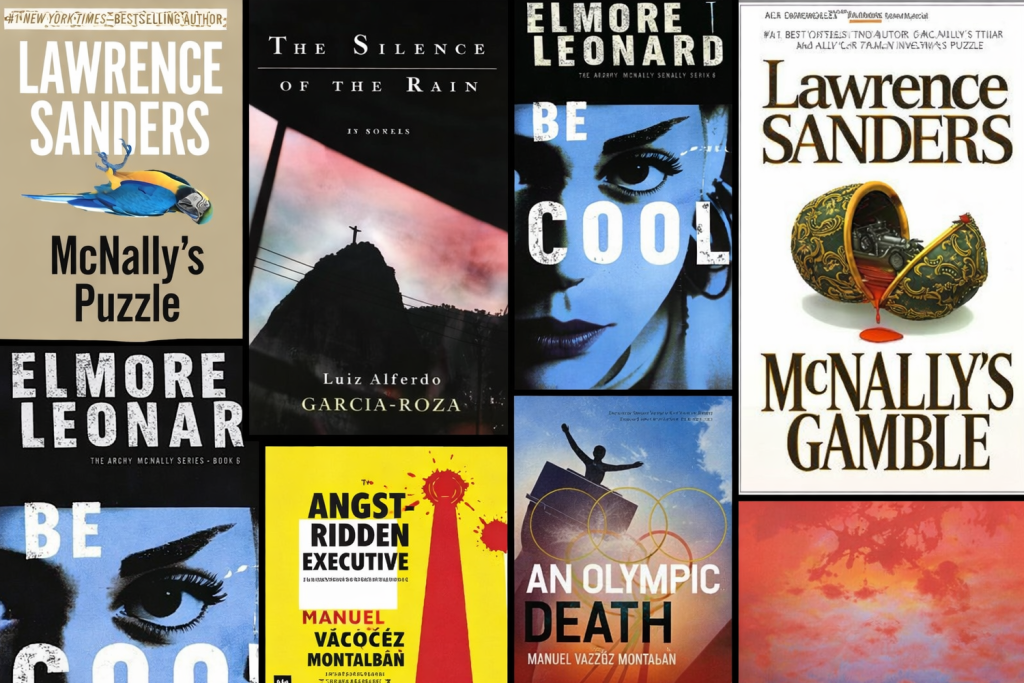
I’ve been enjoying Lawrence Sanders again. Specifically, the Archy McNally series: those breezy Palm Beach mysteries from the ‘90s and early 2000s, starring a trustafarian investigator who solves crimes among the wealthy, catalogs his consumption of calorific food and vodka gimlets, drives a red Miata, and moves around town in clothes befitting a peacock. This is the Palm Beach of Mar-a-Lago before the Mar-a-Lago of now. I’m a fast reader, and I’m already running through the series.
The recent reading spree raised an obvious question: why do I feel so comfortable rereading books from decades ago? Why do crime novels, whether by Sanders or by my other favorite writer, Manuel Vázquez Montalbán (and his Pepe Carvalho series), offer something that new books don’t?
A simple explanation could be nostalgia. But I hate nostalgia. My approach to life is what I call “present future”: feetfirmly in the present, eyes on the horizon, excited for what’s coming. Looking backward feels like a curse, not a comfort. Yet here I am, deep into Archy McNally’s world. It doesn’t feel nostalgic at all. Instead, Sanders and Montalbán feel familiar and great at the same time, even after all these years. Much like Elmore Leonard’s Detroit and Miami crime novels.
Why?
I went looking for answers. The most straightforward framework I found came from Svetlana Boym, a Harvard professor who died in 2015. Her book, The Future of Nostalgia, distinguishes between two types of nostalgia: restorative and reflective. (This is a great book by the way, and worth a careful and deliberate read.)
Restorative nostalgia tries to rebuild the past, to return home. It takes itself deathly seriously and doesn’t recognize itself as nostalgia; it thinks it’s truth and tradition. This is the dangerous kind, the type that feeds nationalist revivals and conspiracy thinking. Look around and you’ll see that nostalgia sweeping the planet, especially around these parts. Trust me, having lived in the past and seen its vagaries up close, I would rather bet on a robotic dystopia.
Reflective nostalgia, by contrast, dwells in the longing itself. It “thrives in algia” and “delays the homecoming, wistfully,ironically, desperately,” Boym writes. It loves details, not symbols. It can be ironic and humorous. That seems reasonable. Maybe this is what these old-new crime novels represent.
Still, I wonder if this framework overcomplicates things. Why not opt for a simpler explanation? I’m not looking to tax my brain. The terrain is familiar. I still remember the details of my youth: the headlines, the music, the movies, and the popular culture of that near past. I can move through these books efficiently, without the cognitive load of parsing new worlds, new characters, new narrative structures. I read them the first time under different pressures, with less accumulated knowledge. Now I can appreciate the craftsmanship without the effort of discovery. I now have the context of time, life, and history to enjoy them anew.
Growing older has made me a disciple of the “long arc of time” philosophy. I’ve been tracking technology and media for decades. For me, books aren’t sentimental objects. They’re data points on a timeline I’m constantly mapping. Reading Sanders from the ’90s isn’t different in kind from reading my own archives or looking at how I covered Facebook in 2007. The appreciation of “then and now” isn’t nostalgia. It’s pattern recognition across time.
Again, knowing myself, I want to explain everything. So I’ve come up with a new idea: Neo-noir.
What the heck is Neo-noir?
Neo-noir is crime fiction that inherits the moral complexity and atmospheric darkness of classic noir, from Chandler and Hammett to the 1940s to 1950s hard-boiled tradition, but for contemporary settings. If classic noir was rooted in post-World War II disillusionment and Depression-era cynicism, neo-noir emerged from 1975 to 2005, a parallel thirty-year arc. This is my explanation, with no academic or intellectual bearing. To me, this is more than just a formal evolution.
Neo-noir (from my personal perspective) reflects a new kind of cynicism. It comes from capitalism’s growing grip onevery aspect of life. The corruption in these books isn’t just about bent cops or political machines. It is about how money shapes everything: justice, relationships, institutions, identity. On the page this may not feel as palpable as it does today. Only recently have we entered late-stage capitalism in its full form, driven by social media and the relentless presence of technology. The neo-noir era caught capitalism in adolescence. We’re living in its maturity. When I read McNally, I see the economic and social disparity of Palm Beach society as a pervasive disease in modern America.
I have a long-held belief that crime fiction is the best form of cultural history. A decade ago, hatred of modern technology began to show up in novels, especially crime books. Now social media, such as Instagram and Facebook, and online stalking are common fare in every other book that reaches the market, reflecting the mood of the nation. Lately, robots and drones are making strong appearances in crime fiction.
Popular fiction, whether police procedurals or contemporary novels, often does better cultural and historical work than formal histories. I’ve learned more about places, eras, and ways of life from crime novels than from academic texts on thesame periods. Montalbán made me want to learn more about modern Spain than any intellectual text ever did. Why? Because he doesn’t just give you a detective story set in Barcelona. He gives you post-Franco Spain: the political transformation, the collapse of leftist idealism, the city’s metamorphosis through the Olympics and into the European Union. Carvalho’s relationship with food isn’t decoration. It’s cultural criticism, a way to understand how a society thinks about itself through what and how it eats.
If it were not for writers from different parts of the world, I wouldn’t have wanted to learn about Brazil, Italy, Vietnam, Japan, and Cuba. Luiz Alfredo Garcia-Roza does for Rio de Janeiro what Montalbán does for Barcelona, with Inspector Espinosa navigating the class dynamics and urban complexity of 1990s Brazil. Andrea Camilleri’s Inspector Montalbano captures Sicily’s particular blend of bureaucracy, corruption, and Mediterranean sensibility.
Massimo Carlotto’s Venetian noir reveals the rot beneath the postcard beauty. Ian Rankin’s Inspector Rebus makes Edinburgh as much a character as the detective himself. James Lee Burke’s Dave Robicheaux series is inseparable from Louisiana, its violence, its beauty, its buried histories. The McNally series does something similar with American class and wealth. These aren’t just stories about crime among the rich. They’re about a particular moment in Palm Beach society, about old money and new money, about how a murky past gets gentrified. Leonard’s Detroit and Miami taught me more about American cities than any urban studies text.
This is crime fiction as embedded journalism. The genre creates a frame for examining how societies actually work: not astheir founding documents or official histories claim, but day to day, who has power, how they use it, and what the real rules are versus the stated ones.
Reading Montalbán now, you know how post-Franco Spain turned out: what became of those leftist aspirations, what Barcelona turned into, how the European project evolved. The books capture a moment of transition in all its ambiguity, but you read with the certainty of the outcome. That creates a kind of double vision. You’re inside the moment with Carvalho, and you’re also looking at it decades later, with full knowledge of where it led.
That’s not nostalgia; it’s historical perspective.
I don’t carry the cultural, intellectual, or academic trappings of writing, books, or journalism. English is an acquired language for me. As a kid, I read a lot, everything from James Hadley Chase to Dickens to Hemingway. I always found pulp fiction, as others derisively called it, a good way to write. It is why, even today, my sentences are short and my words simple. To me, life itself is journalism, a story to be told as simply as it is lived.
A few weeks ago, I read a CrimeReads essay by Margot Douaihy. She explains why noir feels relevant now, writing about finding “strange comfort in noir, the dire, slippery genre that’s a mood as much as a theme of darkness” when “the world feels broken.” I understand that impulse, given my own desire to pick up books from the past. But here’s what matters to me: I don’t want to go back to Chandler and Hammett. Not because they aren’t great. They are spectacular.
But because my neo-noir tells a truth that classic noir doesn’t. Classic noir, for all its darkness, still operates within a framework of moral certainty. Philip Marlowe may walk mean streets, but he’s incorruptible. There’s a code. The world is rotten, but the detective stands apart, untainted. Justice may not be served, but we know what justice would look like. God, that is the world of Bollywood movies, and life isn’t in CinemaScope.
My version of Neo-noir doesn’t offer that consolation. It isn’t moralistic. It acknowledges that we live in a world of moral ambiguity where justice is almost never fully served. The detective doesn’t stand outside corruption. They’re operating within it, making situational decisions, compromised by the same systems they’re trying to navigate. Look around you, and you know you can’t win. All this feels oddly familiar to me.
Growing up in socialist-era India, I had a fairly good understanding of how the world works for different classes. The gap between official narratives and lived reality. How power operates. How systems claim to serve justice while actually serving other interests. The permits and bribes and connections that make things happen or not happen. Later, becoming a journalist I got to see that even more closely.
Neo-noir reflects reality without pretending otherwise. Carvalho burns books for heat while still reading them. He’s an ex-Communist who uses his understanding of ideology to navigate a post-ideological world. McNally works for his father’s white-shoe law firm, protecting the secrets of the wealthy. He’s complicit in maintaining the system, even as he operates with personal integrity within it. Leonard’s characters, cops and criminals alike, are all making deals, working angles, andtrying to survive in systems that don’t care about them.
There is no moral high ground in these books. There are just people trying to do their jobs, solve their problems, and get through the day with some dignity intact. That’s not nihilism; that’s realism. It’s more comforting than the moral certainty of classic noir because it matches how the world actually works. Neo-noir says the systems are compromised, justice is partial at best, and we’re all implicated. And somehow, within that framework, people still try to do the right thing when they can. Okay, I went off on a tangent here, a lot, but you now know how I think.
Back to McNally and Sanders (who happens to be one of my favorite writers and is criminally underrepresented in modern culture). What makes him work, and what makes Sanders’ other creations work (from Edward X. Delaney’s methodical NYPD investigations to Timothy Cone’s rumpled Wall Street cynicism), is a fundamental trust in character consistency. Archy never pretends to be something he’s not; he’s a bon vivant who takes his pleasures seriously. That consistency is what makes rereading work. You’re not discovering who these characters are. You already know. You’re just spending time with people whose company you enjoy, watching them do something they’re good at.
All that intellectual explanation aside, the truth is these are just great books I wanted to read again. Sanders knew how to construct a plot and could write clean, propulsive prose that never got in the way of the story. Montalbán could write. Leonard could write. The books work. I enjoyed them before. I’m enjoying them now.
Sometimes the explanation really is that simple.
January 25, 2026, San Francisco.
As a Barcelona noir reader myself I salute your enthusiasm for Vázquez-Montalbán’s books and his accurate descriptions of a time and a city where I’ve grown up. You should find some time to read his op-eds in national newspapers, they would paint a better picture of an author that was very committed to his political views and his love for F.C. Barcelona, which he described as the
“Symbolic and unarmed army of Catalonia”.
I also encourage you to immerse yourself in Jo Nesbø’s Harry Hole series (start from the third book, first two are quite dull to be honest). It does for Oslo the same thing that the Carvalho series does for Barcelona. Quite a ride if you like tortured characters.
Finally, I would like to draw your attention to BCNegra, the noir festival that we have here in Barcelona every year that is taking place at this very moment, you shall discover new interesting authors if you’re feeling adventurous. 🙂
Excellent post, I follow you for your tech views but this one really touched me. Time for a re-read of Montalbán’s prose, thanks for the reminder!
Thanks Jordi
Jorge,
Thanks for the kind comment. I normally don’t write about non-tech stuff, but somedays things just come to me 🙂 Glad you enjoyed it. That makes me very happy.
I tried reading Jo, and just couldn’t really get into that series. I have no idea why. Maybe Oslo isn’t interesting as a backdrop.
Do you have any other recommendations from the Spanish Noir world?
PS: Sadly can’t travel these days due to personal reasons, but when I can, I will definitely come over.
If you do we’ll book a table for two in Casa Leopoldo and will toast in honor of Vázquez-Montalbán! 😉
I can recommend a couple of series that have been very successful here : the Antonia Scott trilogy by Juan Gómez-Jurado (that has even scored a limited-series in Amazon titled “Red Queen”) and the Elena Blanco series by the mysterious Carmen Mola (don’t know if this one has been translated to English).
Hope you enjoy them if you can find them.
Elena Blanco is going to be the next series I am going to try. Thank you.
Let me know if you enjoyed it!
It would be interesting to read it via translation app or learning to read Spanish 🙂