
Subscribe to discover Om’s fresh perspectives on the present and future.

For thirty-odd years, broadband has been sold as a one-way pipe. The download speed was all that mattered. Bigger the number, better. No one cared about the upload speeds, because the internet was mostly something you consumed. Streaming video, loading pages, pulling files from the cloud. Upload was an afterthought.
All that changed when the pandemic came around, and with it came how we used and interacted on the network.
And if you use upload as a core part of the internet experience, cable broadband is losing again. Not only to some of the fiber providers, but to the upstart, tiny rivals, those pesky municipal broadband providers. They certainly have come a long way since I went to Truckee in 2004 to write about their nascent muni-broadband network being put in place by the local utility.
A new report from Ookla, studying 13 months of Speedtest data from 14 of the largest municipal broadband providers in the U.S., makes that case plainly. Eight of those 14 municipal ISPs beat their local competitors on median upload speeds.
In 2004, I had a core thesis: broadband would decentralize opportunity (it has,) let entrepreneurs build from anywhere (and they do,) and break Silicon Valley’s grip on who got to participate in the tech economy, and it has. I believed it. The municipal networks being built in places like Cedar Falls, Iowa and Truckee, California felt like the capillaries of a new nervous system.
Of course, thesis and reality are two different things, as I have learned time and again.
It didn’t quite happen that way. The infrastructure spread, but the change didn’t happen. At least not at scale. Startups still clustered in San Francisco and New York. The dream of Bend, Oregon and Overland Park, Kansas as legitimate alternatives to the Valley remained a pipe dream. It still is.
What finally forced the shift wasn’t better pipes. It was a pandemic that left people with no choice but to work from wherever they were. Twenty years of broadband expansion did what it couldn’t do alone: it became the foundation for a behavioral change that only a crisis could trigger. And when that crisis hit, it also changed the need for speed, in a direction no one saw, or bothered to even think about. The need for better upload speeds has become the new need for speed.
Overnight, our typical internet usage changed. Upstream video is now part of everything from going to school, talking to doctors, and shopping. We don’t even think twice about FaceTiming, nary a thought about what network we are using, Wi-Fi or 5G.
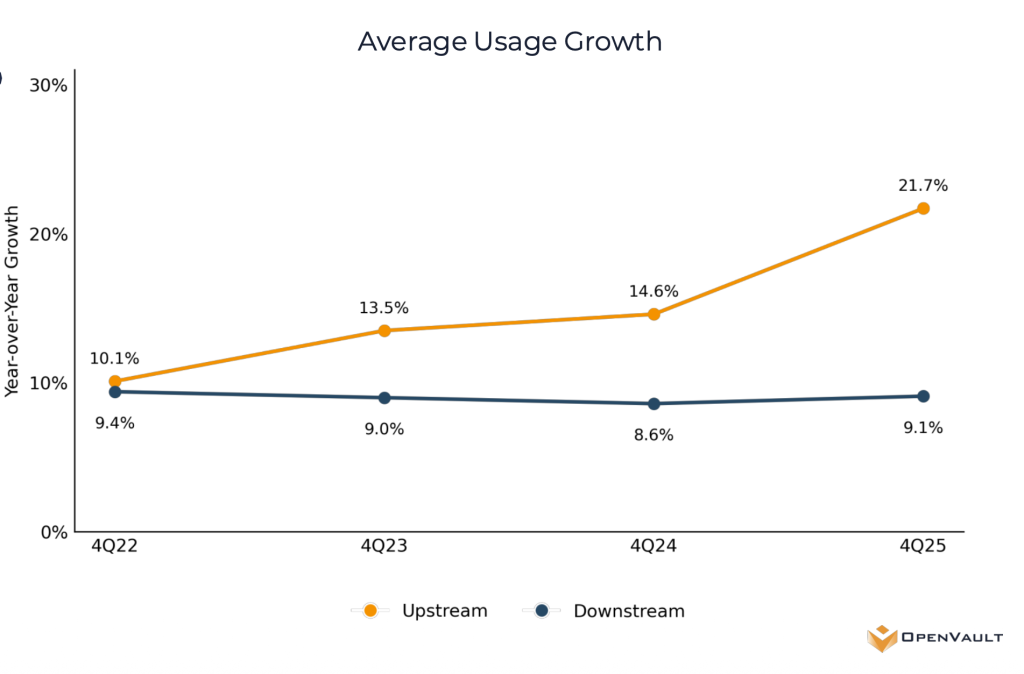
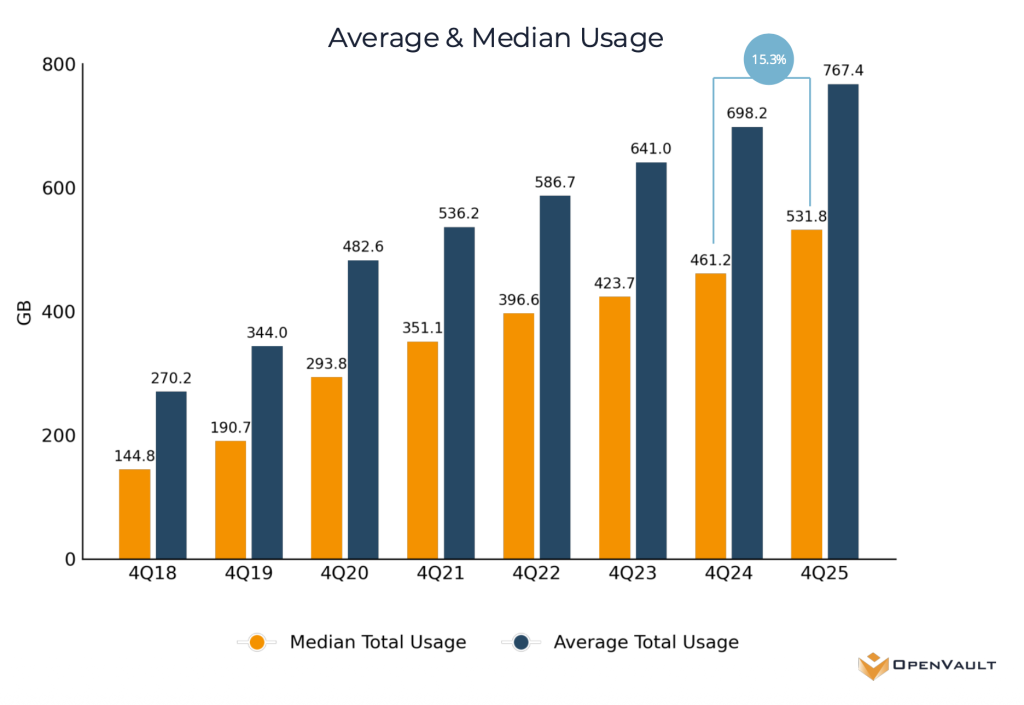
According to the latest OpenVault Broadband Insights report, upstream usage surged 21.7% year-over-year in 2025, the fastest-growing metric. In a side-by-side comparison of fiber and DOCSIS subscribers, fiber subscribers with symmetrical 677 Mbps service consumed 93 GB of upstream bandwidth in Q4 2025. DOCSIS subscribers provisioned at an average of 17 Mbps upstream, used 56 GB. That’s a 66% gap, on identical customers, explained almost entirely by what the network allowed them to do. OpenVault concluded that latent upstream demand already exists on DOCSIS networks. People will use the pipe if you give it to them.
Ookla’s data shows what consumers want. Connexion, the municipal provider in Fort Collins, Colorado, delivered over 300 Mbps upload speeds. Comcast’s Xfinity, its main competition in that market, started at 28 Mbps upload and, to its credit, pushed that to about 99 Mbps by December 2025. Still less than a third of what Connexion delivers. In Georgia, OptiLink, another municipal provider, clocked upload speeds in the 230 to 250 Mbps range against Spectrum’s low-20s.
Why is municipal broadband winning on upload? They built new fiber networks. Fiber is symmetrical by nature. The cable industry spent twenty years architecting its networks around download-heavy TV and streaming. Now it is scrambling to retrofit with DOCSIS 4.0, mid-split upgrades, and high-split architecture to claw back the upload headroom it gave away by design. Comcast and Charter are spending real money on this. They are playing catch up.
Municipal providers aren’t dominant when they face off against private fiber competition. AT&T Fiber is competing with LFT Fiber in Lafayette, Louisiana, pulling 473 Mbps down and 424 Mbps up against LFT’s 113 Mbps and 107 Mbps. GFiber in Utah is outperforming UTOPIA on raw speed metrics. The advantage municipal providers have is specifically over the incumbent cable monopolies.
Cable broadband has ruled the roost for so long, but it is facing all sorts of competition. Not just from muni-broadband, but from other emerging technologies.
Fixed wireless started stealing cable’s lunch, though it seems like it has had its boom moment. Each of these shifts had one thing in common. An infrastructure change forced behavior change. And behavior change exposed infrastructure’s limits. This is the unending yin-yang of any and all technologies.
Communities that bet on municipal fiber, often against fierce lobbying from the cable industry, are sitting on a quiet infrastructure advantage. Most of those cities built symmetrical fiber because it was the technically correct thing to do, not because they predicted an upload-heavy future. They got lucky. Or maybe being technically correct is its own kind of luck.
The cable industry will catch up eventually. DOCSIS 4.0 is real and the upgrades are happening. But “catching up” is not the same as being ahead. And in infrastructure, being first matters more than being right on paper.
It might have started with Zoom in the pandemic, but we are now going to be living with applications and services that will see us transform from being content consumers to data sources. Live commerce, cloud gaming, AI voice and video agents, and spatial computing are already starting to tiptoe into our digital life. It is hard to predict what is the next big thing. After all, video conferencing needed its pandemic moment to become a mainstream behavior.
March 25, 2026. San Francisco
I am lucky – we have fiber 500mbps down and 500mbps up – $50 per month
My cost is now $70 (thanks Google) and way more outages. 😆
Quote from Bob Metcalfe, the inventor of Ethernet. “Do you know what COVID means? I recently figured it out. It means collaborative video. “
He probably meant “network effects”
The change that will force the inet to be a symmetrical producer/consumer network is the apocalypse we are just about to experience thanks to trump’s war.
As a reaction to astronomical gas prices more of us will ship bits not atoms to each other.
I am not sure if I have the mental fortitude to process what is to happen next, but I think we as a society are still digesting the pandemic effects.
Hey Om! I enjoyed the high speed internet article those many years ago, and equally enjoyed this follow up. I was living in rural Eugene OR back then and now live in rural eastern TN now ( as well as, Bay Area Hayward and east of Sac foothills, both with different internet experiences, in between). Back then the best I could do for high speed internet was a dish style service with limited download and paltry upload speeds. As a techie, it was painful. Today, our rural local fiber internet was gobbled up by Spectrum. As a result, I have the cruft of the large org customer service, but thankfully still have the 100/100mb service (definitely not metro speeds, but pretty good!). My techie interests are satisfied!
Had we been still a coax service, like it was up until a couple of years ago before the local provider got a grant for fiber, I’d still be using Starlink as my primary (it is now my backup) and I’d be agreeing with the Docsis situation. I am fortunate.
“Today, our rural local fiber internet was gobbled up by Spectrum. As a result, I have the cruft of the large org customer service, but thankfully still have the 100/100mb service (definitely not metro speeds, but pretty good!).”
I know it is not the same, but Starlink isn’t such a bad back-up 🙂 It does a good job of providing decent connection, pretty much everywhere.