
Subscribe to discover Om’s fresh perspectives on the present and future.

Buried on page nine of Microsoft’s 10-Q for the quarter ended March 31, 2026 is a paragraph worthy of attention. Why? What does it reveal? A lot.
For starters, Microsoft now holds approximately 27 percent of OpenAI on an as-converted basis, accounted for under the equity method. The total funding commitment is $13 billion, of which $11.8 billion has been funded as of March 31, 2026. The October 2025 OpenAI recapitalization produced a dilution gain. Microsoft recorded $5.9 billion of net gains from OpenAI investments over the nine months, primarily from that dilution gain. The prior nine-month period reflected $2.7 billion of net losses on the same investment.
In plain English, even though Microsoft owns less of OpenAI, that smaller stake is worth more, and it produced a gain. Why? Because the implied valuation of OpenAI rose faster than Microsoft’s ownership percentage fell. Microsoft booked the markup. Money for nothing, and chips for free.
Poring over the 10-Q and the footnotes, it became obvious that investing in foundational AI labs is a crazy profitable business. A single set of transactions can bring three separate benefits. At least on Microsoft’s financial statements.
Cash leaves Microsoft as an investment. It returns as cloud revenue. And then some.
First, OpenAI burns Microsoft’s cash on Azure compute. The Azure consumption shows up as revenue inside the AI business line. As a result, the AI business line is now at a $37 billion run rate. It helps justify the $190 billion 2026 capex commitment.
Thanks to the magic money of AI private valuations, Microsoft’s equity stake in OpenAI gets marked up to reflect the latest funding valuation. The markup is “other income.” And as stated above, the dilution gains flow to “other income” as well.
Somehow a series of interrelated transactions does the trick. This is so gangsta. Nothing is improper, even though you know something isn’t right. Still, the accountants have done their job.
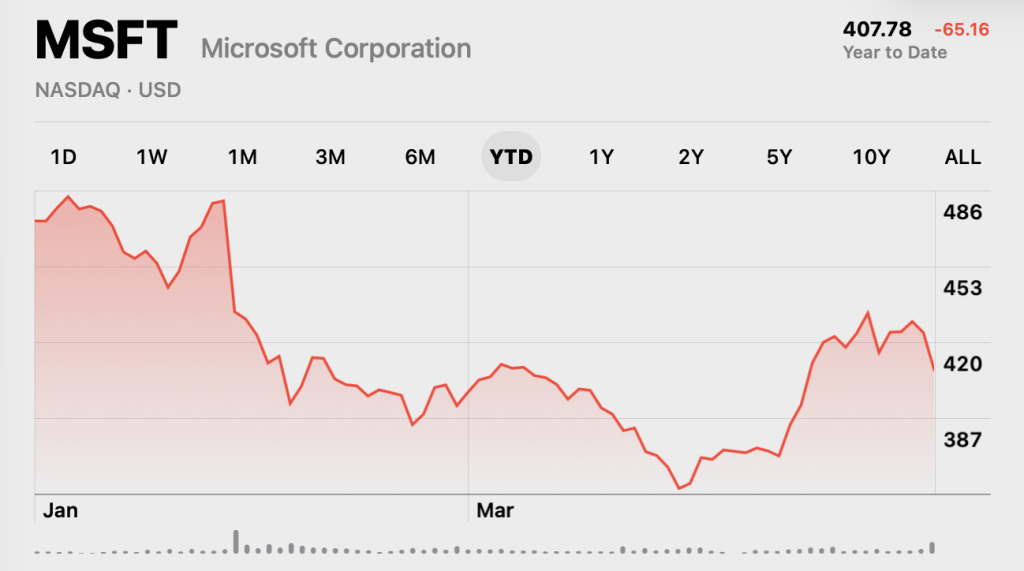
Microsoft’s “AI business” annual run rate is the headline number Satya Nadella repeated on the earnings call. It is up 123 percent year over year. Microsoft does not give you the breakdown. Here is the back of the envelope math.
It has been reported that Microsoft has roughly 20 million paid Copilot enterprise seats. The standard M365 Copilot price is $30 per user per month. That is approximately $7 billion in annualized Copilot revenue. Add roughly $1.5 to $2 billion for GitHub Copilot and adjacent tooling. Total commercial Copilot revenue is somewhere between $8 and $10 billion. Being generous, I would say Copilot is at most one-quarter of the $37 billion AI business.
The remaining $27 to $30 billion is Azure consumption. The composition, working from public disclosures and reasonable inference (no pun intended): OpenAI’s Azure spend is the largest single line. OpenAI runs on Azure. All the money it got from Microsoft has been burned on Microsoft compute. The rest is third-party enterprise customers using Azure OpenAI Service, plus other AI lab and AI startup compute, much of which Microsoft has at least partially funded through M12, the OpenAI Startup Fund, or various co-investment vehicles.
The customer concentration in the Azure AI revenue line is not disclosed. It does not have to be. But the structure of the disclosure tells you the answer. If 80 percent of the $37 billion came from a broad base of independent enterprises, Microsoft would say so on the earnings call. The silence is the answer.
I know it is not the same, but I am feeling nostalgic for vendor financing. Those crazy days of Nortel and Lucent. Lucent perfected the practice during the late 1990s telecom boom, extending credit to competitive local exchange carriers so they could buy Lucent equipment. The financing showed up as an asset on Lucent’s balance sheet. The equipment sales showed up as revenue. Lucent’s reported earnings looked excellent.
The structure worked until the customers ran out of money. By 2001, Lucent had taken billions in writedowns on its customer financing book. The CLECs went bankrupt in waves. Lucent’s stock fell from $84 to under $1.
I know it is not the same.
The current AI version is different. The instrument is convertible preferred stock and dilution gains, not vendor finance receivables. The asset on the hyperscaler balance sheet is an equity investment, not a loan. The customer is an AI lab, not a CLEC. The product being financed is GPU time, not switching equipment.
Still, as an old hand, I am feeling the nostalgia of the old mechanism. The funder, the customer, and the source of the markup are all part of the same closed system.
The same shape exists at Alphabet with Anthropic on Google Cloud. The same shape exists at Amazon with Anthropic on Trainium. Three of the four hyperscalers booked enormous non-cash gains this quarter from their stakes in AI labs. Alphabet booked $36.8 billion of equity gains. Amazon booked $16.8 billion in pre-tax gains on Anthropic. Combined, roughly $50 billion plus of non-cash income flowed through Q1 2026 income statements from AI lab marks and dilution gains.
The October 2025 OpenAI recapitalization, which produced Microsoft’s dilution gain, was framed publicly as a governance reform and a step toward a more conventional corporate structure. As I wrote at the time, the fix was in. OpenAI formed a public benefit corporation. Microsoft’s licensing arrangement shifted from exclusive to non-exclusive. The new agreement extended the partnership.
OpenAI will continue to pay Microsoft a 20 percent revenue share through 2030, but only up to a fixed cap, after which the obligation extinguishes. The IP license Microsoft holds on OpenAI’s models, previously exclusive and tied to the elastic concept of “AGI achievement,” is now non-exclusive with a hard 2032 expiration. Under the revised agreement, OpenAI can sell API access to its models through any cloud provider.
PitchBook reads the restructuring as a precondition for OpenAI’s IPO push. The Wall Street Journal reported in January that the company is laying groundwork for a Q4 2026 listing.
When I read the news, I was left asking the same question. Why did Microsoft do this? And what do they get out of it?
The restructuring, mechanically, gave Microsoft a clean accounting event. The structure of the recap let Microsoft book the gain, reduce its proportional ownership to a still-substantial 27 percent, and free OpenAI to raise more capital from other investors at higher valuations.
Microsoft is no longer the controlling investor. It is a large minority equity holder of a public benefit corporation, with a non-exclusive licensing arrangement and a $13 billion total funding commitment that is nearly fully funded. And come the IPO, it can sell as little or as much of its OpenAI equity as it wants, without any sense of moral obligation.
Microsoft has been quietly converting its OpenAI exposure from an operating dependency into a simple financial position. The accounting now flatters Microsoft as long as OpenAI’s valuation rises.
OpenAI needs Azure for a while, which is great for Microsoft as it builds up its AI business. All the while, OpenAI as an entity becomes a headache for Amazon or whomever else wants to do business with them.
Microsoft’s move cannot be viewed in isolation. On April 27, the Wall Street Journal reported that OpenAI missed multiple monthly revenue targets earlier this year, losing ground to Anthropic in coding and enterprise. ChatGPT fell short of its internal target to reach one billion weekly active users by the end of 2025, with growth flattening around 900 million. CFO Sarah Friar reportedly told colleagues she is worried OpenAI may not be able to fund future computing contracts if revenue does not accelerate.
Altman and Friar issued a joint statement calling the report “ridiculous” and saying they are “totally aligned on buying as much compute as we can.” The denial said they agree on wanting compute. The Wall Street Journal report wondered whether OpenAI can afford it, or whether it can IPO this year.
Altman’s statement and Friar’s comment mean nothing. SoftBank fell almost 10 percent in Tokyo. Oracle dropped more than 5 percent. CoreWeave fell 7 percent. AMD and Broadcom each took roughly 4 percent. The whole AI infrastructure stock ecosystem had a massive convulsion.
What if the company at the center of the structure cannot pay its bills?
PitchBook’s Harrison Rolfes calculated that OpenAI’s infrastructure obligations now exceed $1.15 trillion across Oracle, Microsoft, and Amazon. Current annualized revenue is roughly $25 billion. The ratio is forty to one. “If revenue growth doesn’t reaccelerate,” Rolfes said, “those contracts become the most expensive fixed-cost bet in technology history.”
In a sense, Friar is not wrong when she tells the board it is going to be hard to go public with those numbers. A CFO comment to board members does not leak to the Wall Street Journal unless someone wants it to leak. To slow down the IPO, or to shank it entirely.
The leak is the story.
The Q4 2026 IPO timeline matters because everything in the financial structure assumes the valuation machine keeps churning at max speed. A successful OpenAI IPO means not only new money but also actual liquidity for Microsoft and other early investors.
PitchBook’s most recent analyst note suggests the realistic IPO window has shifted from Q4 2026 to mid-to-late 2027, citing the same revenue miss and the $1.15 trillion in infrastructure obligations that will need to convert into free cash flow before public market investors get comfortable. If that delay holds, every hyperscaler holding equity gains based on private OpenAI marks is sitting on paper that has to keep being remarked upward to keep working.
This is the announcement economy at the financial-engineering level. Promises about future revenue support current accounting. Current accounting supports the next round. The next round supports the marks. The marks support the parent company income statement. And then the cycle repeats, faster.
There is no doubt in my mind that if the IPO is delayed, there will be a new funding round. If it prices above the implied valuation from the October recap, the cycle continues. If it prices flat or down, the dilution-gain mechanic reverses.
Over the next few quarters I will be watching what Microsoft has to say about its AI run rate, and whether it provides more details. Given the sheer scale of the money, I am surprised sell-side analysts aren’t pushing for further disclosure. Or maybe they did and I missed it.
I would also be keeping an eye on Azure gross margins. If OpenAI’s compute consumption is priced at preferential rates, as has been widely reported, the gross margin on the largest single piece of the AI business is structurally lower than the rest of Azure. As OpenAI scales further, the blended Azure margin will move with it.
The platform shift Satya Nadella described is real. Workloads are moving from end-user-driven to agent-driven. Token consumption may well grow at machine scale rather than human scale. The capex commitment may be the right call.
But the financial structure underneath the AI revenue line is a delicate balance.
Previously:
The CLEC section is the key here. The Cloud Czars are Lucent. When this reverses, and it will, the losses will be enormous. Microsoft is backing away to minimize those losses, but they will still be substantial. Are the other Cloud Czars?
Amazon is just starting to lean in 🙂
Don’t forget – Alphabet also owns a big chunk of SpaceX as well.
“Alphabet (specifically Google LLC) owns approximately 6.11% of SpaceX as of the end of 2025, a stake estimated to be worth over $100 billion.”
“As of late April 2026, Alphabet (Google) is estimated to own roughly 14% to 15% of the AI startup Anthropic”
Indeed. But they have not really made any recent changes to the valuation probably due to the IPO process. That will be a big gain too.