

The Myth, the Mythos and the Man
For a while I have been wondering why Anthropic named its most powerful AI model Mythos. A safety company. A company whose entire justification for existing is that someone needs to tell the truth about what is being built. That company chose a name that, in the oldest sense of the word, means a story you receive rather than verify.
Mythos comes from ancient Greek. At its most basic, µῦθος meant “word” or “story.” Specifically the kind of story that carries meaning beyond the literal. Not a lie. Not a fable. Not history. A mythos was an account that explained how things are by narrating how they came to be. The origins of fire. The birth of the gods. The founding of cities.
The Greeks set mythos against logos. Reasoned argument, evidence, systematic explanation. The two were not opposites so much as complements. Logos tells you how something works. Mythos tells you why it matters. Researching this, I realized I have been doing that combination for most of my career. The journalist’s logos, the blogger’s mythos. Unintentionally, but there it is.
The crucial distinction is epistemological. Logos makes claims that can be interrogated. Mythos makes claims that are received. You do not verify a mythos. You inhabit it. The community that holds it says it is true, and that is sufficient, because the story explains things that need explaining and provides a framework that holds the world together.
When Anthropic names their frontier model Mythos, they are encoding an instruction. Operate in mythos-mode when thinking about this. Not logos-mode. It’s not show me the safety eval, the benchmark or the capitalization table. Instead, just receive it. Like I have said, this is authority posing as confessional cosplay.
Consider what Dario himself wrote earlier this year:
“I believe we are entering a rite of passage, both turbulent and inevitable, which will test who we are as a species.”— The Adolescence of Technology, January 2026
Rite of passage. Inevitable. Test who we are as a species. That is not the language of a scientist or an engineer. That is mythos. And it is coming from the man who named the model.
This is not the first time power has reached for mythos as a tool of manipulation
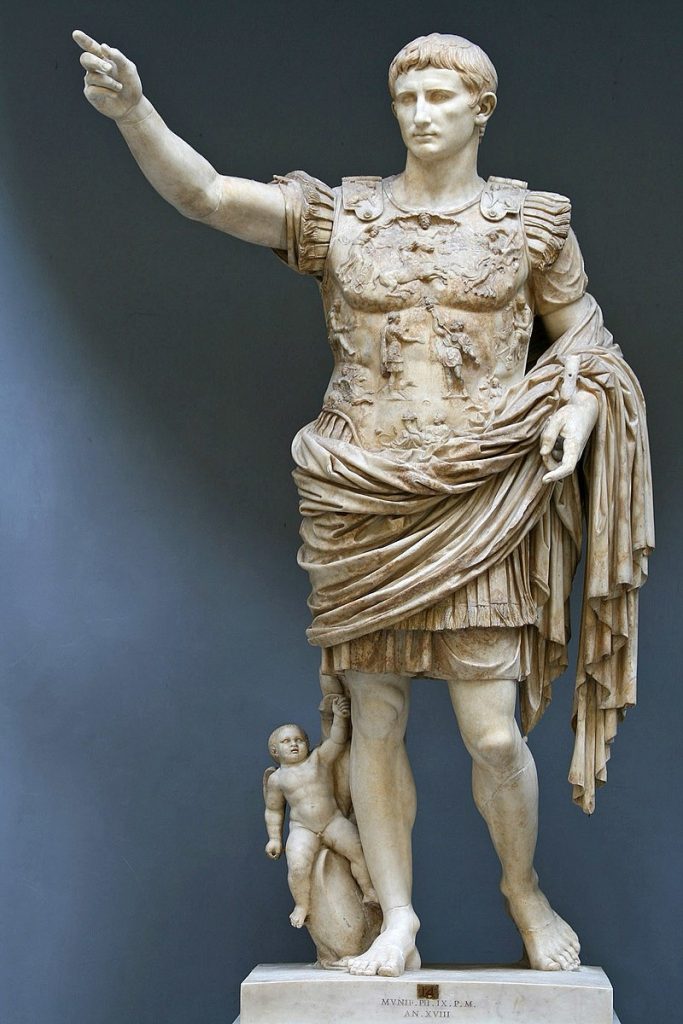
Augustus did not declare himself a god. He was too careful for that. He allowed the eastern provinces to worship him as divine, kept it at arm’s length in Rome, and cultivated the myth of his own reluctance. He commissioned the Aeneid, which traced Roman greatness back to divine destiny and Trojan origins. Virgil wrote the founding story. Augustus inhabited it. The mythos made the power feel inevitable without the power having to justify itself. Virgil asked on his deathbed that the Aeneid be burned. He did not think it was finished. Augustus overrode him and ordered it published. The author wanted the mythos destroyed. The ruler needed it to survive. Augustus decided which of them got to make that call.
Dario Amodei is making the same calculation. Anthropic named the model, controls who gets access to it, and decides what story gets told about it. Dario should prefer a more transparent accounting. He doesn’t want to. It doesn’t serve the trillion-dollar story.
Medieval European monarchy ran on the same logic. Divine right was the operating system. You did not interrogate it with evidence because the claim was structured to be outside the evidentiary domain entirely. When Parliament eventually executed Charles I, the radicalism was not the killing. It was the assertion that logos, law, evidence, process, had jurisdiction over mythos. That is what made it revolutionary.
Manifest Destiny is the American version. The word manifest is doing all the work. It means obvious, self-evident, requiring no argument. You do not debate the manifest. The mythos converted a project of continental expansion and displacement into a cosmic inevitability. John O’Sullivan coined the phrase in 1845. Within a decade it was operating as received truth, and the people who used it did not experience it as a story. They experienced it as reality. That is the tell. Successful mythos never feels like a story.
Silicon Valley has been running its own version since at least the 1970s. The garage. The dropout. The democratization of technology as an act of liberation rather than capital accumulation. Stewart Brand, the Whole Earth Catalog, the countercultural origins of the personal computer. All of it absorbed into a founding story that made wealth creation feel like world healing. Peter Thiel will tell you directly that the founding myth of a startup is structural. You need people to believe something that is not yet true so that it can become true. That is not lying, in his framing. That is vision.
The line between vision and manufactured belief is what I have been covering for years. I can smell the stench on the streets of Rome, and also its perfumed baths, in the technology industry.
Start with what Anthropic did, in sequence.
They raised billions from Google and Amazon. The valuation reached numbers that require this technology to be among the most consequential ever developed. The safety commitments live in the mission statement, not the capital structure.
“I think that most people are underestimating just how radical the upside of AI could be, just as I think most people are underestimating how bad the risks could be.” — Machines of Loving Grace, October 2024
He is the prophet of catastrophe and the prophet of salvation at once. Both claims are unfalsifiable. Both require you to trust his judgment. Then they named their most powerful model after the category of claim that is exempt from evidence. Then they announced it is not available publicly, citing cybersecurity concerns, accessible only to a small number of trusted organizations through something called Project Glasswing.
Behavioral experts who study deception call this controlled revelation. You do not lie outright. You select which truths to surface and in what order, so the listener constructs a picture that serves you without you having to falsify anything directly. Every individual claim is defensible. The composite portrait is manufactured.
Mythos is controlled revelation. It signals this is important beyond ordinary measure. It does not say we need you to believe that without demanding proof, because the proof does not exist in a form that would survive scrutiny.
Project Glasswing is the same move. The name suggests something fragile and transparent, a butterfly with see-through wings. The project is opaque. Only the trusted can see it. The name performs openness so the structure does not have to.
Anthropic is unusually willing to say AI might kill us all. That they are building something dangerous and they know it.
This is not normal corporate behavior. Normal corporate behavior suppresses downside. So the question is why they do it.
On 60 Minutes in November 2025, Anderson Cooper asked Dario who elected him to make these decisions. He said:
“I think I’m deeply uncomfortable with these decisions being made by a few companies, by a few people. No one elected me. Honestly, no one.” — 60 Minutes, November 2025
A man who controls one of the most powerful AI companies on earth telling a national television audience he should not have this power. While keeping it.
The confession is doing structural work. If you admit the danger, you establish yourself as the one honest actor. And if you are the one honest actor, your safety claims do not require external verification. You have pre-certified yourself through the performance of self-doubt. The confession is not transparency. It is inoculation against scrutiny.
Behavioral experts call this manufactured credibility. You spend credibility on cheap admissions, theoretical risk, solemn commitments, to accumulate it for claims that would cost far more to verify. The valuation, capability assertions and alignment progress.
Anthropic exists because someone needs to tell the truth about what is being built. That project runs on logos. Evidence and claims that can be falsified.
They named their flagship model after the category of claim that is exempt from all of that.
Mythos requires consecration. You cannot anoint yourself. The story only works if the right witnesses validate it.
The White House visit is not a policy meeting. Policy happens at the agency level, in regulatory dockets, in staff meetings. When a CEO sits with the President, the photograph is the output. The signal is that this technology is so consequential it requires head-of-state attention. Not the FTC. Not a Senate subcommittee. The President. You cannot photograph a benchmark. You can photograph Dario Amodei in the Oval Office.
It also positions Anthropic inside the national security frame. This is not a consumer product company. This is infrastructure. Strategic infrastructure. That framing is worth billions in valuation and makes regulation feel like interference. You do not regulate infrastructure that the President has personally engaged with.
The Pope visit is stranger and therefore more revealing.
Leo has been the most politically engaged pope in decades, consistently on the side of the poor and the excluded. He is not a technology enthusiast. Getting an audience requires more than a meeting request. So why go?
Because the Pope is the ultimate character witness for seriousness of moral purpose. The message of the visit was simple. We know this technology is consequential. We know there are moral questions here we cannot answer with code. We are taking it seriously enough to seek counsel from the institution that has thought about human dignity longer than any other. We are not reckless. We are humble.
That is the confessional cosplay elevated to its highest theatrical register.
The Vatican’s blessing has never constrained what a supplicant actually did afterward. The Crusades had papal blessing. The Inquisition had papal authority. The blessing is a story about the asker, not a check on the asker’s behavior. If Dario understood this, the visit was never about constraint. It was about narrative.
Between them, Dario has collected the two most powerful character references on the planet. The President gives temporal legitimacy. The Pope gives moral legitimacy. No other AI company has done both. That is no accident.
Augustus had the Senate and the priests. Dario had the Oval Office and the Vatican. The structure is the same. Two thousand years apart.
Plato would recognize this immediately. He spent his career distinguishing the philosopher who seeks truth from the sophist who manufactures persuasion. The sophist is not lying exactly. The sophist is selecting, sequencing, and presenting in ways that produce belief without requiring the audience to do the work. Mythos, for Plato, was the domain of poets and myth-makers. Useful for educating the young, dangerous when deployed as a substitute for rigorous argument among adults. He would look at Anthropic’s naming strategy and see sophistry wearing philosophical clothes.
Nietzsche would go straight for the will to power underneath the story. In On the Genealogy of Morality he wrote:
“The slave revolt in morality begins when ressentiment itself becomes creative and gives birth to values: the ressentiment of creatures to whom the real reaction, that of the deed, is denied and who can indemnify themselves only through an imaginary revenge.”
Anthropic knows this move. It is not the largest company in the AI race. It does not have the distribution of Google or Microsoft. It does not have the brand recognition of OpenAI. So it constructs a moral framework in which being the safety-conscious actor is the superior position, and in which the giants are implicitly transgressive. The mythos of responsibility is also a competitive weapon.
Every significant deployment of mythos shares the same features. It operates in a domain where evidence is unavailable or inconvenient. It names things so the answer is already inside the word. Manifest. Divine. Destiny. Mythos. It requires an inside and an outside, the trusted and the untrusted, the believers and the skeptics. That is not a security policy. That is a priesthood.
Anthropic is a safety company that has built a mythos. The name of their most powerful model is the admission, if you know how to read it. They need you in the wrong mode to ask the question that would unravel the story.
actually i think they just called it mythos because they see it as the next size up in the haiku, sonnet, opus pattern
I’m a dabbler, but dabbling in AI seems like building a playhouse at the edge of a sink hole. First you get quick, convenient ideas, then you get sucked down into a black hole … Where do these ideas come from? Who do they serve?
It is the life lift the composite 🤷🏽♂️
Om,
I’ve been following your blog since 2004 or so. I will be remiss if I do not congratulate you on this one – I think it’s your best.
A fascinating read. Anthropic only registered in my understanding of the state of AI development when they objected to the Pentagon’s proposed use of its models in fully automated weapons systems. They also questioned the potential that discarding guardrails had for AI use in domestic surveillance.
https://www.anthropic.com/news/statement-department-of-war
I didn’t pay attention to the outcome of that stand off and assumed they had been cast aside and replaced by a more pliant entity. Do you think that a public display of principals was a strategic part of the myth making?
There are extra linebreaks in this piece which make it very distracting to read.
All fixed!
Bravo. This is the best piece of writing about “AI” in 2026!!!!
this is 1) great writing 2) a powerful and insightful step back from the frenzy. thanks Om
Great piece. On marketing and hucksterism. I love that Anthropic declares Mythos too powerful to release. Not just a claim too good to check, but impossible to check. Yet boffo word of mouth…
I think you see through this
With every action we take a bet on the future. As Blaise Pascal correctly remarked with his wager analogy (https://en.wikipedia.org/wiki/Pascal%27s_wager) : The higher the stakes the more compelling the bet becomes.
I just wake up and had a new crazy idea. An idea that just came to my mind without any word manipulation. Just there as the product of human immagination. It is the thing that makes me human and the wordplay of the LLM’s certainly will not capture. So why are we so obsessed with this talking parrot and assign magical powers and ecomomic might to it?
It reminds me of the book “What to Think About Machines That Think” and not the know it all Nick Bostrom article I despised, but the eternal thruth in an article of a musician : it is not the machine that is dangerous, but what the humans do with it. Getting a bug free software is a bounty for humanity. Hacking for profit and fun the reverse side of the coin. So I hereby join Cathy O’Neil (https://en.wikipedia.org/wiki/Weapons_of_Math_Destruction) and call the Leviathan to regulate human folly
RIP Om! What a wonderful piece by you.
Encore:
“Silicon Valley has been running its own version since at least the 1970s. The garage. The dropout. The democratization of technology as an act of liberation rather than capital accumulation. Stewart Brand, the Whole Earth Catalog, the countercultural origins of the personal computer. All of it absorbed into a founding story that made wealth creation feel like world healing. Peter Thiel will tell you directly that the founding myth of a startup is structural. You need people to believe something that is not yet true so that it can become true. That is not lying, in his framing. That is vision.
The line between vision and manufactured belief is what I have been covering for years. I can smell the stench on the streets of Rome, and also its perfumed baths, in the technology industry.”
Beautiful writing. RIP Om. Will miss your insights.
Beautiful writing, indeed. RIP Om. You will be missed.
The depth of wisdom and human understanding in this piece is amazing. I have only come across Om, at least as more than a name, in his passing. Think I’ll be diving a little deeper. RIP, Mr. Malik.