Why Fraud Is The Boring Problem

Michael Smith used AI to create music, and then used AI to create bots to get the “plays” and took the smartest technology companies, including Spotify and Amazon, who should know better, for about $8 million. He is going to jail for his crimes. It is easy to dismiss this as one-and-done fraud. It is anything but. It is an early warning of how AI will disrupt the systems that power our digital society: how culture gets discovered, how commerce gets directed, and how conversations get shaped.

At present, most of our digital society is powered by tech that is, generically speaking, recommendation algorithms. Spotify’s Discover Weekly, YouTube’s suggestion engine, TikTok’s For You page, Amazon’s product feed, Facebook’s news feed. All of it runs on signals of human behavior. Stream counts, completion rates, saves, shares, playlist adds, clicks, purchases. These represent people making choices. The only way to fake that


Dollars and Cents of Spotify in 2024:

  • Spotify paid out $10 billion in royalties last year. Since its origin, Spotify has paid out $60 billion.
  • 70 artists made more than $10 million in streaming royalties.
  • 210 made $5 million or more.
  • 670 made $2 million or more
  • 1,450 made $1 million or more
  • 110,500 got cheques for $5,000;  274,000 got at least $1,000 
  • An artist who accounted for 1 in every 1 million streams on Spotify generated over $10,000 on average
  • 357,000 songs were streamed over a million times in 2024

Spotify Annual Loud and Clear Report


I have a beef with “content”

Apple, really stepped into it, when it made an iPad advertisement that essentially showed all creativity (and creative effort) being crushed and compacted into a thin piece of glass. It was a tone-deaf move from a company, that has always relied on (and portrayed itself as an ally of creatives. Last week, Daniel Ek, chief executive of Spotify shared a post on Twitter, that felt equally tone-deaf.

I would argue, that the cost of creating content is not close to zero. Even with AI and automation, there is a price — chips, computers, energy, and even software are not free. If you somehow overlook that assertion, I would say, that describing “creative output” as “content” is not the right framework to use, especially for someone presiding over such a large creative media platform.

If I was a creative, especially, a musician, I would likely take umbrage, because making “content” means


The Real Problem With Spotify

As a way to play music, it was better in nearly every way. Spotify then became my favorite way to listen to music. Recently though, I’ve found myself hating Spotify. The app loads slowly. Music no longer plays instantly. The interface is riddled with recommendations, podcasts, audiobooks, and other junk that I don’t care for. I have to restart the app more often. It forgot its core identity — being a music player.

Arun Venkatesan

Like Arun, I too was a fan of Spotify. Even before it became a streaming giant, it was just a small green dot that allowed me to share music from my desktop with others who also had the green dot on their desktops. It was kludgy, but very cool. Then it turned into a streaming company — and its fortunes changed. I used it every day, up until 2022, when I couldn’t take it anymore.


The Number of Songs Uploaded Every Day Will Shock You

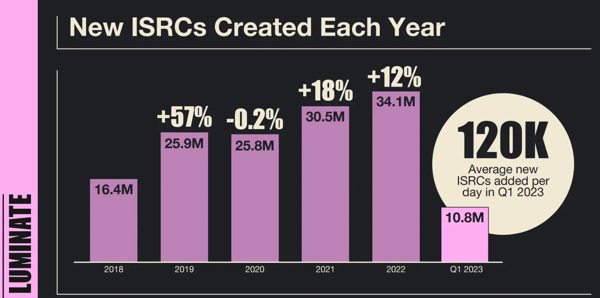
Did you know that 10.08 million new tracks were uploaded to online music streaming services in the first three months of 2023? That’s 120,000 new tracks every day, according to estimates from Nashville-based Luminate, a company that tracks music industry data. At this rate, we are looking at 43 million new tracks into the services by the end of 2023. In comparison, they saw 93,400 new tracks being uploaded daily in 2022, or roughly 34.1 million tracks. In 2021, that number stood at 30.5 million new tracks.

Songs released every day May 2023 Luminate png


A trillion streams!

black and white candybar phone
Photo by Filip on Unsplash

Music streaming saw a 22.6% growth in 2022, making it clear for once and all that we live in a streaming world. A new stat only reinforces that reality. For the first time, on-demand audio streams crossed the one trillion mark on March 23rd, 2023. According to a report from research firm, Luminate, “global music listeners have spent roughly 960,000 years streaming music in 2023, so far.”

I did some back-of-the-envelope calculations. Using UCLA research, I assumed that each streamed song is 3 minutes long. About 10 minutes of music (in median quality) streamed on Spotify is about 12 megabytes. That translates to about 3.6 megabytes per song. A trillion songs should add up to a whopping 3.6 exabytes — that’s a lot of streaming! I am presuming that each stream is equal to one song so I might be either under or overestimating the


Wait what? Even millennials don’t like algorithms 

I read a summary of a research report that was somewhat shocking in its conclusions. Millennials, aka 25-34-year-olds who grew up amid the transition from physical music to streaming, surprisingly, spend the least time streaming music of any segment under 45, this report by MIDIA Research notes.

  • 25-34-year-olds say it is essential to listen to music chosen by humans (rather than an algorithm).
  • The cohort wants a more human social music experience. Even the early days of file-sharing were inherently social.
  • There was a growing resistance to today’s streaming algorithms that push passive listening and provide a hyper-personalized experience.

I would be the first one to admit, I didn’t see this coming. I thought this cohort would be the first to let go of the past. The report points out that, not surprisingly, Gen-Z seems to have a remarkably different mindset. The  16-19-year-olds are growing up with the idea of


Putting some AI in an Oasis

The dumbing down of American is most evident in the slow decay of substantive content in the enormously influential media, the 30 second sound bites (now down to 10 seconds or less), lowest common denominator programming, credulous presentations on pseudoscience and superstition, but especially a kind of celebration of ignorance.

Carl Sagan, The Demon-Haunted World: Science as a Candle in the Dark

San Francisco raged last evening — high winds, steady rain, uprooted trees, and traffic snarls everywhere. It was a perfect evening to stay home and finish work. So I stayed up late, finishing some work, and then got sucked into playing with a handful of new AI tools. When done playing with the latest version of Midjourney — holy smokes, it is terrific — I turned my attention to The Oasis app

 On the website, it says you can create a video with your voice, but with the TestFlight version I am


Podcast Overload

"Free to use license. Please attribute source back to ""https://dlxmedia.hu/""========================Rode Rodecaster pro podcast setup in a podcast studio, microphone Rode podmic, Shure SM7B, audio recording, voiceover, sound panels, podcast channel"
Photo by dlxmedia.hu on Unsplash

“People are willing to do almost anything other than read at length. It requires patience: an atrophied muscle in the smartphone age. At the same time, no one relishes being ignorant or incurious. The desire for self-improvement out there is real. The podcast boom shows that we want erudition without effort: the palm without the dust.  

Financial Times.

Podcasts are seemingly a quick fix for those who don’t want to read books. That is why we have so many authors on the podcast circuit. It is a virtuous cycle of self-promotion and self-improvement. Like most pandemic trends that saw us embrace new technologies and behaviors, podcasting has entered the “digestion” phase. It is time to absorb the excessive growth of the pandemic years. And be as it might be, it seems that the go-go days for podcasting might be behind the sector, which is getting