

WEBOLUTION & Our Connected Future
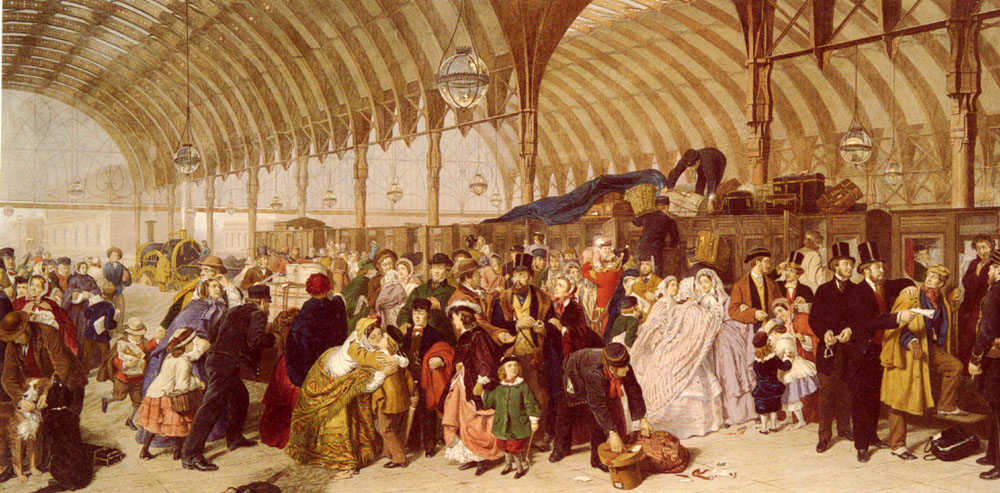
After a hectic summer last year, I took a short break in London. During this vacation, I ended up watching a BBC television show, The Great Railway Journeys of the UK. Like all men who are yet boys, I was immediately drawn to the trains. After dozens of episodes, I was engrossed in the whirl of change ushered in by the age of locomotion. The show was much more than a show about trains, instead, it was a commentary on how the railroads completely changed Victorian society.
By combining the steam engine with wheels and tracks – old technologies being used in a new way – trains connected English cities and fundamentally transformed the way society functioned. Bringing distant points closer especially transformed commerce. For example, food transport became faster and more affordable, bringing fish to inland residents and beef to the coast. Compressing distance and time deflated the impact and rarity of those regional foods, and fish and chips became for the first time an instant staple across Britain.
The show’s core message of sweeping changes simply explained by a technology of connection haunted me for days until its relevance for our own time became obvious — just as the marriage of the steam engine and wheel/tracks opened up a world of possibilities for Victorian England, so the marriage of microprocessors and network connections is dramatically changing the way society functions today.
My core belief is that connectedness has always been the driver of social, cultural, and economic change. And it changes everything – how we manage our health, what we eat, how we consume, how we work, and how we live. Just like railroads did, the Internet is inexorably compressing time and distance, transforming commerce, and blurring regional idiosyncrasies of culture and identity.
We are in a revolution of connectedness that will surpass anything seen in history!
Web-o-lution
Welcome to the Internet Revolution. The early Internet (1974-2000) was like the steam engine without wheels. It worked but it was mobile and it had limited capabilities. The marriage of microprocessors with (wired/wireless) broadband connections is like adding virtual wheels. Now Internet is taking us places, but it is also in different places. And I believe this revolution will continue at a rapid pace over the next decade.
Over the next decade or so, the Internet Revolution should allow us to adapt to the world around us instead of the other way around. With geographical constraints removed, commerce will come to us and we won’t have to go to the store anymore.
As the Internet becomes more embedded in the fabric of our lives, it will also become simultaneously less visible and thereby more important. There was a time when books, trains, cars, and plastic were thought of as “technology” because they were innovative. Eventually, they became such a part of everyday life that we didn’t think about them as much. The same is true with the Internet as it will become the technology of everyday life and will enable scale, efficiency, socialization, hyper-personalization, and accessibility in ways that are still unimaginable.
The Hyperpersonalized Economy, or All About Me
Over the past four years, in parallel to this social web that is arranged around people and their networks, we have seen the emergence of a new kind of mobile Internet. The emergence of smartphones means that technology that once was the domain of work is now a constant accompaniment. But the point isn’t that these phones are now computers, but rather they are becoming an extension of the US.
With this revolution, it has already become easy and common to share moments and other details of our lives that hitherto were publicly unexposed. As the sharing of location data becomes even more widespread it is a cause of concern because its limits are unknown. The situation is only going to get more complicated – we are after all entering a brave new world of sensor-driven mobile experiences. No, this is not science fiction, I will share stories both actual and around the corner.
Recently, I learned about State Farm, the insurance company launching a new app that uses the iPhone’s built-in accelerometer technology in tandem with GPS-based location data to measure your ability to accelerate, brake, and corner. You get a score at the end of the journey.
Of course, for now, the results are held in silos, but what if an insurance company started to keep records of your driving and started deciding the insurance rates based on your performance? It is great news if you are a good driver, not so good news if you are a horrible driver. In other words, the perceived scariness is going to define how we adopt and adapt to this and more such technologies.
The transformation of State Farm from a static insurance company to an algorithmic giant is what is going to be a prime exemplar in defining the “post-industrial economy.” The industrial economy came about as a result of mechanization, which led to mass production and mass migrations.
We had the emergence of new colonial powers – which didn’t rule as much as with armies but with economic might. Sure there were militaries, but when you look harder, even they depended upon the process of being able to mass produce that made all the difference. Industrialization led to the formation of a new kind of economic unit—the corporation – whose mission was to become more and more profitable by making the process of production more and more efficient.
The industrial era economics were dominated by one notion: bigger is always better. The individual had very little or no role to play in this economy. Personalization was anathema to this economy. The Internet economy has become the polar opposite of its predecessor! It is about hyper-personalization. Which essentially means, what people want, when they want, the way they want—and fundamentally this economic process is becoming all about self-expression.
For the longest time, people have argued that the real economy (bricks and mortar) is very different from the Internet economy. In my view, this is a false way of seeing things. The Internet is just a platform, no different than the platform of a retail store, a sports arena, or even a cinema hall. It is a place of connection and exchange. The only difference is – the services staff smart machines are augmented by real people and their real estate is essentially storage and computing resources.
The online world is now starting to mimic the offline, and in more ways than we realize. While the commerce of physical products online is booming, Internet Economics is increasingly becoming less about selling those products, and more about selling engagement and by extension, services.
Life as a Service
The Internet Revolution is inundating us with information about everything and we have infinite choices. We can’t consume it all, even if we want it all. We’re forced to prioritize our consumption—both as knowledge workers and as consumers. To solve that conundrum, more and more products are becoming services. There are the obvious things like cars, movies, and diapers, and the less obvious things like stationary and clothing. In the coming decade, every facet of daily life will become a monthly service. Crazy? Well, the runaway success of ShoeDazzle should be a good indicator of what is to come. ZipCar anyone?
So much of this new revolution is premised on moving away from ownership and moving toward more interaction, access and sharing, in both the physical and virtual worlds. Why buy a car or a vacation home when you can share it and spare yourself the responsibility of maintenance? The internet enables consumers to be more efficient by sharing assets and resources. From the cloud to the crowd, we source and store what matters in an entirely new way.
End of the Middle
As the Internet Revolution progresses, two kinds of companies will emerge: massive scale and small scale. Those in the middle won’t survive. Mid-sized companies can’t produce on a massive scale, nor can they go small and create hyper-personalized options. There’s no value in being in the middle. Here we’ll run down the endangered species list in the middle.
Amplification of Everything
Connectedness is paving the way for more attention to craftsmanship, details, and personalization. A perfect example is Alden Shoes, a company that has been making custom men’s shoes since 1884. For a long time, the company was on the brink of extinction.
But then, several years ago, a handful of bloggers spotlighted Alden’s high-quality, American-made shoes. Suddenly, the company had found a new market – online customers in the U.S. and around the world. Alden Shoes makes fewer than a million pairs per year but brings in over $150 million in revenues. It’s a small company doing big business — doing the impossible: selling American-made shoes in men’s footwear bastions — London, Paris, and Milan. It’s not the “long tail,” selling less of more stuff at Big Co, it’s the “loud wail” that breaks through in a resonant way in the hyperconnected, hyper-personalized world.
Small is the New Big
The magnitude of change in connectedness is much like the sweeping change of the Industrial Revolution. The Industrial Revolution focused on mass production, and to produce on a large scale, companies had to be big. The beauty of Internet commerce is that it allows a small company (small production, few employees) to sell on a large scale.
And because smaller companies can scale to consumer interests, they allow the hyper-personalization needed for customers to stand out from each other. In a way, there will be a revival of the small (virtual) store, but it will be curated. With so many choices in everything, the curator’s role will be important in helping customers find what they want.
As a result, we’ll see is a lot of small brands thriving online and reaching more people in more places. The new mantra will be, “think local, sell global.” Even companies that focus on niche markets can satisfy a few million people worldwide and have a thriving business thanks to connectedness.
The Future
By 2020, I expect my day will go something like this.
The alarm goes off on my iPad. When I open it, my calendar pops up on the home screen. It shows my appointments for the day and how much time I have between them. It shows me the weather and how to prepare for my day before I’m out of bed. The iPad communicates with the connected coffee maker and the coffee starts brewing while I’m brushing my teeth. My toothbrush wirelessly transmits information to the health monitor app on my iPad. After I brush my teeth, I step on the scale, which transmits more information to my iPad.
As I leave the house, my personal cloud reminds me I forgot my keys and my Nike+ fuel band. Somewhere during the day, my connected refrigerator is going to send an alert, asking me to approve ordering groceries from Whole Foods, because we are running low. Calendar on my phone realizes that I have a dinner appointment but have not made reservations so it finds some choices and alerts me — and all I do is make choices.
Daily gadgets from my iPad to my car to my television will be smart enough to connect with each other and track my daily activities, needs, habits, and patterns. I’ll use my connected devices to live more efficiently and intentionally. There will be many virtual assistants who will be sifting through millions of services and options and make the world for me.
In this future, the companies that will thrive aren’t the ones who are the biggest or with the most money – instead, they are the ones with the smartest software and the most connected. Their focus is on services, hyperpersonalized and emotionally resonant. Here I will summarize and proscribe the principles and agenda for action for thriving in this future that is already present.