
Subscribe to discover Om’s fresh perspectives on the present and future.

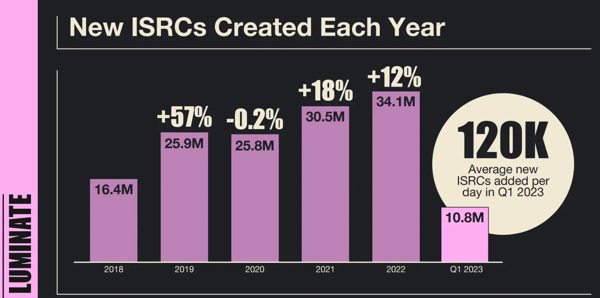
Did you know that 10.08 million new tracks were uploaded to online music streaming services in the first three months of 2023? That’s 120,000 new tracks every day, according to estimates from Nashville-based Luminate, a company that tracks music industry data. At this rate, we are looking at 43 million new tracks into the services by the end of 2023. In comparison, they saw 93,400 new tracks being uploaded daily in 2022, or roughly 34.1 million tracks. In 2021, that number stood at 30.5 million new tracks.
According to the music industry’s moaner-in-chief, Lucian Grainge, a lot of this music is AI-generated. Much of the record industry will go through the same convulsions as the written media. Radio as we know it has lost its preeminent position as a source of music discovery. Instead, it is TikTok, and other social platforms, where the mob rules. During the early days of the deconstruction of the publishing industry, there were Slashdot, Digg, and Reddit. They were the same idea except on a smaller scale. Sure, you can spend millions to buy placement in “playlists” or bribe the influencers. But in the end, consumers decide what they like and want to hear.
Warner Music Group CEO Robert Kyncl (via Music Business Worldwide) remarked, “It can’t be that an Ed Sheeran stream is worth exactly the same as a stream of rain falling on the roof.” He wants higher royalty for his artists and, more importantly, his shareholders. The publishing industry used to say the same about their content versus content from blogs or content factories.
Google and Facebook didn’t care much about how much care and effort went into creating their words. The clicks were the currency of attention — each click informed the algorithm to send more clicks in a certain way. The same will happen (and is happening) in the music and video industries — attention begets attention.
And things are going to get worse — AI will produce more tracks. And in the end, discovery will be key. Musicians will have to keep going direct and finding their audiences. Record labels will be for a select few — just like the New York Times or Washington Post, or The Wall Street Journal are for a select few writers. For everyone else, you have to go find an audience.
Comments are closed.
Hi Om, how do you think the proliferation of content from AI will affect aggregators in other industries, such as movies and education? Will aggregators become more important as a means to match content with customer needs and wants or will customers increasingly skip aggregators altogether and build their own courses or movies using AI to meet their own unique needs and wants?
Peter
This is a good question. I have been thinking about it a lot. And I think we will have to build an AI-assisted system where AI helps individuals like myself or a radio DJ develop curated and recommended playlists of things to read, listen to and or watch. In many ways, it is back to the future — human touch will matter. And individual recommendations matter. Because in the end, we need to start thinking about what is real, and what is worth the attention.