

Amazon’s Thin Client: Wrong Idea, Wrong Time. Here’s Why.
…we have a generation that is growing up with modern computing interfaces. Instead, we are still pushing the “classic” models onto them. Why? If computing has to become modern, then we have to use modern models for everything.
That’s me in May 2021.
Amazon, according to the internet, is launching a $195 thin client computer that allows workers to access cloud-based virtual desktops. This may sound familiar, and like many other experiments before, this too is coming at an awkward time. I say awkward because of where we are on the long arc of computing.
As we start to transition to an AI-based future, it represents an old idea of computing. This future will lead us to rethink what a “compute” device is, but also how we interact with them. AI is also going to make us rethink what work is and how we work.
Amazon’s new device may meet the same fate as its predecessors. I have closely observed this market and have written about almost every evolution and devolution of the concept.
During the heyday of the early Internet, Sun Microsystems came up with an idea for a network-first computer, code-named Corona, which would officially become known as JavaStation. I broke the story of its existence because I was extremely excited about the future it represented — a cloud-centric era where the computer relied on network resources and minimal local processing power, which was revolutionary. (Random Side story: My Corona scoops got me banned from the official Sun press conference.)

I kept writing about different versions of Corona over the years. In the 1990s, variations of “Corona” were created by Oracle (Network Computer), IBM (Net Station), Wyse (Winterm), Hewlett-Packard (Entria), and Acorn (NetStation). They all failed due to limited local processing power, heavy network dependency, and immature software. The lack of reliable and very fast broadband networks didn’t help, and even local networks at work were temperamental. Perhaps a good example of the right idea at the wrong time?
The WinTel personal computers were entrenched and were getting more powerful and cheaper. The one area where PCs were vulnerable was security and device management.
During the 2000s, a market emerged for “thin clients” that were meant to boost server-based computing. Companies like Wyse, Dell, HP, and NComputing launched these “terminal computers,” but they had very little commercial success. While many companies bought these devices, they had little impact on computing at large, as they mainly facilitated access to Windows and Windows-based applications, offering a mediocre experience.
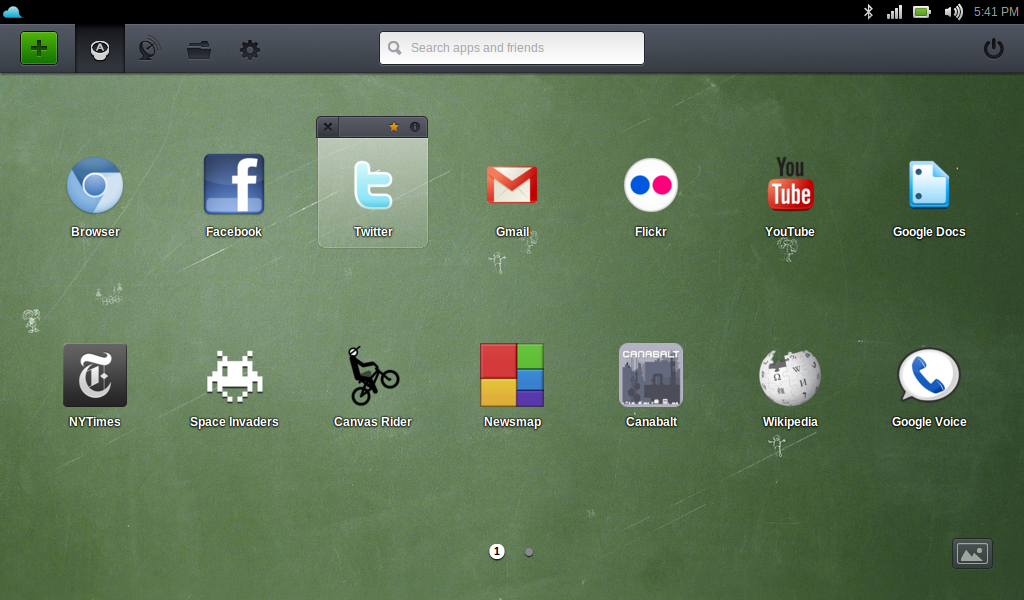
In the late 2000s, the idea of a network-based computer started to take shape on the consumer front. The emergence of OLPC (One Laptop Per Child) felt like the beginning of the development of a consumer cloud computer. Intel launched a NetPC initiative, and the Linux world came up with Zonbu. However, it was not until 2009, when I first saw JoliOS, an OS developed by the French startup Jolicloud, that everything felt exciting again.
It was a perfect combination of cloud services: Music Apps, Google Docs, YouTube, Social Apps, and many more, integrated into a familiar desktop paradigm. You could open the web service as if you were opening a local app, connect via the Internet, and of course, you had local storage to work with online storage.
It was the perfect idea for the time. Broadband was aplenty, laptop prices had fallen drastically, web apps were booming, and everyone from around the world was trying to get on the internet. JoliOS could be installed on any laptop and turn it into a cloud-first computer. JoliOS was so good that others copied it. Google launched ChromeOS, which would make it part of its Chromebook push.
Then something strange happened on the way to the bank.

Apple’s iPhone (iOS) and Google’s own Android turned out to be the best cloud computers, redefining computing. Everyone wanted a phone and a connection, and they got a computer that could do everything a normal computer could do, and more. This anywhere, anytime computing came without a keyboard or a mouse. It was a piece of glass that has turned Apple into a multi-trillion-dollar company.
These early cloud computers were stepping stones crucial for learning and development, but they couldn’t quite revolutionize the market as initially hoped. Innovation is often a series of trials and errors, a relentless pursuit where today’s failures help shape the future, as I have said time and again.
We are now amidst another computational shift—one that is going to roll out over the next couple of decades, redefining how we live, create, work, and cope with our increasingly hybrid reality. Fifteen years after smartphones started to redefine computing, this transition to AI will again redefine how we live, create, work, and cope with our increasingly hybrid reality.
As I wrote earlier this month:
What does the next step in personal computing mean? So far, we have used mobile apps to get what we want, but the next step is to just talk to the machine. Apps, at least for me, are workflows set to do specific tasks. Tidal is a “workflow” to get us music. Calm or Headspace are workflows for getting “meditation content.” In the not-too-distant future, these workflows leave the confines of an app wrapper and become executables where our natural language will act as a scripting language for the machines to create highly personalized services (or apps) and is offered to us as an experience.
In this not-too-distant future, we won’t need apps to have their wrapper. Instead, we would interface with our digital services through an invisible interface. Do I need to create a playlist in my music service when I only want it to play a certain kind of music? (By the way, that was the number one use case on Amazon’s Alexa.) Alexa, Google Home, and Siri are some technologies that have set the stage for this interaction behavior. Our kids are growing up talking to machines — for them, it will be natural to use their voice to get machines to do things.
The Register believes that Amazon has a good shot at winning this market, showing that not everyone is as skeptical of the move as I am:
AWS has picked an interesting moment to enter the field: desktop virtualization stalwarts Citrix and VMware (by Broadcom) are both in transition and demonstrating little evidence they see cloudy desktops as crucial to their futures. It’s also early days for Microsoft’s Windows 365 Cloud PCs, with the OS behemoth only recently clarifying its plans for a client app. None of the other virtual desktop players have scale and reach to match AWS.
However, thin clients are only six percent of the PC market, which represents the past of computing in itself.
That’s why I keep thinking — Amazon surely didn’t time this new product right. Or maybe, it is just another big company trying to check the boxes and telling Wall Street that they are doing something.
2 thoughts on this post
Comments are closed.
Interesting 🙂
re: “a cloud-centric era where the computer relied on network resources and minimal local processing power, which was revolutionary.”
Not so revolutionary; sounds a lot like mainframe days when you worked at a terminal. Everything old is new again.
BTW – every time someone mentions talking to your computer, I think of Star Trek and then the movie where Scottie picks up the mouse and speaks into it.
Keep’em coming.