

Vision Pro’s Long Shadow Over A Boring CES 2024
CES 2024, unlike its predecessors, lacked the usual impact because tech companies now prefer their own events for product releases. This was an in-between year, and no one knew what to build, or whom to copy. As is usually the case, the looming shadow of Apple, along with the launch of its Vision Pro device, only highlighted the fact that this was a lackluster year.
Whenever Apple launches a new product category, it captures all the attention. However, the industry still puts on a smiley face — thanks to buzzwords like AI, Robotics, AR, and VR.

The reduced Chinese presence significantly altered CES’s wild-and-wooly personality. Additionally, the need for chips and software to excel in AI may have contributed to the lackluster quality of the AI devices. The ChatGPT launch took everyone by surprise — Apple, Google, and the rest of Silicon Valley.
The reality is that products that make a splash at CES rarely become a big deal in the marketplace. The technologies that everyone talks about at CES do start to show up in products, though not as originally envisioned. When you review the news out of Las Vegas, you can view the press announcements from Samsung, Intel, AMD, and Qualcomm as pointers of what direction the industry will take — if not in the next 12 months, then in 24-36 months.
Take, for instance, Google and Qualcomm. They are developing more powerful chips for phones that can process AI data on-device—something Apple has been pumping out for a while. Samsung says it will use AI to upscale content to 8K resolution. Qualcomm has also announced chips that will allow 8K resolution in Quest headsets. The Vision Pro was there without actually being there.
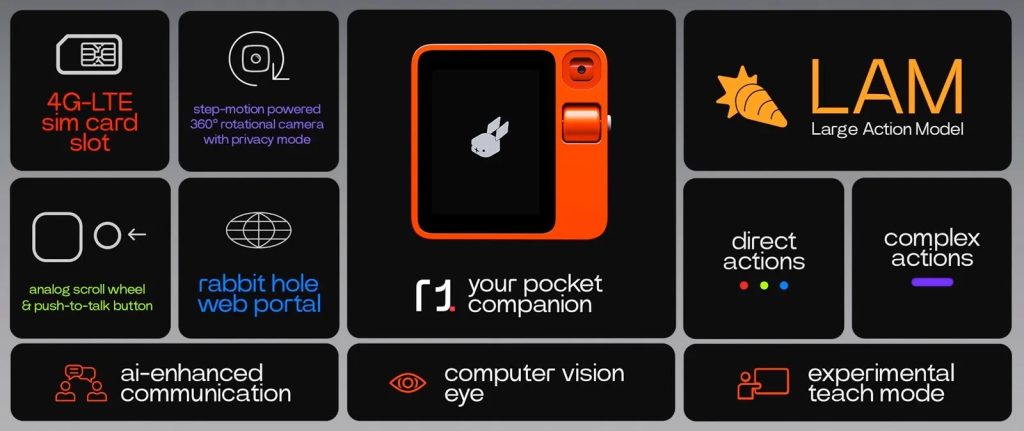
The one device that stood out was Rabbit’s R1. It presented a clear and concise use case. It is a well-designed device, and the price point ($200) is attractive enough for the company to attract early adopters. The company sold out its initial run of 10,000 units. It got me excited and in a way, it shows what future generative AI-based hardware products will try to do.
We are likely to see more such products in 2025 — mostly because APIs will be easier to use, Qualcomm will put out new chips into the market, and the network providers will figure out how to get AI to fill up their 5G airwaves. Meta, the largest VR headset maker, made no announcements and was nowhere at the show. That speaks volumes about the state of the market and the lack of impact of everything else.
They offer better performance and resolution, but the market is still not mainstream. And they are ugly. From my perspective, the highlight of the AR/VR news was the Qualcomm XR2+ chip. It supports displays up to 4.3K resolution per eye running at 90Hz, boasts a 2.5x better GPU performance than the XR2 Gen 2 found in the Oculus Quest 2, and has 8x better AI performance. They are trying to catch up to the specs on Apple’s Vision Pro.
We are going to see a few more new devices in the years to come. Nothing this year is worth even thinking about. I am interested in keeping an eye on Somnium Space’s modular PCVR headset. As an aside, the company that was going to change “AR” has finally found a market it can chase: Magic Leap has received medical certification for its Magic Leap 2 AR headset.
Both AR and VR are on a slower ramp than many believe — 36 months from now, the landscape will change mostly because Apple’s Vision Pro will seed the market.
On a personal note, I am excited about the emergence of Qi2, which will lead to chargers with the same charging speeds as MagSafe. I anticipate having docks cheaper than MagSafe. Bluetooth Auracast will make headphones become part of auditory “augmented reality.” I am excited about this market.
Amazon announced Matter Casting, its rival to Google’s Chromecast and Apple’s AirPlay. It will allow streaming from Amazon’s Prime Video app to Echo Show devices. Amazon will add other devices later. Amazon, Google, and Apple created Matter, a digital home standard, through their efforts.
In the new-version-of-old-tech bucket, my former GigaOm colleague Janko Roettgers who writes a great newsletter, LowPass, points out that, “For years, TV makers have tried to find ways to effectively make the TV disappear, either by physically hiding it or by making it blend in with its surroundings. That trend is also on full display at CES 2024.” They can keep trying, Apple already reinvented the old with its brand-new face computer!
January 15, 2024. San Francisco