

Is the (US) Internet Really Slowing?

Given our ever-increasing digital lives, what I am about to say makes little sense — recently released numbers show that there might be a historic slowdown in internet traffic growth. Three of the largest content delivery networks (CDNs) — Akamai, Fastly, and Edgio — indicated this when talking to investors after reporting their most recent earnings.
These companies are now being forced to contemplate dire strategies. Things are bad — Akamai is cutting 2.5% of its work force, about 250 jobs. Fastly is planning to slash 130 jobs, or about 11% of its workforce. Edgio filed for Chapter 11 bankruptcy in September.
“In terms of traffic growth, it is growing very slowly – at rates that we haven’t seen in the 25-plus years we’ve been in this business. So it’s growing very, very slow. ” Akamai CFO Ed McGowan (Akamai’s Q3 Earnings Call.)
What are the reasons? Well, they’re reporting less use of their services by streaming companies, online game providers, and others. As Akamai executives pointed out, streaming and online gaming are facing their challenges.
While this is an obvious answer, I wanted to dig a little deeper, so I got in touch with folks at OpenVault, a company that keeps a close eye on how traffic moves on the networks of large service providers.
They said overall and downstream growth rates remain positive but have begun to decline. During the third quarter of 2024, overall internet traffic growth was 7.2%, the lowest year-over-year increase. Downstream usage increased 6.8%, the lowest figure since the company started tracking separate upstream and downstream numbers in 2017. Upstream growth was slightly higher at 13.9%. The 2020 lockdown saw monthly usage increase 40%, but it has trended downward since then.
| Year | Total Average Monthly Usage(GB) | Total Usage Annual Increase | Total Median Monthly Usage (GB) | Downstream Average Monthly Usage (GB) | Downstream Average Annual Increase | Upstream Average Monthly Usage (GB) | Upstream Average Annual Increase |
| 2023 | 641 | 9.20% | 423.7 | 600.9 | 8.98% | 40.1 | 13.60% |
| 2022 | 587 | 9.51% | 396.6 | 551.4 | 9.40% | 35.3 | 10.30% |
| 2021 | 536 | 10.97% | 351 | 504 | 11.50% | 32 | 3.23% |
| 2020 | 483 | 40.41% | 294 | 452 | 39.1%% | 31 | 63.16% |
While slowdowns in streaming and online gaming are good reasons, there might be a much more macro reason — the industry in general is facing subscriber growth challenges, mostly because the Affordable Connectivity Program (ACP) was canceled. For instance, Comcast, in its most recent earnings said that it lost 87,000 broadband subscribers and that without ACP losses it would have actually added 9000 subscribers.
ACP, a federal program, launched in December 2021. As of Feb. 8, 2024, over 23 million households relied on the program to access affordable internet service — $30 per month for eligible households and up to $75 per month for households on qualifying Tribal lands. It ended in June 2024, when the $14.2 billion in funding Congress made available ran out.
OpenVault noted that its reporting on averages, rather than total usage, means the decrease in average usage growth is due to fewer subscribers, which also negatively affects total usage growth. These households typically have more members and consume more data per person, potentially having an outsized impact on overall traffic trends.
In its most recent report, OpenVault pointed out that households with incomes under $50,000 a year had the highest average monthly data usage (639 GB), despite having the slowest average internet speeds (530 Mbps). Additionally, single- and two-person households have an average monthly data usage of 606 GB or less, while households with four or more members consume over a terabyte of data on average.
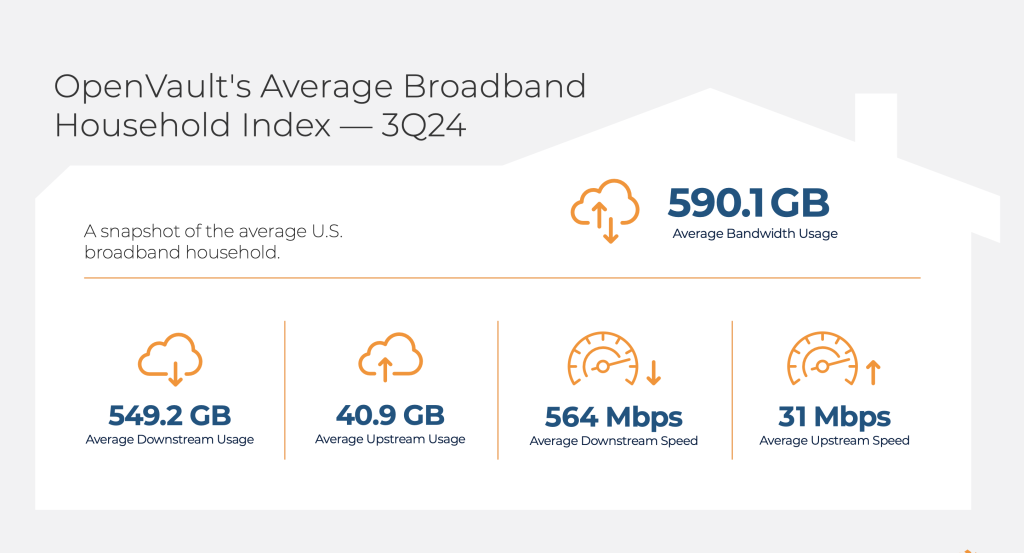
OpenVault, in its most recent report on traffic trends, noted the following significant information:
- The monthly average data consumed by subscribers in the third quarter of 2024 was 590.1 gigabytes, up 7.2% from the third quarter of 2023’s average of 550.2 gigabytes.
- The category of super power users consuming 2 terabytes or more per month increased by 25% year over year.
- Extreme power users consuming 5 TB or more per month increased by 44% since Q3 2023.
What’s my forward-looking analysis?
More than a decade ago, I wrote an essay about media’s future, pointing out that the ubiquity of connectivity would lead to a plethora of choices and demands on our attention. Fast forward to today, that future has come to pass. I have always believed that despite all the hoopla, we live in a world of finite attention, and no matter how much we multiplex our attention with various activities, there is a certain cognitive limit and, more importantly, physical constraints. As Netflix co-founder and former CEO Reed Hastings once famously quipped about competing with other companies: “We actually compete with sleep.”
Sure, watching online video has become a pervasive behavior, but with it have come better techniques for compression and smarter digital distribution. We have not had any new big bandwidth-heavy applications emerge yet. AI, in its current shape and form, has no impact on network growth.
Chetan Sharma of Chetan Sharma Consulting says that AI traffic on mobile networks is nonexistent at this point. He also pointed out that there have been some interesting developments in Finland when it comes to mobile data networks: Elisa’s data consumption for both aggregate data traffic and per-user consumption has started to decline (for three straight quarters). Finland is generally three to four years ahead of the U.S. in data patterns — so we should keep our eyes peeled on what happens on American data networks.
Bruce Leichtman of Leichtman Research Group pointed out in a conversation that the last time we saw this kind of slowdown in ISP growth was back in 2017. He noted that we are living in a post-pandemic world that accelerated growth, leading us to a peak. Future broadband growth could likely track the number of new homes built—also known as new greenfield opportunities.
The slowdown in growth doesn’t surprise me, nor does it worry me. First, we are not regressing in usage — both traffic and usage are still growing, even from what is now a big base. There is no turning back from the digital epoch. What is true is that the technology industry is in a period of gestation. Smartphone sales have plateaued. PC and console sales have plateaued.
We are all waiting for a new class of devices and new applications that marry it all — AI, sensors, and hyper-reality. Once they arrive, we might see another big bump in network usage. Who knows — they might just be around the corner.
Right?
- Tech History Fact: Edgio, formerly known as Limelight Networks, rebranded in 2022 after acquiring Edgecast from Yahoo. Edgecast had previously been a minor player in the content delivery network (CDN) market.
Nov. 14, 2024, San Francisco