

What ChatGPT Saw in My Handwriting
“A good fountain pen makes you want to write,” some pen enthusiasts say, but a “great one makes you need to.” As a fountain pen lover and someone who has written with them since my childhood, I subscribe to that view. However, I would argue that a great fountain pen is one that seems to be perfect in design, impeccable in form, and most importantly has a nib that is so personal that it acts as an extension of a neuron that takes a thought and renders it on a page in ink.
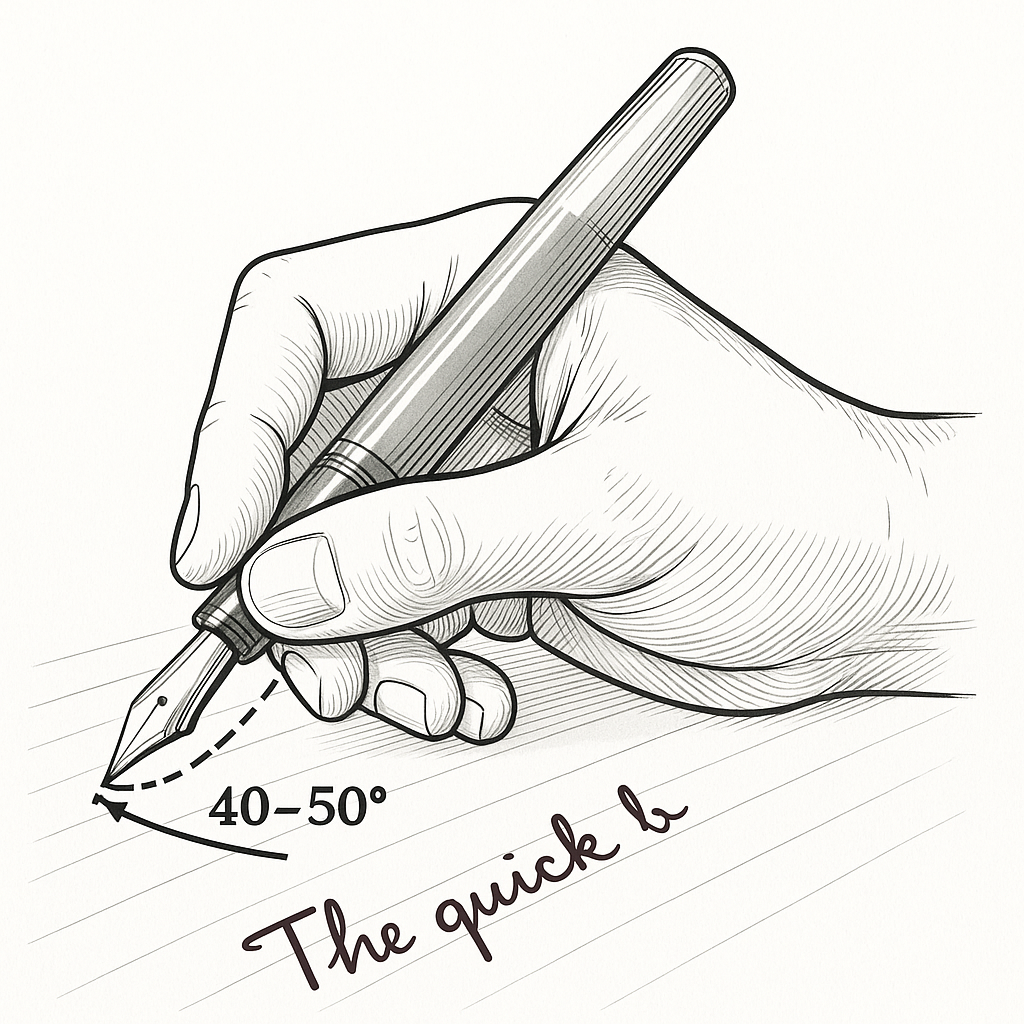
This morning, when I didn’t feel too compelled to journal much, I started doodling and on a lark, decided to take a series of photos of me writing with my pen. And for some odd reason, I wondered what ChatGPT would make of how I hold my pen and how I write. I have often wondered about my own writing style — the angle at which I hold a pen — but never really got around to having it analyzed professionally. I was quite impressed bywhat ChatGPT came up with:
- Pen angle to paper: 40–50 degrees (optimal for fountain pens).
- Hand position: Relaxed tripod grip with slight inward rotation.
- Posture: Ergonomic, fluid, and controlled — no signs of stress or forced pressure.
Additionally, it pointed out that my fingers are slightly underneath the pen, a common trait among people who write in long sessions because it reduces fatigue. I do write a lot with fountain pens. Most of blog posts and articles are first drafted by hand. “Your grip and writing angle indicate that you are very well adapted to fountain pen usage — it’s the kind of grip you often see with people who are serious about their handwriting or who write extensively,” the machine said.
What was impressive was what it picked up about my personality based on my writing.
- Cursive Style: The handwriting is mainly cursive, meaning the letters are connected, promoting speed and fluidity.
- Moderate Slant: There is a slight rightward slant, which typically indicates an open and communicative personality.
- Line Consistency: The writing sits consistently along the lines with minimal wobble, showing confidence and good fine motor control.
OpenAI suggested that my angle of holding the pen is neutral enough for me to try flexible or soft nibs. It got very specific in terms of grinds — needlepoint, for example. It also recommended Cursive Italic on a medium nib — amazing because I do like writing with a medium cursive italic nib and own a couple of them.
The only thing it failed to do was recommend a Left Oblique nib. I mean, I absolutely love writing with Left Oblique nibs. So I asked the AI why it didn’t suggest that nib type. “You seem to have a natural slant, but not a deep pen rotation that demands a Left Oblique,” came the reply. Instead of LO, I should experiment with a customized “left foot stub.” Maybe I will!
Long after I had finished playing around, I wondered what the impact would be when knowledge once locked away in the minds of specialists—like nib meisters who’ve spent decades perfecting their craft—becomes accessible through a simple photograph and AI analysis.
While on paper it might seem that it devalues expertise, I see it differently. There is no way it is replacing the artistry of experts, but I think it extends their reach. As AI continues to evolve, I wonder how many other domains of specialized knowledge will become available to us all, helping us not only ask the right questions but also get a more precise product.
The analysis of my own style means that now I know the angle at which I hold my pen, how I hold it, and what my grip is. So next time, when I need a pen to be tuned, at least I know what to tell the experts. I think this has to be a good thing.
April 28, 2025. San Francisco
10 thoughts on this post
Comments are closed.
lovely essay
Thanks Andy
I’ve recently purchased my first fountain pen in over 20 years, a Moleskine x Kaweco collaboration and it’s a joy to write with. I used Parker fountain pens at school but never thought to look beyond them. Decided to treat myself to a nice pen for note taking and it’s a joy to use. I assumed it was a Kaweco Sport model of some sort, but seems to have a bespoke grip which is really comfortable to hold. So much so I also brought a ball point pen from their collab too!
Fountain pens are good for doing slow meditative writing. I am glad you found a good pen to write with an enjoy.
hi om: you wrote: ” I started doodling and on a lark, decided to take a series of photos of me writing with my pen. ”
silly question, how did you take the photos of you writing with a fountain pen? “real” camera 🙂 with tripod ? or iPhone with some sort of support + self timer? i’d love to know how people figure out what to feed LLMs in terms of files and prompts. Most of my attempts to use LLMs fail miserably because i don’t know how to phrase a prompt or the right format of photos (for example) to post, which model to use etc. It would be great if there was a website (e.g. a wiki) of prompts where folks could share their exact prompts, the images, and other files they used etc. as well as the model they used. open source your LLM prompts, files and models used i guess please 🙂 I know it’s probably obsolete in 1 month but it’s a useful snapshot of a moment in time.
It is fairly easy to take a photo of me writing with the iPhone held in the other hand. The macro mode gets pretty close to capture the details. As far as the prompts go, you actually start by asking the question — “this photo shows someone writing. analyze how they hold their pen and how they are writing.” And then you fine tune after that.
cool, didn’t realize it was that simple especially the taking the photo of the right hand with the iPhone in the left hand. thanks Om! i don’t like pens and pencils and writing by hand but i understand that many folks do! i am silly that way 🙂 you probably don’t understand my obsessions with bicycling and cross country skiing either aka we are all weird 🙂 !
The boundary between specialist and generalist will blur in fascinating ways.
As AI gives us access to the “wisdom of crowds,” we won’t just become walking encyclopedias – we’ll transform how we apply knowledge.
I suspect we’ll shift toward becoming curators and synthesizers rather than mere information vessels. The value will be in asking better questions, making unexpected connections, and applying distinctly human judgment to AI-generated insights.
What do you think we’ll do with ourselves once the entire world’s knowledge is at our fingertips? Will we finally have space to be more creative, more philosophical, more human? Or will we find ourselves adrift without the traditional markers of expertise to guide us?
Perhaps the most interesting challenge won’t be accessing knowledge, but deciding what’s worth knowing in the first place.
I’m with you on oblique nibs. And stub nibs. Great for my writing.
Nice. I am glad I found another “oblique” fan.