
Subscribe to discover Om’s fresh perspectives on the present and future.

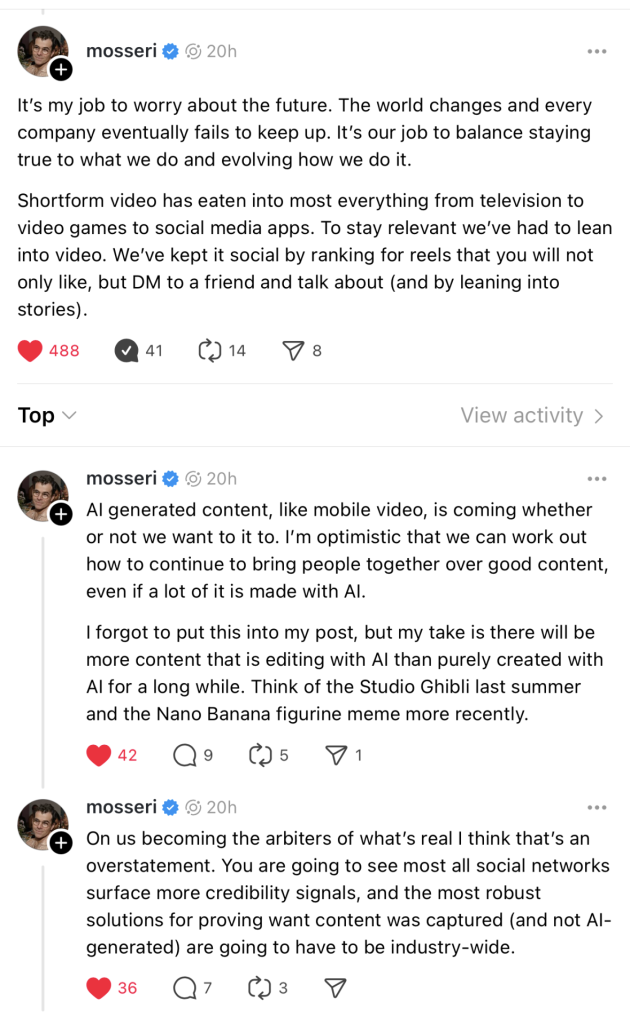
Adam Mosseri, Instagram’s chief doesn’t often respond to critics. When I wrote that his year-end memo cast Instagram as a future referee of reality, he pushed back on Threads. He called it an overstatement and then laid out the need for “credibility signals,” tools to prove content authenticity, and industry-wide verification. That isn’t a rebuttal; it’s reframing. Instagram may not want the label “arbiter of reality,” but it seems content to take on the role.
In an earlier essay, I argued that the social internet, with Instagram as the primary example, was shifting for the third time: from social graph to interest graph to what I called the trust graph. In this model, the platform decides what counts as real and prioritizes “who” over “what.”
The reason? AI makes “authenticity infinitely reproducible.” Instagram can no longer trust its feed or its images. The direction is clear: Instagram aims to control not only what you see but also what is real enough to be seen. The open question is whether audiences will accept the platform as a trustworthy guide in an era of visual doubt. We are already seeing a distorted reality in which AI fakes fool millions. Of course, you’ve heard of Mia Zelu, the fake influencer who made waves during Wimbledon.
Meta, Instagram’s parent company, rarely engages in public discourse. So Mosseri’s response matters. From his comments, I gathered that Instagram will do whatever it takes to anticipate and embrace what’s next, just as it adapted to short-form video (now nearly a $50 billion-a-year business). His job is to worry about Instagram’s future and keep it relevant as a cultural vanguard. Nostalgia for old Instagram won’t save it. That means the app will change again. And often.
When he says, “We rank for reels you’ll like and DM to a friend and talk about,” I read it this way: real engagement now happens in DMs, not in the feed. The subtext is that the public feed is dying. “DMs are where people share now” signals revenue displacement.
Published research suggests Instagram will have three billion monthly active users in 2025, and roughly 72 percent of U.S. Gen Z say they use it primarily for messaging. I am not Gen Z, but I also use Instagram for direct messaging, especially with my fountain pen friends.
Meta doesn’t provide an official messages-per-day number, but the product roadmap speaks for itself. In 2025 alone, it rolled out more than twenty DM features, from editing and improved navigation to richer interaction tools, a clear sign ofhow central messaging has become to the user experience. If this is the trend, then Instagram needs to figure out how to capitalize on it.
The question everyone keeps asking is about AI and AI slop. Here is what Mosseri said:
“More content will be edited with AI than fully created with AI.”
He acknowledges the obvious: there will be far more synthetic content than human-made content. Instagram can’t stop AI slop, so it will have to live with it. He continued:
“My take is there will be more content that is edited with AI than purely created with AI for a long while. Think of the Studio Ghibli last summer and the Nano Banana figurine meme more recently.”
.In a March 2025 chat with MrBeast, Mark Zuckerberg said he sees AI as a way to help creators distribute and localize content more effectively. From that perspective, Mosseri is merely echoing Zuckerberg.
AI will seep into daily life through the tools we use, Instagram among them. Few will notice the shift because it will beginas augmentation: first filters, then edits, translations, and rewrites, until generation takes over. I would argue AI is already creeping into everything as a tool. Zoom call transcripts and summaries. Apple’s proof read, and Ai camera search, are only the most obvious examples.
Asked whether Instagram should be the arbiter of what is real, Mosseri pushed back:
“On us becoming the arbiters of what’s real I think that’s an overstatement. You are going to see most all social networks surface more credibility signals, and the most robust solutions for proving what content was captured (and not AI-generated) are going to have to be industry-wide.”
By saying “most all social networks,” he frames an industry-wide argument rather than one specific to Instagram. Platforms may not like the optics of being seen as Temples of Truth, but they are already laying the groundwork for thatfuture.
He’s not wrong. This is no longer just an app design problem; it is governance work. The problem spans the internet,especially social networks. Meta does not want to shoulder this burden alone, for strategic, political, or legal reasons. The company recognizes that proof of reality is less a feature and more infrastructure built with camera makers, standards bodies, and other platforms.
And for now it needs creators and their reels and authenticity, just as it gets ready for the new future. So it gives lip service to “creators.” It still has to perform a delicate balancing act between the present, where creators dominate, and the future, where they may be less relevant. Since Facebook took over the service, Instagram’s parent, Meta hasn’t really prioritized creators or creative output. In a 2024 interview with The Verge, Zuckerberg said:
“I think individual creators or publishers tend to overestimate the value of their specific content in the grand scheme of this…when push comes to shove, if they demanded that we don’t use their content, then we just wouldn’t use their content. It’s not like that’s going to change the outcome of this stuff that much.”
This post drew widespread criticism and hand-wringing from creative communities. However, it did tell the harsh truth about content and the internet. I’ve been an internet-first creative since the early 1990s, and I’ve learned that the internet’s metabolism makes no distinction between creative and non-creative work.
Meta still relies heavily on user content to train its AI systems, so it needs to maintain the pretense. Instagram ispositioning itself for a feed full of approved “AI creators.” The reaction to Mosseri’s comments only reinforces that AI content curators have already become a legitimate creator category.
Meta’s interest in synthetic creators datesback to 2023, when t launched celebrity AI characters on its platforms. Since then, generative AI has advanced significantly. If the timing of Mosseri’s memo is any indication, I suspect we’ll see exponential improvements by the end of 2026. That’s when things really change and become more complicated.
In the Meta and Instagram context, synthetic content is simply the next evolution of advertising and ad-based monetization. Unlike real human creators, synthetic content lives, evolves, and moves at the speed of the network.
Synthetic content can chase trends and popular formats and be trained instantly, but only if we keep believing in the feed. Advertisers may be ambivalent about AI and altered reality, but the efficiency of spending tends to win. Regular users stillwant a reason to come to the platform.
If seeing is no longer believing, the hard question is this: will users accept platforms as mediators of truth when the same companies that built the systems that destabilized attention now run them?
The platforms that fractured our focus now promise to restore our sense of reality. That’s not just a product pivot; it’s a claim to power that deserves more scrutiny and conversation, not acceptance.
January 7, 2026. San Francisco
Really appreciating your perspective on this issue, Om, as both a photographer and someone who’s been deeply immersed in the tech and social media fields.
I think what we are seeing here are clear signs of just how critical (and valuable) “proof of humanity” will be. The blockchain world has been on this for years. The players have changed and there are various approaches and motives, but it’s no coincidence that Sam Altman is chairman of the board at World (formerly “Worldcoin”). The guy who’s busy cranking out synthetic agents knows just how comparatively rare (and valuable) a real person will be.
The “trust graph” thing Mosseri mentions is going to be critical too, and it’s going to have to be a protocol — not something controlled by any single corporation. Zero-knowledge proofs will be essential here, and the Ethereum ecosystem is building really interesting approaches (Ethereum Attestation Service, for example).
Looking forward to more posts from you on this front!
Gideon
the biggest challenge of “blockchain” world is that it is just too complicated and too wrapped up in the whole notion of “money” and “grifting” and unless that goes away and it becomes plumbing at the OS level, we are going to struggle with that. Also, it still has to overcome its network latency challenges. Still, there is hope.
It is going to be an interesting transition to watch, especially over the next five years.
Very interesting piece as always.
I still think Mosseri’s point, if partially accurate, gives a very biased definition of what social media is about.
Credibility mostly comes from comments, from the communities. Something where platforms can fairly easily restrict or moderate participations if they shift from automatic moderation to real governance as you mention (I wrote a piece about it: https://aliveinsocialmedia.substack.com/p/digital-prosthesis-tending-to-our ). Credibility also comes from a clear roadmap; something Meta used to do (remember their infamous “redbook”?) but has a bit disappeared from their comms.
This post turned my stomach (that and too many cups of coffee). I can’t remember a more chilling observation than, “I’ve learned that the internet’s metabolism makes no distinction between creative and non-creative work.”
I won’t rail against AI-slop pervading my feeds, but I am starting to see more YouTube thumbnails with “No AI” labels affixed and that gives me hope the human audience has the critical gene to detect, and reject, the lazy, mendacious, and creepy.
I look forward to the collapse of the AI-ouroboros financial circle jerk.
David as someone who has seen it all from the start, this is part of the cycle. We get a whole bunch on nonsense, and then humans start to really figure out how to co-exist with the technology. Sadly, the Internet makes no distinction between good or bad. Machine has no morals, just implications. Anyway, like you I am looking forward to the next half a decade and what it really means.
I can’t rule out that this is a desesperate move from social media to bring back users at publishing on their feed. By saying “authenicity” is the way now, they are also saying “we will push content that doesn’t look good, don’t be afraid if it looks imperfect”.
Down the road, if nobody publishes anymore, these places are just empty shells and I really don’t think DMs will be enough …