
Subscribe to discover Om’s fresh perspectives on the present and future.

I didn’t really want to do a quick breezy review of something that has touched me at a deep emotional level. (John Gruber nails it in his review of Neo.)
Yes, I am talking about the new MacBook Neo. I can’t remember when I used the words “cute” and “want” about a computer in the same breath. The iBook, maybe? That machine was a little cuddly, colorful, weird thing that made you feel something. Then Apple went serious. Silver. Graphite. Pro. Aspirational. Expensive. And along the way we all forgot that computers could make you smile just by looking at them. Just as none of the cars make you smile and giggle. They are a boring interpretation of a truck or a Tesla.
Then came the Neo. $599. The fun is back. Citrus yellow. Indigo blue. Blush pink. Colors that say, be happy. It’s okay to be silly.
I have had a review unit for four days. Used it. Held it. Caressed it. It looks like a MacBook. It works like a MacBook. It feels like a MacBook.
Everything about it is a MacBook. Except it isn’t.
Four days in, the question stopped being “is this enough?” It became something simpler. What is this, exactly? What is a machine, really? What does it need to be?
First, it’s the name. It is stuck in the crevices of my mind. Neo comes from the Greek neos. It does not simply mean new. Neo means renewed. It means the return to the generating principle after drift.
As it happens, I have been spending time in philosophical texts, ancient and modern. One concept I came across in my reading adventures was Neo-Platonism. Developed by Plotinus in the third century, it was not merely a new version of Plato. It was a return to first principles, a deliberate stripping away of accumulation to recover what was essential. The Neo-Platonists believed all of reality emanates from a single perfect source, The One, and that understanding flows from returning to that source rather than moving further from it.
In language, neo- signals deliberate revival. Neo-classical, neo-noir, neo-pragmatism. Each usage implies that someone looked at how far a tradition had drifted from its originating idea, identified what that idea actually was, and rebuilt from there. It is an act of editorial courage disguised as naming. When Apple called this machine the Neo, consciously or not, the argument is right there in the name.
Neo does not mean more. It means the return to what is essential.
Apple, at least when Steve Jobs roamed its corridors, knew what was essential. It has since lost some of that clarity. It has lost some of what Aristotle calls telos.
Telos is the purpose toward which a thing is directed, the end that defines what it fundamentally is. Not what it can do in a benchmark, not what features it has, but what it is for. The telos of a hammer is to drive nails. The telos of a chair is to support a seated person. Strip away the ornament, the extras, the margin-justifying additions, and you get to the thing itself.
The history of Apple’s greatest products is a history of correctly identifying the telos and ruthlessly removing everything that is not it.
The original iPod. Music in your pocket. Not a camera, not a phone, not an app platform. A thousand songs, a white brick of plastic and steel and joy. When Jobs pulled it out, nobody asked whether it was enough. The question answered itself.
The original MacBook Air. Portable computing, untethered. No optical drive, few ports, impossibly thin. Jobs pulled it out of an envelope and the argument was over. The Air was not a lesser computer. It was the laptop reduced to its essence. Jony Ive once said the best designs are the ones where you cannot imagine adding anything and cannot imagine removing anything. The Air was that.
The MacBook Neo is in that tradition. It runs on the A18 Pro, the same chip family that powers the iPhone. That detail sounds like a compromise until you think about it properly. The iPhone is the most refined personal computing device ever made. Its chip is optimized over a decade for exactly the kind of work most humans actually do. Writing, communicating, reading, browsing, thinking. Early benchmarks show the Neo outperforming the MacBook Air M1 in single-core performance. That is not a consolation prize. That is the telos.
If we had more of a philosophical tradition in Silicon Valley, we would be aware of what Heidegger called the danger of Gestell, his concept for how technology frames everything and everyone as a resource to be optimized, extracted, maximized. These days that means pushing AI into our laptops and ads into every corner of our internet experience.
Customers and reviewers alike look at a laptop and ask all sorts of wrong questions. How much RAM? What GPU? Can it run Final Cut in real time? Nobody stops to ask what they actually need it for.
The spec sheet becomes the thing. The benchmark becomes the measure. The webpage becomes a place to extract every cent. Every human relationship on Instagram an opportunity to transact. And somewhere in all that maximization, the person using the machine disappears.
Ask yourself what you need a laptop for. I asked myself the question. To write. To read. To talk to people I love and people I work with. To think. For all that, the Neo is enough.
And that’s me, someone who already has a MacBook Pro. With the exception of my multilayered editing workflow in Photoshop, after four days, I find the Neo to be enough. The only reason I keep going back to my MacBook Pro is because of Claude CoWork. I wish I could run that on this new machine.
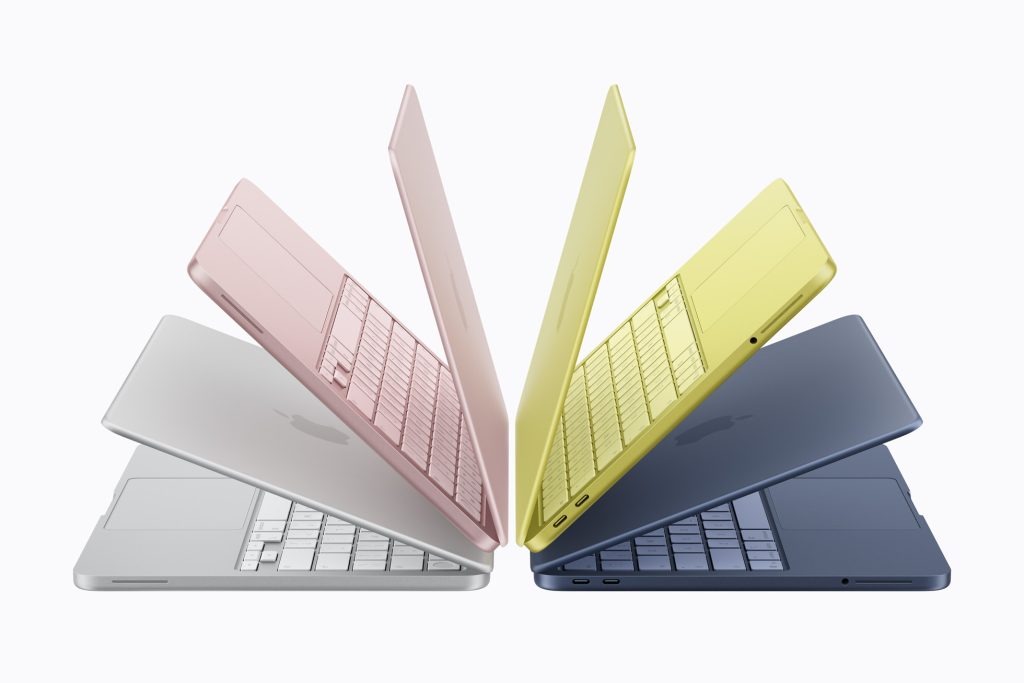
What if everyone asked that question and found the same answer? Why worry about more cores or something hard to contemplate? What’s easy to contemplate? Four colors with color-matched keyboards. Color is not cosmetic. Color is a statement about the relationship between a person and their tool. It says this belongs to you, not to your job title or your budget category. It says computing can be personal and colorful again. (By the way Gruber is talking about color in his review footnotes. “The Neo’s citrus is a beguiling colorway. Everyone I’ve shown it to likes it,” he write. “But is it a green-ish yellow, or a yellow-ish green? In daylight, it looks more like a green-ish yellow.” His comment is about to become a meme. )
In Zen Buddhism, there is the concept of ichi-go ichi-e, meaning this moment, this meeting, only once. A tea bowl needs to be only a tea bowl. A laptop does not need to be a phone, a gaming console, a media center. The completeness of the simple thing is what gives it meaning. You do not add to it.
The MacBook Neo is a laptop. A complete, beautiful, sufficient laptop. It costs $599, but the real disruption is not the price. It is the reminder that “enough” is not a failure of ambition. It is often the highest form of design.
The name says it all. Neo means a return to the generating principle. A machine rebuilt from what a machine needs to be, with full awareness of what came before. Not less. Not a budget compromise. A renewal.
Jobs understood this. The iPod. The Air. The original iPhone’s single button. The radical move was always the same. Identify the telos, trust it, and cut everything else. Sometimes the most courageous thing you can build is exactly what is needed, and nothing more.
I really hope Apple sells a lot of it. Not that I have anything to gain from it. Except the idea that in this era of soulless hyper-capitalism, for a brief second, we can smile and experience the essence of a machine.
March 10, 2026. San Francisco
A neo-neoist essay! 🙂
🙃
I have just set up my Neo.
I work with everything in the cloud, no matter where I am, so the setup was truly easy, wonderfully boring, and a reminder of the old Apple saying. It just works.
I’d assigned the morning to get it configured and into a usable state, but it was ready in less than an hour. I downloaded and tested my utility go-tos, like Little Snitch and my Safari plugins. Then all of the quirky writing tools and apps I’d commonly use. Finally, I was prompted to update the OS to 26.3.2. That was it.
It just works.
Ichi-go Ichi-e, indeed. Every experience is unique, occurring once. The Neo, is a consumer windows PC category destroyer. The time has finally come.
The Sisyphean second that you end with, is much needed in this timeline one keeps waking up to daily
Amen to that. I am glad you caught that. 🙂
Why can’t you run Claude Cowork on the Neo?
I can’t transfer my work flow. I have set up new work flows already.