
Subscribe to discover Om’s fresh perspectives on the present and future.

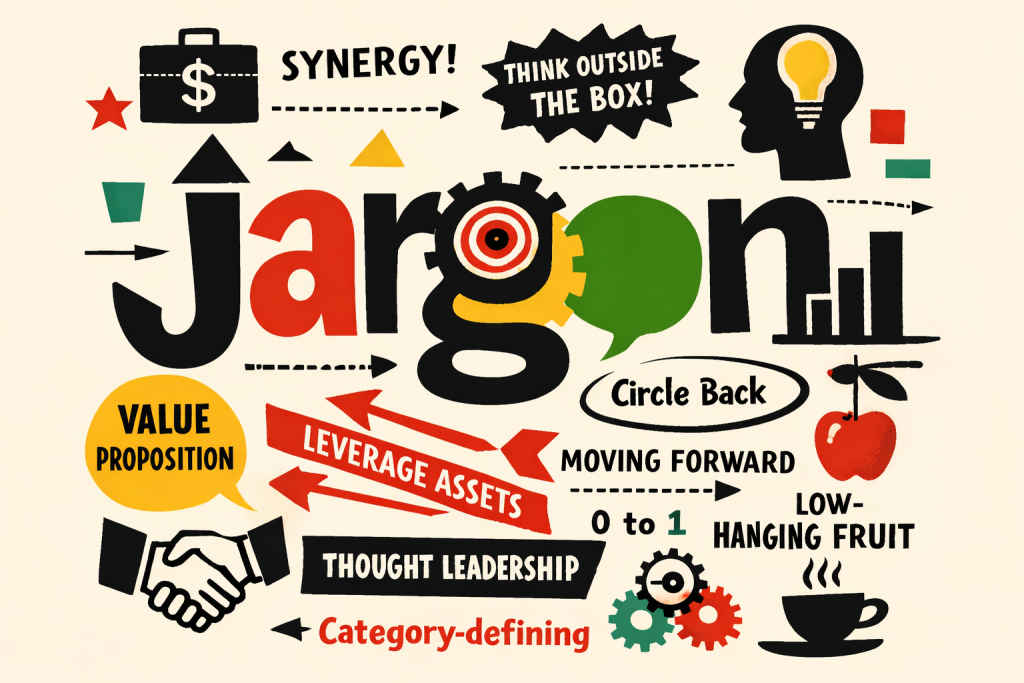
I have been a writer long enough to know this in my bones: jargon sucks. It is a crime against writing. It abuses your readers and your listeners. And it is a sure sign you do not know what the heck you are talking about. If you cannot explain something in plain terms to your mom, you do not have a clue. You are reading from a script, pretending to be master of the universe.
And yet.
Listen to any podcast. Scroll any LinkedIn post. Skim any Twitter thread. You are drowning in it. The calling card of the clueless and the pretentious. Jargon!
And it is the lingua franca of corporate America, as new research shows.
Shane Littrell, a cognitive psychologist at Cornell, has created the Corporate Bullshit Receptivity Scale (CBSR) to measure how susceptible people are to what he defines as “a semantically empty and often confusing style of communication that leverages abstruse corporate buzzwords and jargon in a functionally misleading way.” Now that sentence itself is a perfect example of jargon. Littrell should follow his own advice.
Jokes aside, his research shows that many people cannot tell algorithmically generated nonsense (sentences assembled from real corporate vocabulary but stripped of meaning) from actual quotes from Fortune 500 executives. Littrell surveyed more than 1,000 office workers.
Ouch!
Like I said, jargon is the clutch of the clueless. The research shows that individuals who score higher on “corporate bullshit receptivity” perform worse on work-related decision-making tests. They see their boss as a visionary transformational leader, inspired by empty corporate mission statements. People who are receptive to this stuff tend to produce more of it. They are not cynics playing the game. They actually believe the words work.
Now look around Silicon Valley. We have our own dialect and it is getting worse. Tech bro slang these days ranges from “vibe coding” to “agentic workflows” to “founder mode” to “10x” to “unlock.” With every year, I hear more and more MBA speak, with extra reverence for whoever invented the latest term.
Littrell’s research draws a line between jargon and bullshit. Jargon can be useful when it carries real meaning for people who share context. Bullshit mimics the structure and rhythm of jargon but is empty on purpose, or by accident, or because no one bothered to check. Sadly, even well-meaning jargon meanders into bullshit. “Product-market fit” once described something real.
Illustration made with ChatGPT
It’s not just corporate jargon, there’s a kind of everyday empty, shorthand, buzzwordy way some people talk too: “speaking my truth”, “holding space”, “authenticity”, “personal brand”. When I hear them—more so, when they’re stacked and piled into a conversation—they loose meaning, which is likely the last thing the other person would want when they’re trying to speak honestly. It’s of course a good thing that there’s a vocabulary for these things, but like corporate jargon, it starts to feel like a chore, deciphering these hieroglyphs.
Agreed. The whole thing has now leaked into personal spaces as well. I can’t tell you how many times I have to listen to this bullshit. And try living in San Francisco where you can’t escape this when having coffee alone.