

AI is the New Netflix
At my 2008 NewTeeVee conference, I asked Reed Hastings, then CEO of Netflix, whether streaming video would become the first killer app of broadband. It seemed obvious: video would consume capacity. And eventually it did. Streaming became the thing that made people care about downstream speed, drove the upgrade cycle, and reshaped how operators planned capacity. Now I think we’re watching a rerun of the same movie.
AI is becoming the killer app of the next broadband era. Not because of what it downloads, but because of what it uploads.
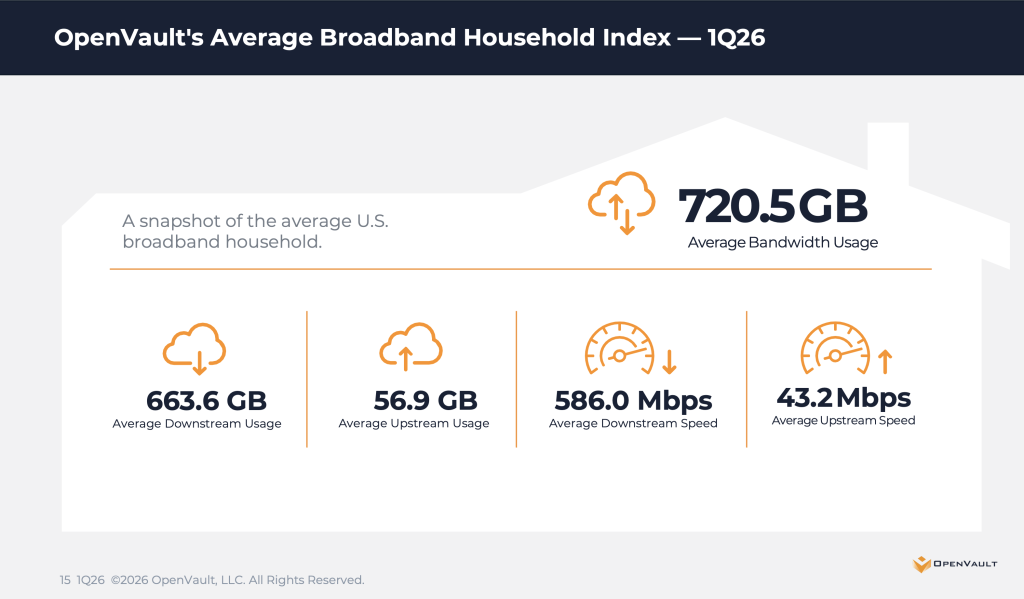
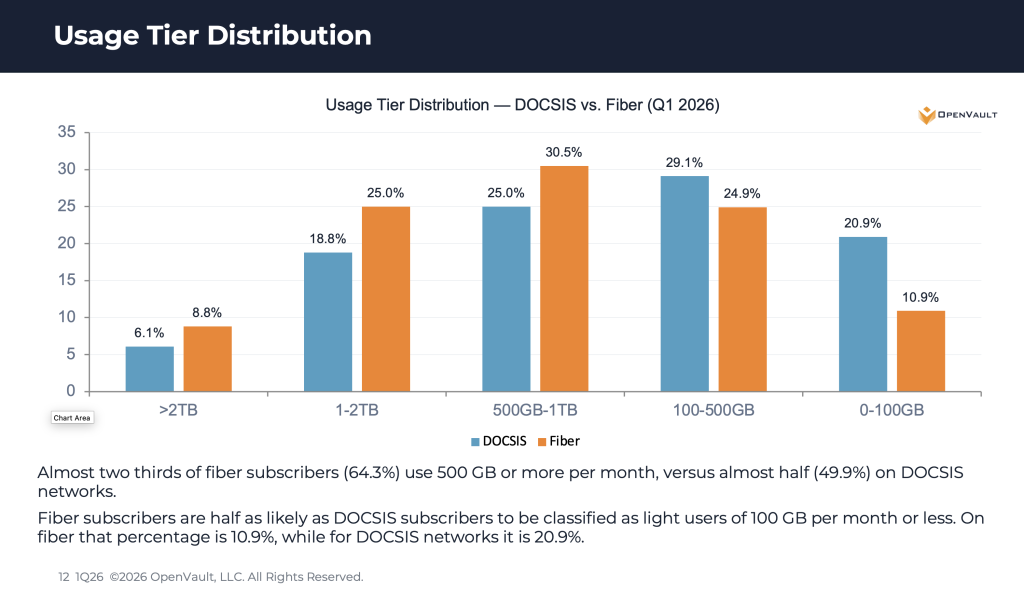
If you have been following my writing on how broadband traffic is changing (the upload nation piece from March and the Internet of AI piece from earlier this month), you know I have been watching this. The Q1 2026 report adds more weight to it.
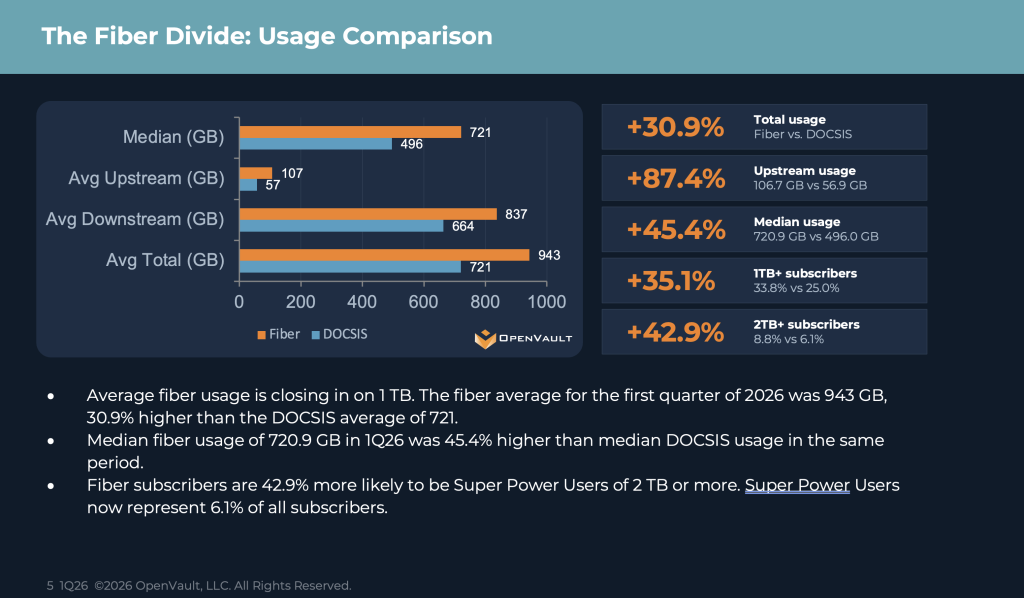
Earlier this year, when I wrote about fiber upstream averages crossing 100 GB for the first time, I called it a turning point. The new data confirms that and shows early signs of changing behaviors.
Cloud Sync Eats Upstream Data
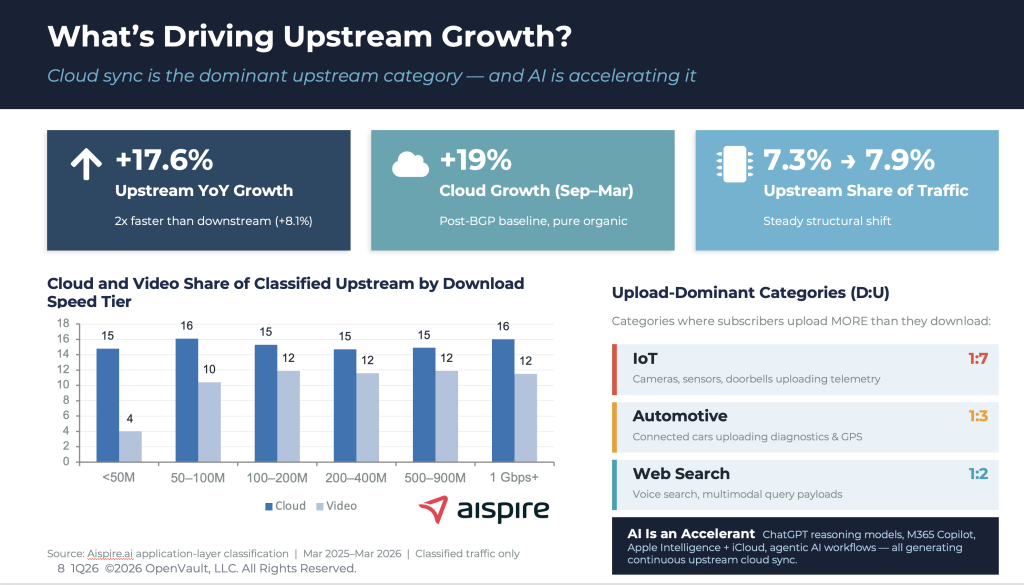
Using application-level data from Aispire.ai, OpenVault identified what is driving the upstream surge. Cloud sync is now the dominant upstream category across every speed tier, comprising 15 to 16 percent of all classified upload volume.
What has changed in the past 18 months is the nature of what’s being synced. ChatGPT reasoning models, Microsoft 365 Copilot, Apple Intelligence, and agentic AI workflows are generating upstream traffic that didn’t exist at scale in 2023. All of it flows to the cloud in the background.
IoT (cameras, sensors, doorbells) now accounts for 7 times more upload than download. Your doorbell doesn’t stream video to you; it streams to the cloud. Connected cars send 3 times more data outbound than they pull down. GPS, diagnostics, telemetry. And web search is generating twice as much upload as download, because voice queries and multimodal payloads are heavier than the typed searches they replaced.
The old asymmetric broadband model (fat downstream, thin upstream) was engineered for passive consumption. That model is finished.
Tale of Two Networks
One finding stood out. OpenVault’s first-ever breakout of residential versus non-residential subscriber behavior shows a 2.3x gap in download-to-upload ratios. It reveals how differently the same pipe gets used.
Residential subscribers run at a 23:1 download-to-upload ratio. Video comprises 48% of their downloads. That’s the familiar story.
Non-residential subscribers run at 7.3:1. Cloud connections account for 20% of their uploads, with a nearly symmetric 1.6:1 ratio for cloud specifically. At the 1 Gbps+ tier, cloud services make up 25.5% of non-residential upload traffic. Businesses running servers, SIEM tools, and cloud infrastructure behave more like small data centers than living rooms.
This reminds me of my own setup at home. An OpenClaw instance running on one machine, network-attached storage, a few other boxes humming away. Work-related computing running over a residential connection. I suspect that within a few years, this will be commonplace.
When cord-cutting was new, I was an outlier, writing about it at GigaOm while most people still paid for cable. Within a decade it was mainstream. Non-residential behavior on residential networks is going to follow the same arc.
The Bigger Picture
OpenVault’s Q1 2026 data points toward what the network is becoming. Not a delivery pipe, but an infrastructure layer of modern life. The upload economy has momentum. The next wave, agentic AI running persistently on consumer devices, hasn’t fully arrived yet.
But the numbers are already rumbling.
Source: OpenVault Broadband Insights, Q1 2026. Application-layer data from Aispire.ai.
May 13, 2026. San Francisco
Thank you for this insight Om, it’s behavior that will drive the next wave of infrastructure. So with your inference that Agentic will drive further the broadband upload model, are we going to head to more a peer-peer centric model than the tree / hub and spoke models that are really behind the webs underlying “client server” model? New technologies needed or new business models? what are your thoughts?
Certainly in Power networks, I’m betting that it goes that way. In fact I am predicting that the distribution folks “head in the sand” modus will lead to their downfall reminiscent of the telecoms powerbase decline of the 90’s. Maybe overthinking this, but my raw gut feeling says not. Microgrids are the flavour du jour in the power hungry AI age.
I suppose really I am asking that question: what tech and what business models do we need next?
It is the same answer I gave you when we were doing structure. The AI as we have come to know it will seep into everything the way cloud and mobile did. It has to because we are incapable of processing the machine scale information, data ans processes of the post digital world at a human scale.
It worked for so long, but now it doesn’t. Every simple thing is so big and complex. Really weird to think we are looking for big bang apps, when it is a death by thousand cuts.
Agentic is just how software underlying our world would work. Forget the buzzwords. We did during the cloud, and look where we are now!
Technology and internet are a continuum.