
Luckin Isn’t Stupid

Centurium Capital, the controlling shareholder behind Luckin Coffee, is buying Blue Bottle from Nestlé for under $400 million. Smart move.They are not buying just a just a coffee brand. They’re buying a pre-built foothold in the US, plus a brand that still carries a premium in markets where Chinese names have historically struggled, South Korea and Japan, for example. How much of that international footprint is actually part of the deal remains unclear.

But for a company that wants to eventually take on Starbucks in its own backyard, this is a serious opening move. This is the same playbook Amer Sports ran, using Chinese capital and operational muscle to acquire overseas brands and build a global empire while everyone else is busy panicking about tariffs and trade wars.

Nestlé, meanwhile, got exactly what it wanted. They’re keeping the packaged goods business. The cold brew cans and bags of beans move

With Neo, Apple Goes After Windows 11

It has been a long time since I used the words “cute” and “want” about a computer. Last time, I probably did when Steve Jobs (RIP) was trying to save Apple and introduced the iBook. Oh, baby, that was cute, cuddly and just different. Apple’s new “Neo” machine made me go cute. And the $699 (for the configuration and color) price tag didn’t make me feel bad to “want” one.

Of course, the market of one is a market of none. Apple needs to convince millions of people to buy this low-end laptop, and steal users away from Chromebook and Windows ecosystems. And hope that these switchers could eventually buy more things from Apple, especially those high-margin services.

Let me reiterate what I wrote earlier in the week. The timing for the launch of the new Neo computer is fortuitous. Microsoft’s ham-fisted approach to grafting Artificial Intelligence (AI) into Windows


Apple Does Fusion.

For the first time in five generations of Apple Silicon, these chips are not a single piece of silicon. The newly announced M5 Pro and M5 Max use what Apple calls Fusion Architecture. This is a big structural change, with long-term implications. And you can see this at work in the newly announced flagship Apple laptops. On the surface these are two third-generation 3-nanometer dies, bonded together into one system on a chip. But dig deeper, and with this modular, scalable silicon approach, Apple is setting itself up to cash in on the computing needs of the AI future.

To understand what Apple launched today, we have to go back just over five years, when Apple launched the M1 in November 2020. I wrote then:

“This approach to integration into a single chip, maximum throughput, rapid access to memory, optimal computing performance based on the task, and adaptation to machine


Apple Does Value (Week)

Tim Cook calls it a “big week.” I’d call it Apple’s “budget week.” Or value offensive. Either way, the first week of March 2026 is not about Apple introducing flagship devices. Instead, it is about Apple showing off its operational scale, taking on the value section of the market, and trying to suck up as much profit as it can to keep its multi-trillion dollar valuation intact.

Today Apple announced the iPhone 17e and a new iPad Air with the M4 chip. Tomorrow or Wednesday, we’ll get a low-cost MacBook, an M5 MacBook Air, and updated MacBook Pros.

Apple has decided that $599 is the new floor for a “real” Apple device. Not a hand-me-down, not last year’s leftovers. But a current-generation product with current-generation silicon. This is going to really put a dent in the phones in the pre-owned market.

To illustrate my point, the iPhone 17e gets the


$110 Billion in Name Only

I wrote last month about the announcement economy, where bombast and news releases are meant to dominate news cycles. Being right or wrong doesn’t matter. Whether the money actually arrives is a different question entirely. OpenAI’s $110 billion funding round is the purest example yet. We (including me) are talking about the headline number, regardless of how much and when the actual money hits the bank accounts.

I wrote a piece based on that jaw-dropping headline number. I mean, that is the kind of amount the VC industry would raise in total less than a decade ago. Still, as someone on social media pointed out, it isn’t money till it’s money. So, I looked at the SEC filings. They tell a different story. To be pedantic, and I am, on day one the actual cash committed was zero. Anyway, here is a quick update from SEC filings and disclosures.

Amazon


What To Read This Weekend

Okay, this might be the N+1 attempt to rekindle this newsletter format. I start with good intentions, but always fail at maintaining continuity. I am going to give this one more try, and see how it goes. As Yoda said, “Do. Or do not. There is no try.” — Om


If you were to look for a single thread running through everything, we all seem to be asking, who’s really in control? And this shows up, very subtly, in whatever I seem to be reading online these days.

Whether it’s AI flooding music platforms, algorithms using your browsing history to price gouge, or self-built doorbell cameras as a national surveillance network, the theme is the same. Systems built for convenience are the ones that own us. But I have written about that already.

Here are five articles that are worth your time.

  • “Suno Hit $300M While Artists Declared War.” How


Block & Tackle: Job Cuts & the AI Narrative

Jack Dorsey, CEO of Block (the company formerly known as Square), went on X (the company formerly known as Twitter, which he co-founded) and shared a lower-case employee memo, candidly outlining his decision to cut about 4,200 people, just over 40 percent of the company’s staff. The memo was in sharp contrast to the investor letter shared with shareholders, prompting John Gruber to quip on Daring Fireball, “That’s a telling sign about who he respects.”

Wall Street loves nothing more than job cuts. It loves them more than it loves vision. In my jaded eyes, the market wasn’t rewarding his AI narrative. It was rewarding the cut. Block stock surged 22 percent on the news. And frankly, no one is looking at Block for any AI vision.

Either way, the thrust of the memo was AI. In way too many words, what Jack was saying was that AI is here,


Amazon & The Cost of (AI) Lateness

My word, the torrent of news keeps coming. You have hardly had time to digest the news of the $30 billion raise by Anthropic, and here we are dealing with $110 billion in new funding by OpenAI. (Well, not the entire round is done, but that doesn’t make for a splashy headline, does it? But it fits the bill for our new announcement economy befitting our unhinged now.)

TLDR of OpenAI’s news. Amazon put in $50 billion. Of that, $15 billion now and $35 billion when IPO is announced or AGI is achieved, which in itself is a hilarious set of what-ifs. Nvidia put in $30 billion, not the headliner $100 billion announced last September. SoftBank, which should be renamed as Soft(Touch)Bank, put in $30 billion. The pre-money valuation was $730 billion. Post-money, $840 billion.

Anyway, while drinking my morning coffee, I looked at the news and couldn’t help but


The Big Poppa

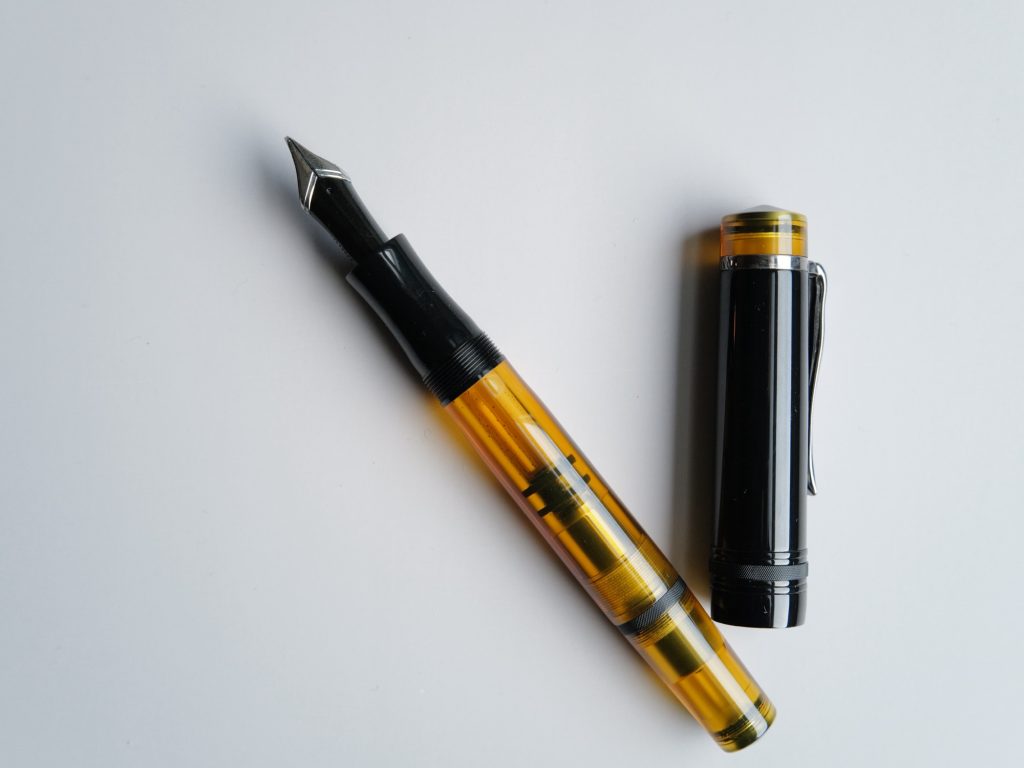
It was almost a year ago, while perusing the “pen” Instagram, I saw a big honking pen made by Shawn Newton of Newton Pens. It was a Knickerbocker. And unlike that team from New York, this is a winner. I had never seen anything quite like it. It was made from an industrial plastic called Ultem. It had a chonky cap. It used a Bock 380 nib. And on top of that it was a piston filler. Most importantly, it reminded me of yellow cabs. Don’t ask me why, but it did.

A few months later, when attending the San Francisco Pen Show (2025), I asked Shawn if he still made that version of the pen. No, as that was part of a small batch production for a group buy. He said he might have some leftover parts and if he did, he would be happy to make me one.