What’s on my Spotify 2021 list?

While I was away, Spotify released its annual “Top Songs of the year” list. I quite appreciate this feature from Spotify. Music, at least for me, reflects one’s state of mind, and the list gives you a window into your inner self. My musical tastes were biased towards jazz, blues, and electronica in the past. However, this year, my top songs list is dominated by what one would call “ambient music.” 

An unusually large number of pianists feature on this list, along with the likes of Mary Lattimore and Roger Eno. My top artist of the year is a Japanese musician (saxophonist and pianist) Akira Uchida, and other favorites include Rose Riebl, Nils Frahm, and Brambles. Uchida has 114 listeners on Spotify, which is such a shame. 

Why ambient? And why these artists? And what do they say about the year that was? After a challenging 2020, I thought of 2021


The Perils of Data Categorization

Nothing is more frustrating to me than YouTube, which decides my front page based on my likes. It seems I can’t have multiple interests — variables — and thus, I must watch certain kinds of videos. In its infinite wisdom, Twitter believes that only the people whose content I like or share are the ones whose content I want to consume. And don’t get me started on online dating services — they could learn a thing or two from Sima Taparia

And that is because the post-social world of today is starting to coalesce around variables that are less humanistic and more biased towards corporate goals. “We live in a world that demands categorization,” I recently read in a newsletter, Tiny Revolutions. “We have to do some self-definition so the world knows what to do with us, and so that we can bond with others who share our interests, values, and concerns.”


Will Spotify become Facebook of streaming?

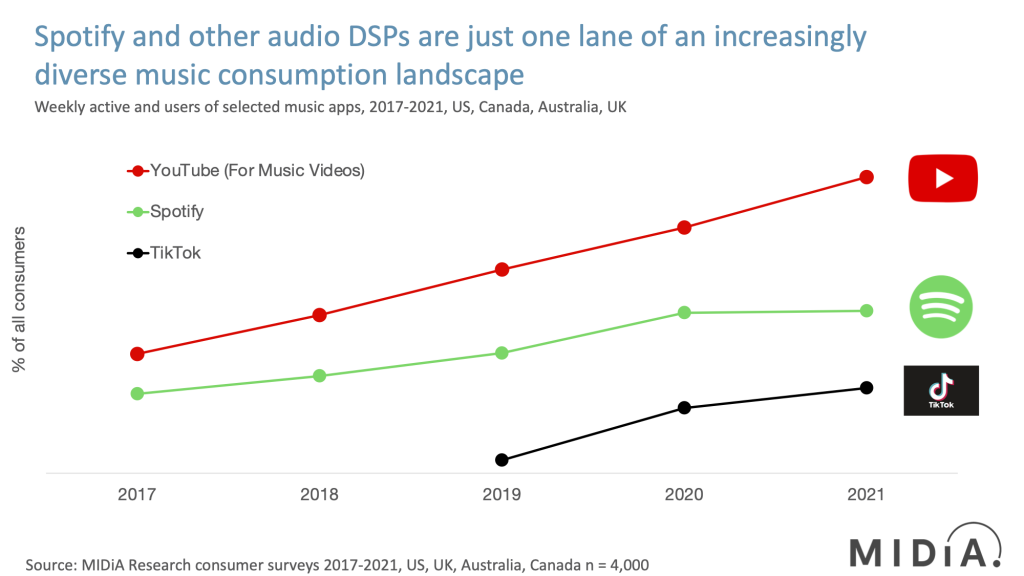
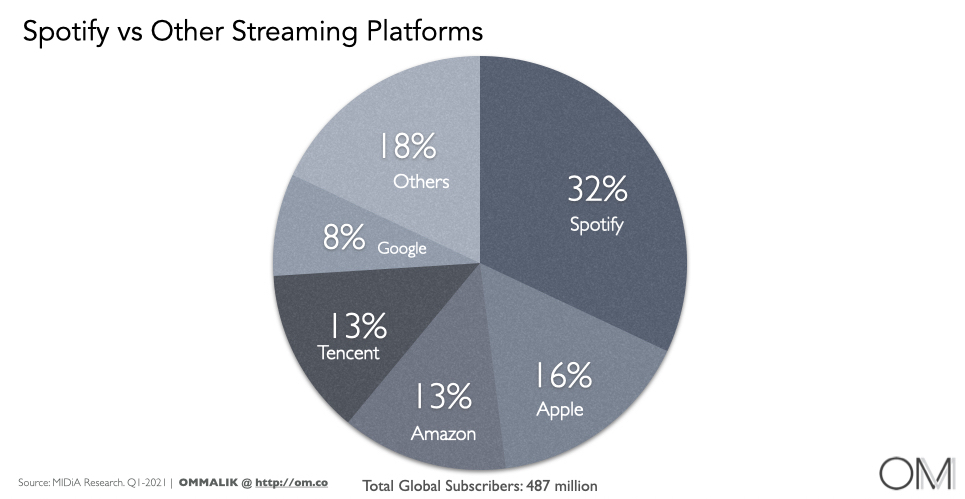
Spotify continues its global dominance, adding 27 million net subscribers between Q1 2020 and Q1 2021, more than any other single service. However, it lost two points of market share over the period because its percentage growth rate trailed that of its leading competitors.

Google was the fastest-growing music streaming service in 2020, growing by 60%, with Tencent second on 40%. Amazon continued its steady trajectory, up 27%, while Apple grew by just 12%.

Google’s YouTube Music has been the standout story of the music subscriber market for the last couple of years, resonating both in many emerging markets and with younger audiences across the globe. The early signs are that YouTube Music is becoming to Gen Z what Spotify was to Millennials half a decade ago.

MIDiA Research

Facebook might be the biggest social platform, but it is on the outs with Gen Z. I wonder if Spotify will find itself


What goes before wisdom?

Moon over San Francisco. Made with iPhone 12 Pro Max

While my week has been noticeably quiet here on my internet homestead, it has been quite the opposite for me out in the real world. 

I had to go to the dental surgeon to remove a couple of wisdom teeth that had become nuisances and were putting the entire neighborhood in distress. I recognize that it was a pretty minor procedure, but like any reasonable adult, I am scared shitless of visiting the dentist. I was in a state of panic for two days leading up to the event, unable to sleep and overcome with anxiety. 

On the day of the procedure, it all turned out to be relatively fast and straightforward — thanks in large part to the surgeon, who kept talking to me about photography and his love of Lindorf technical cameras. Of course, now he is a


Vinyl Conundrum + other notables

Happy Sunday, everyone! I have slowly (and unintentionally) slipped into “summer mode.” I have been working only a little and reading quite a lot. Last week, I also met Ken Kocienda, a former Apple software engineer and designer, to talk about art, life, photography, and watches. 

I didn’t spend as much time on Twitter (either perusing or tweeting), so there isn’t a “Tweek” wrap-up for the week. But several articles caught my eye that I probably would have tweeted, and here they are: 

Vinyl Is More Popular Than Ever. Surprisingly, That’s a Problem

During the pandemic, vinyl sales in the U.S. exploded, growing 28.7% in 2020 to $626 million, even beating out CD revenues of $483 million. Vinyl sales have been growing steadily over the years. Everyone (and I mean everyone) is making and selling vinyl records, including Target and Walmart. The annual demand for vinyl is between 320-400 million albums,


Twitter Scrolls

Twitter is going the way of subscriptions in 2021 — after buying Revue, the company today snapped up Scroll for an undisclosed amount. The acquisition is a smart move — it allows Twitter to play to its strengths — media and media distribution. 

Scroll is a prix fixe media buffet –for $5 a month, readers can view articles, ad-free, from about 300 odd media outlets. The $5 a month subscription is then shared with the publishers. Good idea, but as Scroll founder Tony Haile points out in his blog post announcing the deal, “we’re not moving fast enough.” 

A lot has to do with the media industry and its bureaucratic disfunction. The fact remains that destination viewing of media is becoming a habit only reserved for a fading generation of readers. Discovery, distribution, and consumption of media have taken on a different meaning. And believe it or not — Twitter is smack


Bandcamp vs Streaming

What do Nils Frahm, Anne Mueller, Jeannie Schulz, Mary Lattimore and Atli Örvarsson have in common? They are among three dozen artists whose albums I bought last year from Bandcamp, an Oakland, CA-based music service. It was my way of supporting these artists. As I wrote earlier, “we need to figure out how much we value the music and the musicians,” so that “we can use our dollars to encourage them to keep creating.”

And I am not alone. 800,000 customers spent $48.3 million on what Bandcamp calls Bandcamp Fridays — every first Friday of the month, Bandcamp forgoes the 15 percent cut of the digital sales (and 10 percent cut of the physical sales.) All money goes to the artists. Bandcamp Fridays started as a one-off feature on March 20, 2020, it has become a regular feature. In a year since the company has sent $148 million to the artists.


Podcasts had a bumper 2020

black and silver microphone with white background
Photo by Jukka Aalho on Unsplash

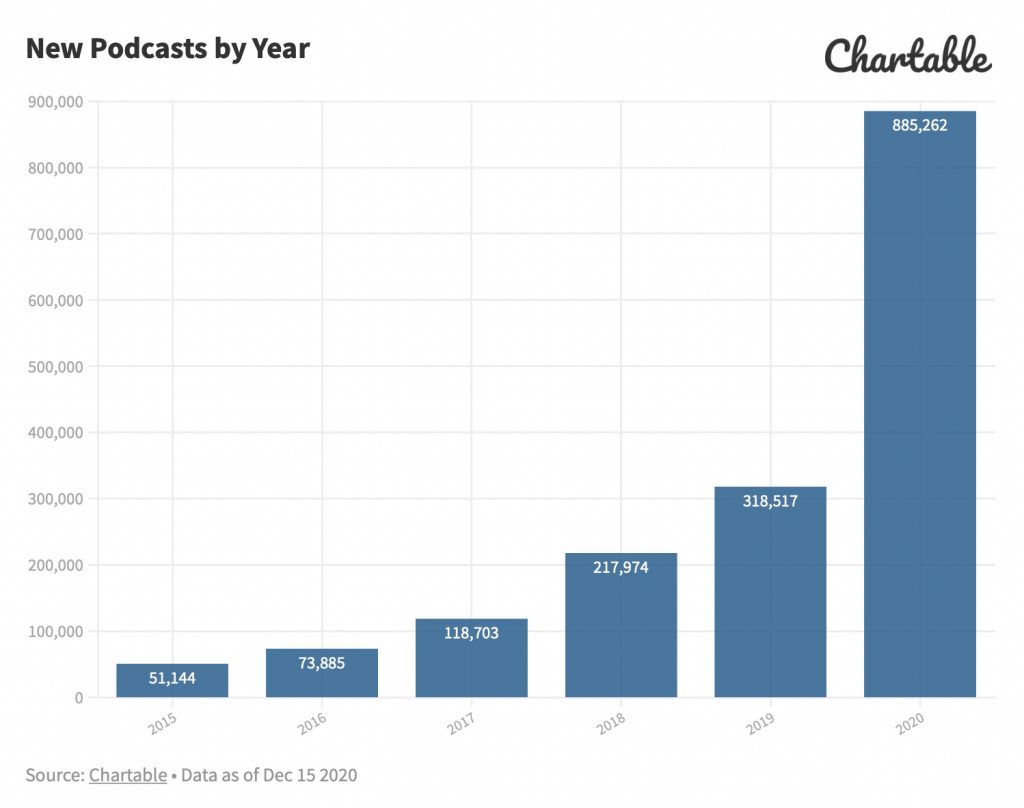
From a billion-dollar valuation for social Internet’s “it” startup, Clubhouse to billionaire Mark Cuban co-founding his own version of a live “fireside chat” app, audio is the new hotness. Amidst all the hubbub, it is easy to think of podcasting as an old fuddy-duddy — which is ironic given that podcasting had its best year ever in 2020. 

A full analysis of the year in podcasting is available over on Chartable, the podcasting analytics platform. Jam-packed with facts, figures, and smart analysis, the write-up is well worth reading. Here are some highlights:

  • There were 17,000 new podcasts started each week in 2020, totaling roughly 900,000 by the end of the year. 
  • Half of those new podcasts are in English, but other languages are growing fast — led by Hindi, Chinese, and Portuguese. 
  • Monthly downloads increased by 180 percent. 
  • Chartable says it is seeing 1.2 billion downloads per month