Sweet Streams are made of this

Matrix movie still
Photo by Markus Spiske on Unsplash

A few weeks back, I posed the question: Is “stream” as a design paradigm over? I asked because of some behavioral changes that have become prevalent on the internet. First, most of the internet is now algorithmically organized by large platforms, so we are increasingly predisposed to receive information in atomized form. With those two trends in mind, the idea of people going to a destination — say a blog — to consume information in reverse chronological order doesn’t isn’t relevant as much. 

I shared the article with two fellow bloggers who are big thinkers about web architectures, user experiences, and Internet software — Jim Nielsen and Jeremy Keith. Jim sent me an email and subsequently shared his thoughts on Mastadon. He is still thinking about the design concepts, but his way of organizing information is simple: “his words” (aka posts) and other “people’s words” (aka links.) He will


Is “stream” as a design paradigm over?

person typing on laptop computer
Photo by Kenny Eliason on Unsplash

Earlier today, I read something that led to the question” do we even need to organize the blogs in the reverse chronological stream? Ben Werdmuller, frustrated by the design of his website’s homepage writes:

As of right now, the homepage is a mix of long-form posts, short thoughts, and links I consider interesting, presented as a stream. It’s a genuine representation of what I’m reading and thinking about, and each post’s permalink page looks fine to me, but it doesn’t quite hold together as a whole. If you look at my homepage with fresh eyes, my stream is a hodgepodge. There’s no through line.

Like Ben, I, too, feel the same way. What Ben is asking and I am echoing: are these end-days of using “stream” as a design and information organizing principle? It has been just over two decades that I have written “for” and


Why internet silos win

Ever since Elon Musk took over Twitter and turned it into a tawdry reality show in which he is the star, the villain, and the comedian, everyone has been talking about a new decentralized web. New products, such as Mastodon, and new technologies, such as Activity Pub, are part of a new desire to build a new “fedeverse.” This is utopian thinking about taking the web back from the centralized web platforms.

One of my favorite bloggers, designer Lars Mensel notes:

We all feed social networks and online platforms with unprecedented amounts of data, hardly accounting for the fact everything might vanish when the ownership of a network changes (as seems likely with Twitter’s ongoing nosedive) or the business model collapses.

Mensel is right. And it makes sense that more of us should be doing it, but we don’t because, in the end, we want an easy way out. Manuel


What’s Worth Reading: Thanksgiving Weekend Edition

I returned from a quick trip to London on the day of Thanksgiving, thus missing the bonhomie of the weekend. While I did miss the slices of pie, it was good to spend the time watching The Silence of Water on PBS Masterpiece (via Amazon Prime.) The Italian crime show is beautiful in location, cinematography, and acting. And despite having to follow the subtitles, it is worth binging. 

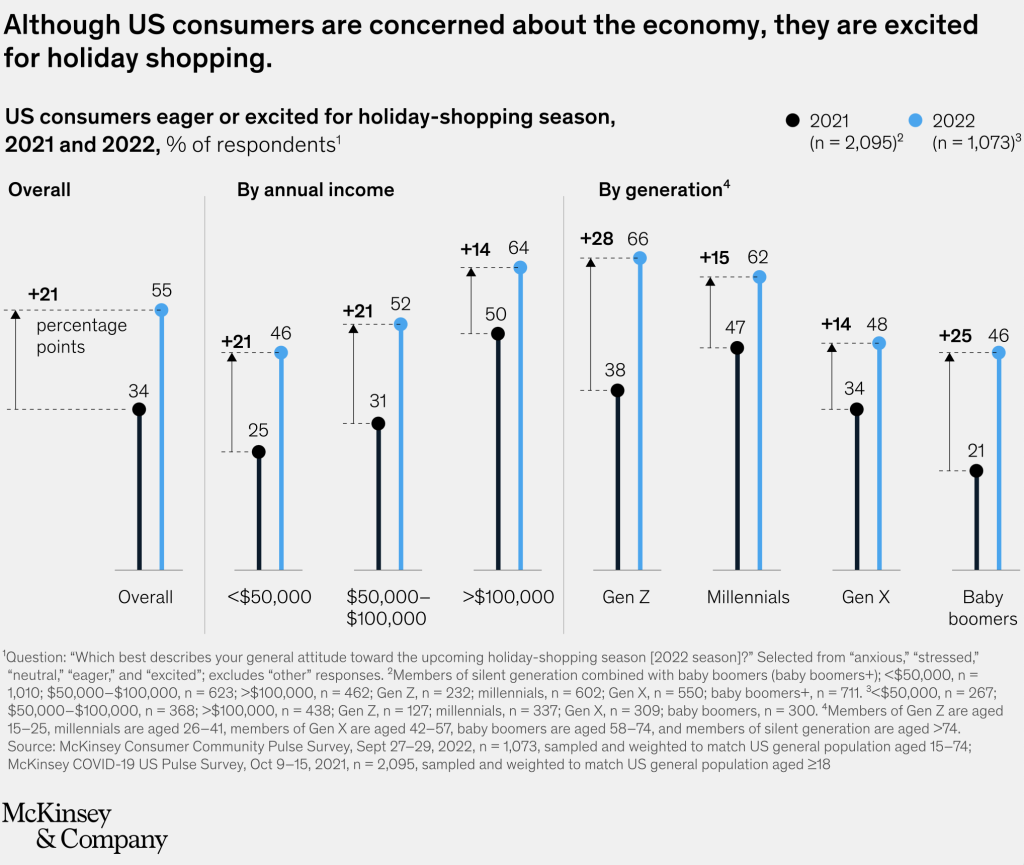
The show was an excellent way to stay away from the incessant come-hither siren call of Black Friday — a disease that has also spread to the United Kingdom. I used the opportunity to stock up on memory cards, but that’s all. For the rest of America — despite economic doldrums, it seems to be the season of shop till you drop. I call this the consumerism curse.

The long weekend was also a good time to reflect and read. 

What I am reading


In My Newsletter I Trust

blue and white logo guessing game

No matter how often this happens, we don’t learn our lessons — we continue to till other people’s proverbial land and keep using their social spaces. Whether it is Facebook, Instagram, LinkedIn, or Medium, we get trapped in the big platforms because they dangle the one big carrot in front of our eyes: the reach, the audience, and the influence. 

And we keep doing their bidding — they use our social networks, our work, and our attention — and, in the process, help make their networks gigantic and indispensable. We become pawns in their end game. And then they change the rules of the game — after all, if you own the league, you make the rules.

I have known the truth about social platforms. I quit Facebook and Instagram years ago, and candidly I am better for it. I don’t need 5000 friends — 15 good ones will do.


Of Monsters & Media

The paragraph (below) sums up the predicament of the post-social world: there is hardly any difference in information, misinformation, and disinformation anymore. You have to spend more energy and burn more neurons to distinguish what is real and what matters. You are better off paying no attention. And yet, there seems to be no escaping! 

Kanye is a public figure, making news 24/7.

Kind of like Elon Musk. Like this guy can solve the problems in Ukraine, like he knows more about the situation than Zelensky, like Ukraine should just accept that Crimea is now part of Russia, even though Russia stole it after the 2014 Olympics. There are people who can’t get over what the state did to them a hundred years ago, but Ukrainians should just get over it. And how the hell would Elon even know? It’s a full-time job keeping up on the world situation, and


There is no “social” in “social media”

water droplets on glass panel

Should we drop “social” from social media? There is nothing social about this social media. And most of these platforms are essentially networked information distribution systems, and more and more of that information is just noise or disinformation. And humans aren’t helping either. 

Everyone, including Captain America fantasist billionaires and yours truly, in some fashion or the other, are nothing more than mere botnets? In our divided modern “now,” one person’s information is another person’s fake news. Rumors are mere facts for the media to report on with a question mark? And at the same time, the news is a source of rumors; all you need to do is add a question mark. Either way, can we stop pretending that social media is social, about friends & people?

The biggest lie these platforms feed us is the idea of them being “social media” and “social networks.” In reality, they exist


One needs ‘Social Silence’

Every so often, when I read what passes as news on the internet, I find myself triggered. Whether it is the choice of what to write about, or the news itself, I am gobsmacked by the sheer stupidity that envelopes us.

To be fair, stupidity and poor news judgment have always been with us. In the past, that steamy pile of nonsense stayed confined to tabloids and rags sold at the grocery counters. Social media sadly pushes it all right up our noses. And since gods of engagment reward publications with gifts of attention, even respectable publications don’t hesitate to promote and push the vapid and the hollow.

Such material triggers me. And I often find myself wanting to scream out loud. There is a platform for that — Twitter. And all too often, I draft a tweet and then discard it. It is an old habit carried over to


The future of tech as I see it

Captured at San Francisco on 27 Feb 2022 by Om Malik

I recently sat down to talk with my friend Howard Lindzon on his podcast Panic with Friends to discuss the future of technology. Howard has shared the show notes on his blog. I wanted to draw out three core themes I addressed in my conversation, and they are all correlated. 

I have a long-standing approach to holistically understanding technologies and their impact. I look at pure technologies such as semiconductors & networks and think about their impact on products, behavior, and change. At the same time, I look at our behaviors today and how they disrupt the present technology ecosystems. 

Much of my current and future enthusiasm stems from exciting work underway in the semiconductor world, with Apple’s M1 being the most visible example of the possibilities unlocked by cheap computing, cheap GPU, and machine learning capabilities. It is not