

A Letter from Om Issue #06/2023
Hi! In case you are new around here, I’m Om. In this letter, I share my latest thoughts, articles worth reading from around the web, my recommendations & occasionally, my photography.
In this issue, I address the following:
- Why AI won’t eradicate humanity
- The Why of Apple XR Glasses
- Some of my recent pieces
- Some Good Reads
Why AI won’t eradicate humanity
I have spent most of my past week playing around with Adobe’s new “Generative Fill” technology, which is very much like AI programs such as Dall-E and Midjourney that can create pictures based on written text, except that it works within the confines of Adobe’s Photoshop. You can type a phrase, such as “place a tree in the background,” and the program does it quickly and accurately.
As a photographer, I primarily use Photoshop to eliminate objects like out-of-focus grass clumps or tree stumps from my images. Even using tools like an editing tablet, drawing careful selections could take as long as an hour. Now, using the “Generative Fill” technology, all I have to do is select what I need to remove, and tell Photoshop to erase it. The results are astonishing: fast, accurate, and natural. It is hard to distinguish between the edit and the real image.
Large language models, natural language processing, machine learning, this disparate set of technologies is quickly becoming part of my daily life — they’re my augmented intelligence. Stable Diffusion manipulates images, while the Midjourney server open in the Discord app and helps me create artwork for my blog posts. MacWhisper window takes my voice memos and transcribes them, then Lex.Page, powered by GPT4, turns that disjointed string of text into notes.These open windows on my laptop are a glimpse of what is to come: As the world has become more complex, we desperately need a way to wrangle all the data, streams, and tasks.
Some of the smartest people in technology say they are worried that AI is worse than pandemics and nuclear weapons. What I worry about is not AI extinguishing humans, but our humanity.
Look at how we use navigation apps: We now blindly follow wherever they lead us, having lost our ability to make independent decisions. No one who has grown up with GPS knows how to get where they’re going without it. And that’s the real risk of this new wave of “AI” — we become more reliant on machines than ourselves.
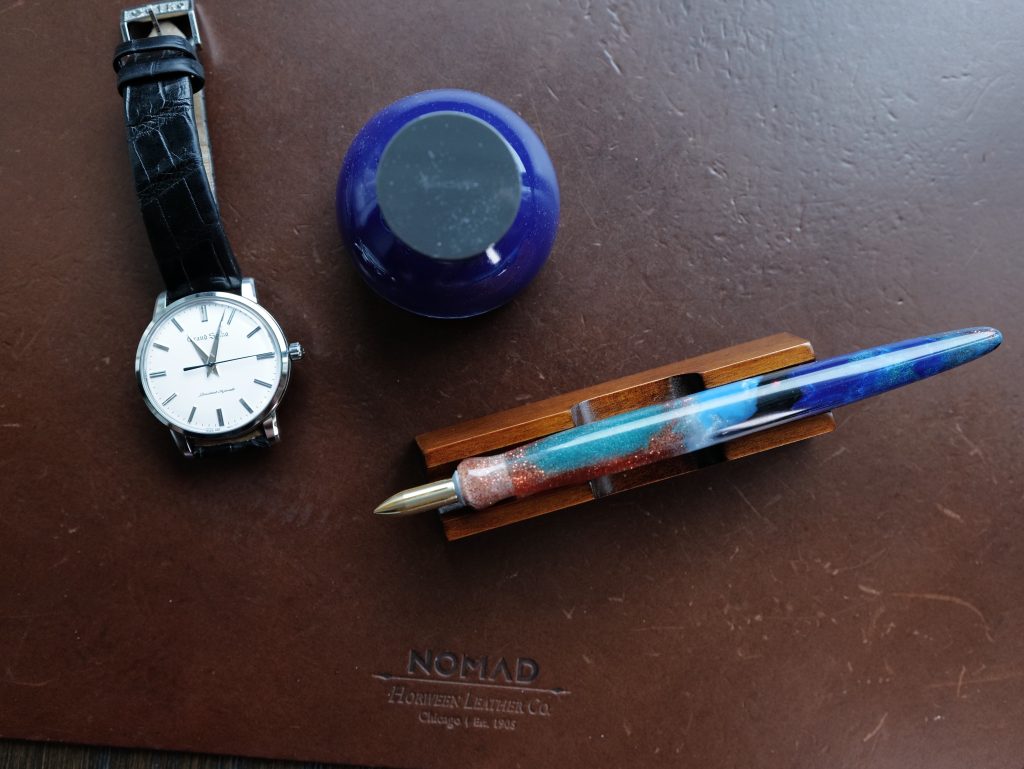
With machines taking more control over my life, I have taken a few steps to remind myself that I am a person. I have turned to things made by hand. When I look up from the many open windows of my laptop, from the corner of my eyes, I see a leather mousepad, a handmade notebook, a manual wind watch, a bottle of hand-crafted pigment ink to be used with a dip pen with a brass nib. The results of my day are recorded in the notebook. Conversations are succinctly transcribed on paper. And when I am distracted, I take a Q-tip, dip it in ink, and doodle.
Still, I know that despite my efforts, these new augmentation tools will only become an even larger part of my life, and that this digital Hotel California of convenience will be an unavoidable reality for everyone. I already don’t know how not to use Adobe’s Generative Fill, even if it will cost me more money on top of whatever I am paying Adobe already.
Apple’s XR Headset Reality Check
In a few days, either I will look like a genius or a certified dumbass. Given my track record, I would bet on the latter — but that still won’t stop me from writing what I am about to write. The Apple rumor machine says that on Monday, Cupertino will announce a new gadget, most likely mixed reality glasses. Since several articles are speculating on this new rumored device’s design, capabilities, and features, I will skip going into detail about those features. What I’d like to do is explain why this device should exist and what will be its true killer app, which continues to elude other entrants in the “mixed reality” business.
I look at future technology trends by studying the confluence of better networks, cheaper storage, and computers. Just like digital music, it has allowed me to predict and prepare for the eventual arrival of digital telephony, online video streaming, cloud computing and distributed work.
Just before the turn of the century, with the emergence of MP3s, it became clear that digital music would trump physical media because convenience trumps everything. We early adopters wanted all of our music to go, and we bought some ugly and awful MP3 players to carry it— try looking up Creative Labs Nomad or the “Rio MP3” player from Diamond Multimedia. But their software wasn’t easy to use, and transferring music over from our computers took forevers.
In 2001, Steve Jobs introduced the iPod. It was, like every other MP3 player, a hard drive in a box, albeit a pretty one. More than that, it was simple and fast, especially for those who owned the Mac computers. Windows users had to wait a few years to enjoy iPod’s magic. It used firewire connection technology to sync songs from the desktop using iTunes software. That tight integration brought simplicity missing before to the digital music world. That package brought digital music into the mainstream.
I bring up the iPod because I see the parallels with the launch of these new “glasses.” Instead of music, the digital content would be video games and entertainment videos: These new “glasses” could be like a portable big-screen television, ready to go and play your favorite video content anywhere, as if you were at home. s
To be fair, I have proposed the “glasses are the new TV” ideaa lot. Four years ago I wrote, “The big (TV) and biggest (movie theater) screens are going to go the way of the DVD. We could replace those with a singular, more personal screen — that will sit on our face.” Since then, the pandemic has happened. Movie theaters as a content-consumption space have lost their pre-eminence. More and more movies are available on demand. We already live in a world of too-much video, and with the rise of new AI technologies, we will see an exponential jump in it. (Mark my words, YouTube is going to become bigger than Google itself.)
Live sports could be the killer app for this kind of content. Consider MLB charging a few extra bucks for me to watch the Yankees-Rays game sitting right behind the home plate, in addition to offering a standard television stream. Or courtside seats at the Lakers game? The glasses can and should open new immersive opportunities. Of course they said the same about 3DTV! Add the extensive gaming library to the mix, and you suddenly have another use for these glasses.
Unlike Facebook, Apple won’t have to search for new gaming apps — Apple, thanks to the App Store, has a big reach and can create new opportunities for game developers who are already all-in on Apple.
Steve Jobs “very much wanted to do for television sets what he had done for computers, music players, and phones: make them simple and elegant. ‘I’d like to create an integrated television set that is completely easy to use,’ he told me. ‘It would be seamlessly synced with all of your devices and with iCloud.” No longer would users have to fiddle with complex remotes for DVD players and cable channels. ‘It will have the simplest user interface you could imagine. I finally cracked it.’”—Walter Isaacson
Just as iPod eventually became the iPhone, the clunky glasses that might launch next week would be a far cry from its possibilities. Of course, a week from now, I could be eating my words — in hindsight, we are all either geniuses or idiots.
Some of my recent pieces:
- The rise of the “Resale” Culture.
- Exit Captain America. Enter Elliot Carver
- What’s wrong with Leica Q3
- The number of songs uploaded every day is going to shock you.
- Ben Smith’s Traffic.
Worth Reading
- Streaming has made docuseries a thing, and I am with the author — docuseries are ruining sports.
- Twitter is fragmenting. Twitter, and its right-wing clones are very much like Fox — that’s not where the future happens. (Also, As Platforms Decay, Let’s Put Users First.)
- A very gentle introduction to the large language models without the hype. (Also, what the hell is Generative AI anyway?)
- This is how your profile is built online using the data available online. This is a scary piece, and a must-read.
Etc.
- A set of photos from my trip to New York.
- Two songs I recommend for this summer — Karma by Taylor Swift with Ice Spice & Rita Ora’s Praising You. They have proper summer anthem vibes.
See you all in two weeks!
June 1, 2023. San Francisco
3 thoughts on this post
Comments are closed.
You know when we’ll really know AI is here?
When Alexa has it. AI is necessary to make voice interfaces work as intended. I can’t recall all the code words all the time. Unless I tell Alexa the specific song or album I want I may not get it, even when it’s right there on Amazon Music, available in just a few clicks. Services like Alexa, Google and Siri should be able to access anything that’s on your mobile device, and seamlessly. That’s not true now. it’s why they seem to have “failed.”
Would love to hear from other “Om-ers” on this.
Hey Google. The name is Blankenhorn, not Blankenhron. Although that’s a new misspelling to me.
Haha, that is funny! Also, welcome to my life of misspelled names!