

The Reality of AI: Vanishing White Collar Jobs
Microsoft has announced a “historic” agreement with the AFL-CIO — a “new tech-labor partnership on AI and the future of the workforce.” Microsoft CEO Satya Nadella tweeted that Microsoft is working “to ensure labor has a voice in the development of AI and workers have the skilling opportunities they need to thrive in this new era.”
That makes for a great soundbite — and a great way to win the public relations battle. It also protects the company from any political fallout, especially when AI starts to impact the job market. It is also a prudent move — 2024 is an election year, and you can count on politicians to use the “fear factor” to their own benefit.
When you dig into the details, the agreement is a nothing-burger. The AFL-CIO represents about 12.5 million workers, most of whom are in sectors that would almost be considered non-white-collar. And even the white-collar workers the AFL-CIO represents will be marginal at best. The reality is that the first order of impact of what we know of AI is going to be felt in the white-collar professions.
Before I dig into the why, let me remind you that I think of AI “as augmented intelligence rather than artificial intelligence, you’ll begin to understand its radical and significant role in the arc of technology.” The way I think about it, “intelligence can be artificial. Or it can be a tool to help humans survive a more complex, more connected world that is moving ever so faster. I believe we need optimism to move forward. But we don’t have to be blind to its problems. A bit of skepticism is good because we humans have our fallacies, like technology.” With that out the way, let’s get back to the impact of AI, and the automation it is going to unleash on the white collar jobs.
White-collar jobs are normally associated with professional, managerial, or administrative work. In comparison, blue-collar jobs involve manual labor. The automation of tasks normally undertaken by white-collar workers — for example, legal assistants and members of marketing and sales teams — will impact employment opportunities, especially at the lower end of the white-collar spectrum.

To gauge the risk to white-collar jobs, I consulted the US Bureau of Labor Statistics’ Occupational Outlook Handbook. My thought was — job trends can give us insight into areas of high risk. According to the report, employment in the United States is projected to increase by 5.3 percent during the 2021–31 decade, adding about 8.3 million new jobs. These are mostly service sector jobs — the U.S. is no longer a manufacturing-first country.
First, the good news — a bulk of new jobs will come from healthcare and other aspects of the service economy that involve some kind of manual labor. (See the list.) I then tried to narrow down the scope further to what could loosely be labeled as white-collar gigs.

Even within this segment, I narrowed down the scope of jobs and eliminated any gig that involved in-person work or physical activity — i.e., work that couldn’t be automated using AI — for instance, retail window display arrangements. These are jobs that involve using computers and/or other information technologies.
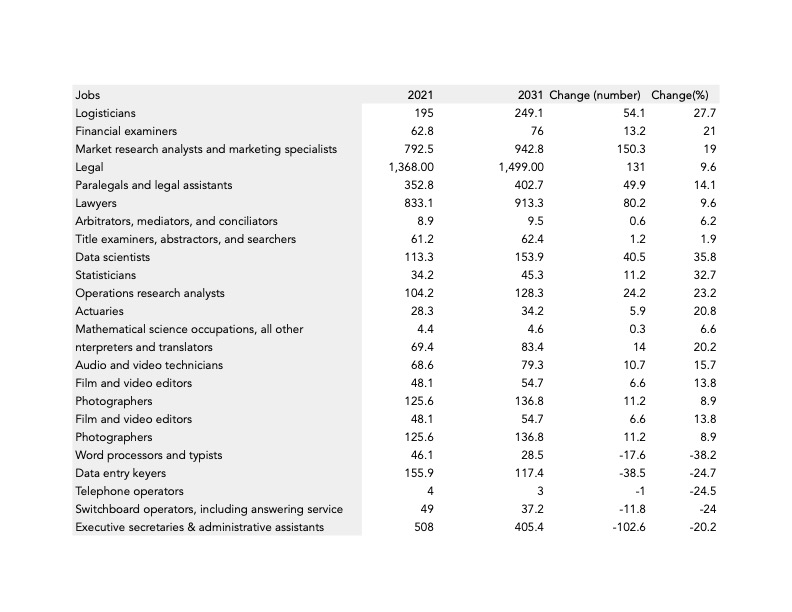
That’s about 5.7 million jobs in 2031, according to BLS data — a growth of about 451,000. These forecasts don’t take into account the role of AI — and were released before OpenAI’s ChatGPT came to the market. Since then the technology world has gone on a mad dash to the AI future. And that’s why it was interesting to parse the details of job growth, and look at the kind of jobs that will offer employment opportunities.
Most of the jobs listed above are in the direct line of sight of AI. While I don’t think we are going to see an end to these kinds of jobs — we are going to see a compression in opportunities for growth. For instance, if AI editing tools keep getting better, the opportunities for audio or video editors will become more limited. Market research will become much faster and need far fewer employees than it does right now. We might not need as many legal assistants and paralegals as we do at present. And we have not even started to factor in the loss of jobs in call centers and customer support.
“I can’t sit here and say that AI will never displace a job. I don’t think that would be honest. AI is well-designed to accelerate and eliminate some of the parts of people’s jobs that you might consider to be drudgery. By working directly with labor leaders, we can help ensure that AI serves the country’s workers.”
Brad Smith, President, Microsoft
This is a scary reality of the future — at least looking from the vantage point of today. The next decade or so is that of disruption — not because of some “AGI,” but because we are going to see increased automation of tasks that have until recently provided employment to many millions — and in turn supported society and its societal infrastructure. Automation through AI means fewer jobs, which in turn means compression of the economy itself unless we figure out a way to create opportunities that are new, vibrant, and currently non-existent.
When reading through the Microsoft press release and comments from its leaders, I kept thinking: why are we not asking the right questions about jobs and the future? Microsoft is an unabashed champion of all things AI — and rightfully so!
AI is a force multiplier for all aspects of our lives — both for good and for bad. I believe good will outweigh the bad, but the transition is going to be quite bumpy. Perhaps Microsoft, instead of talking about things in abstract and political terms, should start sharing directional examples for society to better prepare for the change.
There isn’t much time to twiddle thumbs, because job disruptions can lead to societal disruptions pretty fast. We have history for a lesson — at the turn of the last century, automation and the rapidity of change led to enormous upheaval, unrest, violence, and disruption.
December 11, 2023. San Francisco
2 thoughts on this post
Comments are closed.
Hi Om, thanks for sharing this. It is deeply thought-provoking.
Great point about “Microsoft, instead of talking about things in abstract and political terms, should start sharing directional examples for society to better prepare for the change.“
You also ask “why are we not asking the right questions about jobs and the future?” What could some of these questions be?
Thanks!
Thank you for the comment. More to follow in days to come. I posted a conversation with Sean Gourley and I would suggest you take a look at that to get a better perspective.