

iPad at 15: Hit or a Miss?
Yesterday slipped away, and I never got a chance to mark the 15th birthday of the iPad, perhaps one of the most misunderstood products in Apple’s lineup. The confusion over the device is not limited to reviewers or buyers but extends to Apple itself, which hasn’t really been able to give it the direction it deserves. Had Steve Jobs not died, the iPad likely would have received more focus, attention, and appreciation.
Over the years, it’s fair to say the iPad has suffered from a subpar operating system experience. There has been a distinct lack of popular and hit applications. Still, one can’t ignore the amazing hardware and its true capabilities. If only there were more interesting apps — not games — that tapped into what Apple packs into it. The device has been a playground for new technologies — screens, LiDAR, M-class silicon, for example.
Still, there is no denying that for children and elders, the iPad is a perfect computer. Children, in particular, seem to be intuitively drawn to it, swiping and interacting with ease. Giving my mother an iPad and seeing it open up her world has been a joy to watch. I am sure that sentiment is shared by others with aging parents. Not surprisingly, those of us who have grown up using desktop computers struggle with the elegance, simplicity, and constraints of the iPad.
I fell in love with the iPad the minute I played with it. I still am! It reminded me of a slate — on which I learned to write from my grandfather. That slate was very analog. “On January 27th, when I first picked up the iPad, I was that 4-year-old boy again. I felt like I was getting that old slate of mine one more time,” I wrote in my first (but not last) essay about the iPad.
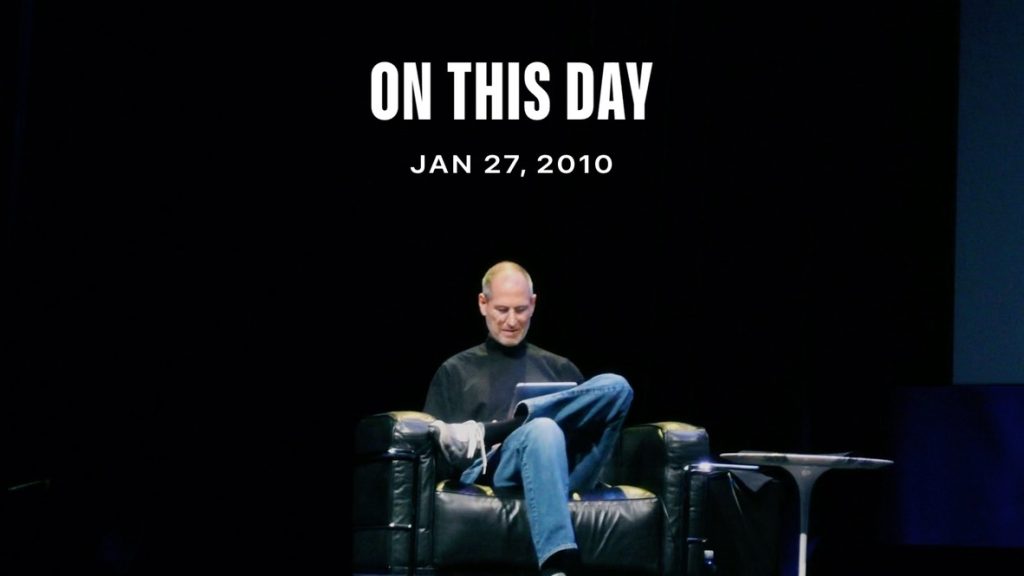
Still, my first impression of the iPad was that it was device “made for the consumption of digital media: games, music, photos, videos, magazines, newspapers and e-books. Sure, you can use it to check your email or work on a keynote, but the iPad’s primary purpose is to help you consume the ever-expanding amount of digital content on offer.”
Looking back, I think I might have gotten that right. Up until a year ago, when Vision Pro entered my life, iPad was my primary media consumption device. From reading news and checking out social media to watching YouTube and Netflix or streaming music to my speakers, the iPad was my media appendage. I have used the keyboard to write, do email, and post to my blog. I have edited photos on Adobe Lightroom. Still, media consumption was the primary use case. I have since shifted a lot of my video consumption to the Vision Pro, though I wish YouTube would make an app for Vision Pro (or let someone else do it).
Given the iPad’s positioning, it isn’t surprising that it has, almost from day one, found itself in the iPad vs. MacBook debate, especially with the release of the 13-inch iPad Pro. I stopped paying attention to that debate about a decade ago and started to figure out how to maximize its potential, particularly when I was on the go.
I still prefer to carry my iPad (11-inch) with its Magic Keyboard on short trips, such as to Seattle or Los Angeles. However, I take my MacBook Pro on longer trips, like when visiting Delhi. Even then, I use the iPad on the plane. It’s just easier — I have a mobile internet connection, plus iPadOS is more secure, and you can quickly set up a VPN on iPad and iPhone.
For air travel, the iPad’s portability and connectivity make it an ideal companion. Its compact size fits comfortably on tray tables, and I can stay connected even at 30,000 feet. The added security features of iPadOS provide peace of mind when accessing sensitive information on public networks.
Fifteen years have passed since Steve Jobs introduced the iPad to the world, and its design has proved remarkably timeless. Even rivals — looking at you, Samsung, which blatantly copied the original concept — have not been able to improve upon it. Apple has done its best to make the iPad more powerful and more beautiful. But like a Porsche, the original design was so good that it can only be marginally tweaked.

Based on numbers reported by Apple and estimated by market research firms, Apple sells about 51 million iPads a year. Since 2010, it has sold nearly 770 million iPads. Over the past 15 years, Apple has sold $350 billion worth of iPads, calculated using average selling price and total estimated iPad sales.
While it is talked about, it is quite popular as an “enterprise” device. From airline pilots, onboard crew, to fast food worker to other businesses use iPad as an on-the-go computer. It has obviously gone unnoticed by the popular media, but it keeps the money machine chugging along.
The iPad is expected to bring in more than $27 billion in 2024. That’s more than the collective revenues of Snap, Pinterest, MongoDB, Roblox, Unity, Palantir, Dropbox, Roku, and Cloudflare. Not bad for a product that is often called middling. While the iPad’s success is impressive, I wonder about its potential had Apple’s visionary co-founder Steve Jobs lived to guide its development. Jobs, who introduced the iPad in 2010, might have become…
From My Archives:
21 thoughts on this post
Comments are closed.
I would just add that using Leica FOTOS on iPad is an efficient way to quickly review and cull images from a day’s shoot–especially on an airplane.
True. Except Leica app is not exactly an inviting experience 🙃
Do you have an idea of how, and how much, it is used by governemtnt, businesses, etc.? I have seen it being used to take orders, on firetrucks, etc.
Apple has a big business selling into airlines and fast food operations. In other places, though you see more of the Android devices.
The iPad reminds me of a problem in medicine. Cures don’t do nearly as well for the industry as maintenance. The tablet is a hip replacement. The phone is your Ozempic prescription
Haha. I guess, we are all dealing with medical system these days, and hence the analogies. Not that you are not wrong.
I worked on the XOOM launch for Motorola. No amount of features/specs could put a dent in the Jobs-era hit factory.
Even after Google’s acquisition, and some really great leaps (Moto Z, the Hasselblad camera Mod, Shattershield, et al) my take over the last 10 years was:
“Sure, I carry the Pixel but the iPhone, iPad and MacBook are the best experience for the largest percent of users.”
Clearly a hit.
Robert,
I kinda feel the same way. Lot of great Android phones out there but honestly, the Apple experience is something else all together. I really struggle to consistently use Pixel — no matter how great it has become.
Two major software drawbacks are non-mixing, exclusive audio mode (cannot have two videos playing simultaneously, or gaming while watching a YouTube)
and the stupid under-developed Files app that is slow as molasses and is limited in compatibility with 3rd party NAS systems (copies folders as empty – without content and no error, so you may lose data if you’re not looking carefully)
Ironically, Files is very useful to me when I have a good 5G/WiFi connection with the iCloud subscription. I wonder if that is a feature and not a bug?
What would you say to a product manager who introduced a “feature” like that?
You copy a folder with your current work documents, then delete in from the source NAS. You then look on the iPad and it is an empty folder.
Because the iPad has the best apps in my artistic domain, music and drawing, I thought it would evolve to a point where I could discard the MacBook and the iPhone and do with only the iPad and the Watch. But, nope. Even if Steve were still around, Apple wants me to own all four—plus the AirPods and the Apple TV—and iCloud, of course, because Apple’s business is its ecosystem. No one else has that. This is Steve’s true legacy. “You can check out any time you like, but you can never leave.”
Hotel California, Apple Edition 🙂
“Not surprisingly, those of us who have grown up using desktop computers struggle with the elegance, simplicity, and constraints of the iPad.”
I grew up with desktop computers but to me, the iPad is still my favorite computing device. The 11″ M4 iPad Pro, from a hardware perspective, is iPad perfected. It’s thin, light, comfortable to hold and has an amazing screen. But iPadOS needs work.
I can only speculate but I think if Steve Jobs were still around, he would have had the iPad on a trajectory to eventually replace the Macbook.
I agree iPadOs needs work, but we think so only because we have used MacOS. Clearly, we don’t know what iPadOS needs to do. Not one of the critics, reviewers (and myself) can’t put a finger on why something feels off. And I keep going back to the problem — our brains are too used to the default behaviors on the Mac.
Ah, the iPad—a device that has woven itself into the very fabric of our digital lives over the past 15 years. Its evolution from a mere tablet to an indispensable tool is nothing short of remarkable. Yet, one must ponder: has it truly reached its zenith, or are there uncharted territories it has yet to conquer? Your insights provoke a contemplation worthy of the iPad’s legacy.
Do you use it often and what do you use it for?
Yes, I use my iPad daily for reading, note-taking, and sketching. Its portability and versatility make it indispensable for both work and leisure activities.
The iPad Mini is exactly right for me as a media consumption device. Even though I am still firmly Windows and Android everywhere else, the mini is my constant companion. I am now on number 3.
You TOTALLY nailed it.
Hope you are good!
Hi Jim
So nice to hear from you. I am glad you are enjoying iPad Mini.
I wish they improved the iPad Mini screen a little bit. I think this is a good form factor and can be a perfect accompaniment for those of us who want to carry a smaller phone, and instead opt for the big one 🙂
“it’s fair to say the iPad has suffered from a subpar operating system experience.”
This statement just isn’t true for 99.5% of real, non-tech elite iPad users. My 76 year-old mother and my twelve-year-old niece represent the most prevalent iPad users. I’ve never heard anyone in this group complain about a vague notion of the inadequacy of the iPadOS so universally common (and poorly articulated) among jaded tech writers.
Apple has always been consistent and I believe correct – iPadOS and macOS are and will continue to be distinct and complementary operating systems customized for the use cases and form factors appropriate to each.
Objectively, the iPad is perfect. It’s an amazing moneymaker for Apple that allows millions of loyal users to make of it anything they wish.