

1.5 Billion Broadband Connections
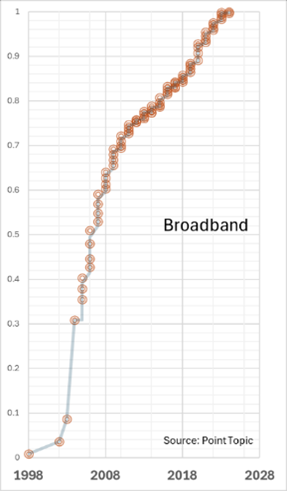
When I started writing about broadband, there were fewer than a few thousand T1 lines, but the magic of fast, always-on internet was pretty obvious even back then. In almost three decades, broadband has become ubiquitous, both at home and at work. We now almost always assume there should be a fast connection on our phones. This broadband ubiquity has enabled Google, Netflix, Meta, and scores of other companies.
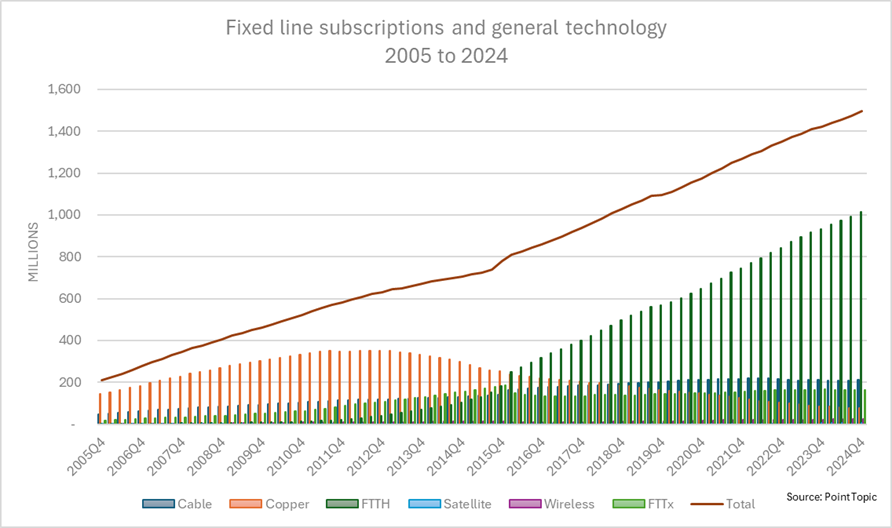
A recent report from research firm Point Topic shows that there are 1.5 billion fixed broadband lines. The growth has been remarkable: It took just over a decade to reach the first half-billion lines in 2010, eight years to add the next 500 million (reaching 1 billion in 2018), and only six years to add another 500 million. The acceleration in demand was a result of the COVID-19 pandemic, which made us even more dependent on high-speed internet connectivity.
Here’s how the numbers breakdown:
- Asia-Pacific: 925 million (61.7%.)
- Europe: 308 million (20.5%.)
- Americas: 236 million (15.7%.)
- Africa: 25 million (1.7%)
- Middle East: 6 million (0.4%)
As of mid-2024, the number of broadband lines in the U.S. exceeds the number of households. Africa still lags in fixed-line broadband subscriptions, though it has made significant strides in mobile broadband adoption. Experts anticipate that satellite broadband will have a substantial impact in Africa and other regions where traditional wiring is challenging and costly.
Looking ahead, the challenge isn’t simply about reaching the next billion connections. The world faces a more complex problem: preventing a new form of digital bifurcation where advanced markets pull even further ahead. If artificial intelligence (AI) becomes a core part of all digital experiences, the lack of connectivity will leave a large swath of humanity behind, simply because they lack access to better digital tools.
Satellite internet has been touted as a potential great equalizer, but given its economics, one has to wonder if we’re putting too much faith in it. Still, can’t help but think about the day when I got a private T1 line installed in my tiny East Village apartment. It felt as if I was the fastest gun in town. Now, even 1 Gbps Webpass connection feels “meh.”
February 2, 2025. San Francisco