Upstream Speeds, Needs Up Again

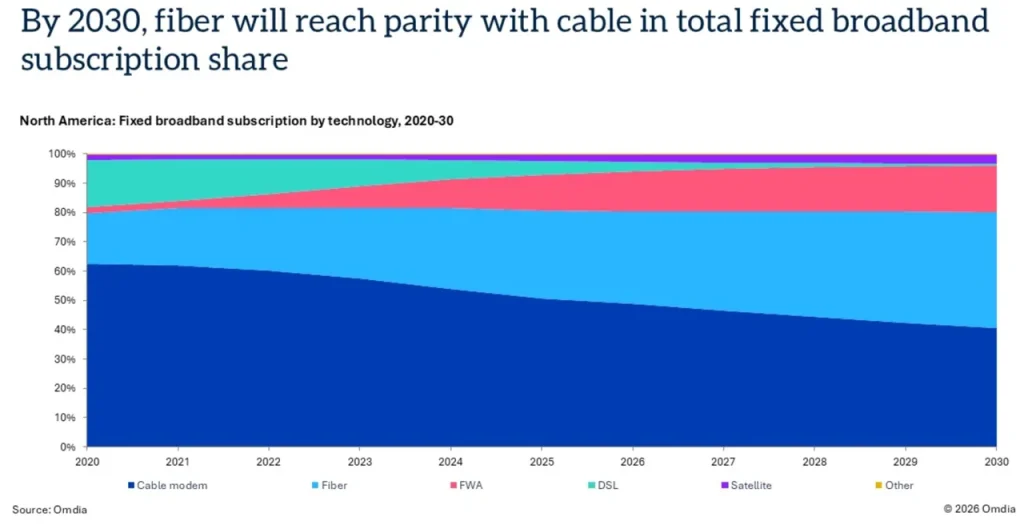
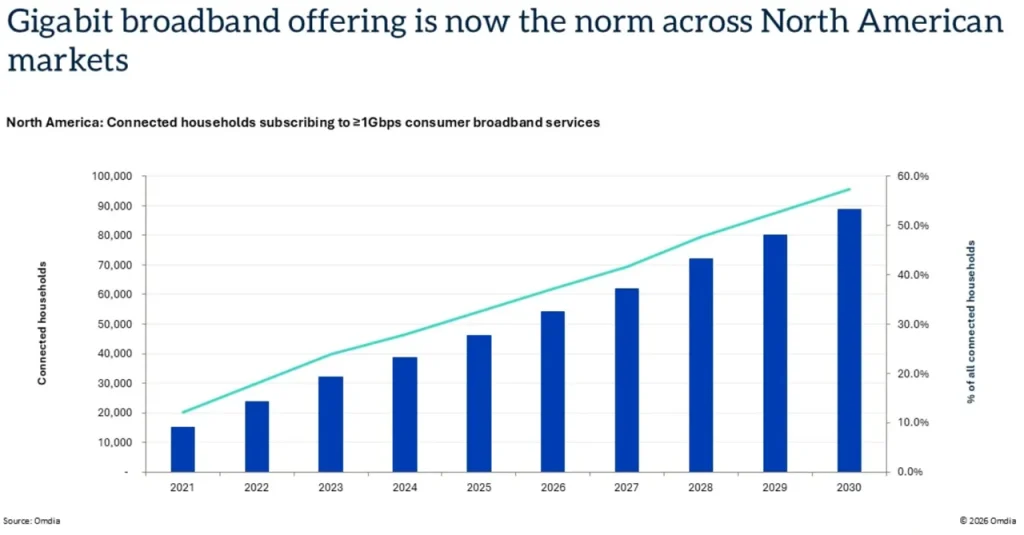
Just a quick update to my earlier piece on upload speeds, fiber, and why municipal broadband was beating cable in the game of speeds and feeds. New data from OpenVault backs it up.

Speaking on the Fiber for Breakfast podcast, OpenVault CEO Mark Trudeau pointed out that during the first quarter of 2026, the fiber upstream average crossed 100 GB for the first time, reaching 106.7 GB. DOCSIS subscribers on the same systems used 56.9 GB. That’s an 87.4% delta, up from the 66% gap OpenVault reported just a quarter ago in Q4 2025.

Fiber subscribers averaged 943.4 GB overall against DOCSIS subscribers’ 720.5 GB in total data consumption. The median gap was even wider, 721 GB on fiber versus 496 GB on DOCSIS. Fiber subscribers averaged 556 Mbps upstream. DOCSIS subscribers averaged 43 Mbps.

As I have always said, give people the pipe and the bandwidth, and they will


Sam Always Wins

“Sam Altman has it. You could parachute him into an island full of cannibals and come back in 5 years and he’d be the king.” — @paulg

Anytime anyone underestimates or tries to do an end run around @sama, I remind myself of this golden nugget from PG, the man who knew him best before he became Sam the man. Just a reminder for present and future @OpenAI employees and investors. (My Tweet)

Over the past week or so I noticed that CFO Sarah Friar and AGI chief Fidji Simo were doing the press. Why them and not Sam? We know Sam loves being in the spotlight. Was there some kind of palace coup in the works?

Well, there might have been something to my late night ruminations. The Information reports that Altman has excluded Friar from key financial meetings. She has been reporting to Simo, not him, since August


What To Read This Weekend

Every few years a startup comes along that dominates the headlines and grabs all the attention. For all the right and wrong reasons. I have been following the industry long enough to see that pattern repeat itself. Netscape, Amazon, Facebook, and more recently, OpenAI.

The headlines are driven by the curiosity of the masses. And then curiosity of the masses drives the headlines. This is an endless loop, till we move on to something new. A lot of you might have forgotten that Facebook’s every move was dissected in the press. It even merited two dedicated blogs, AllFacebook and Inside Facebook. And that’s not to mention other consumer-focused technology blogs.

OpenAI is part of the larger curiosity, and fear about AI, which is dominating the global attention sphere. It is dominating the investments, it is dominating the policies, and it is dominating the social dynamics. OpenAI, to put it bluntly,


Why OpenAI bought TBPN

“A newspaper is not only a collective propagandist and a collective agitator, it is also a collective organiser.” — Vladimir Lenin

In 1902, Lenin argued that his revolution needed a newspaper of its own, and that newspaper was (unironically) named Pravda, which means truth in Russian.

“The standard communications playbook just doesn’t apply to us. We’re not a typical company. We’re driving a really big technological shift.” — Fidji Simo, 2026

Simo, OpenAI’s CEO of Applications, explained this to OpenAI staff as to why OpenAI had just bought TBPN. Different century. Same logic to explain an emerging new socioeconomic order, a new post-revolution reality.


To recap, OpenAI, weeks if not months before its public offering, has acquired the Technology Business Programming Network (TBPN). It is a daily, three-hour live tech talk show hosted by founders Jordi Hays and John Coogan. The show had 58,000 YouTube subscribers, $5 million in revenue


OpenAI: The Fix Is In

An update to More Magic Math from OpenAI


The final mad dash to IPO is on for the big AI companies. SpaceX, OpenAI, and Anthropic have all made their intentions clear. And nothing could be more obvious about OpenAI’s intent than today’s new funding announcement. A few things have changed since I wrote that piece. Some confirm my thesis, and one surprise, though not really.

So, the company says the round closed. $122 billion in committed capital, up from the $110 billion announced in February. Does committed mean money has passed the transom? We won’t know. What we do know is that at a post-money valuation of $852 billion, the anchors are Amazon, Nvidia, and SoftBank. Microsoft participated again, though not clear for how much. The additional $12 billion came from a who’s who of institutional money, including a16z, Sequoia, BlackRock, Blackstone, Fidelity, Temasek, D1, and Dragoneer. The FOMO gang!


Penimimal

“One should not only photograph things for what they are, but for what else they are.” — Minor White

I have not been out in the wild making landscapes for a while now. Almost a year. However, I have found new subjects to explore. San Francisco, obviously, remains my favorite muse. California is my darling. But at home, I have been exploring how to push myself creatively. And one arena I have been exploring is fountain pens — my other lifelong hobby.

I write with them. I cherish them. I collect them. What I wasn’t doing was photograph them.

I also found that most fountain pen photography is quite boring. The sameness of it. Product shots, meant more for a sale than for enhancing the beauty of objects so lovingly created. I wanted to do something different. More abstract. More me.

As the philosopher Dōgen said: “Not to seek reality


What To Read This Weekend

The news cycle has been moving at hyperspeed and sometimes it is really hard to keep up with so much information, most of it not much more than a drop in the bucket. So, I did what I usually do. Take a step back from it all, and decided to just slow down the cycle around my own interests. As a result, most of my writing this week is a bit more personal.

Whether it was celebrating my 23 years in San Francisco or simply using AI to identify the right phrase to describe myself, it was quite fun, and an exercise in some philosophical meandering. I also took the time to write about broadband, and yes, I got all worked up about Google flipping my favorite internet service provider to a PE-owned company. Now I am going to be looking for a new service.

Nonetheless, I took the time


Seeker

Photo by Chris Michel

A few days ago, the Day One journal app gave me a prompt: what is the one word that would describe you. That made me think hard. I was thrown for a loop.

I have always struggled to describe myself. Not sure how others see me versus how I see myself. This is not the first time I have had to confront this question. As a child and as a young man, I dealt with this same challenge.

I have been thinking about this for a few days. It is hard to use one word to describe a whole person. It is a strange way to think of yourself. I came up with many descriptors, but they are not the whole thing. I knew that already. Still, I wondered why they were the fragments that I chose to put down on paper.

When I offered my


‘Astound’ed. Google Flips Its Fiber To PE.

I have been a WebPass customer for years. Fast, reliable, founder-run. When there was a problem, you could reach someone who gave a damn. It was the kind of internet service that made you forget you were dealing with a utility.

Then Google bought it.

That should have been the warning sign. Google buys things it should have no business touching. It launches products without a plan. Its decisions to get into new markets are a map of some mediocre executive’s ambition.

I watched the service slowly get worse. More outages, stagnant speeds, the kind of indifference that sets in when a product becomes a line item rather than a mission. Like it was for Charles Barr, founder of WebPass. When Barr was running the show, the speeds went from 50 Mbps to 100 Mbps to 200 Mbps. All for less than $50 a month. Eventually the speed went to