Books! Books! Books!

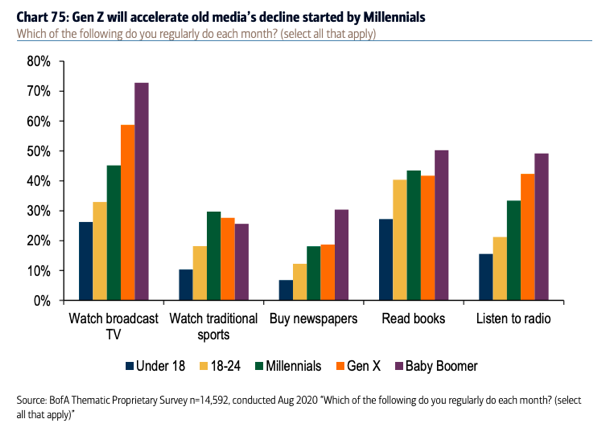
Paul Kedrosky’s Charts Newsletter had this wonderful graphic highlighting the increasing woes of traditional media formats, thanks to millennials and GenZ. However, things don’t look bad for one category: books.

Kids (and older kids) are still reading books at a decent clip, and perhaps will continue to do so, mostly it is a good antidote to the fractionalized and noisy media environment. This is such a huge opportunity for innovation around the “book” format.

With digital book formats and the rise of audiobooks, there is an opportunity to make books more in sync with the new audience. For start, books could be leaner — most books are about 50 percent overweight. They could be published faster — the current cycle takes somewhere between 18-to-24 months before a book is available to the readers. My ideal book — given my millennial like attention span — is one that takes an equivalent

Why the Kindle App Is Just Better With Bookerly

I was spending too much time on Facebook and Twitter, so I took them off my home screen and replaced them with the Reeder and the Kindle apps, mostly to go back to reading the good stuff whenever I have a few minutes. The Kindle app is getting a lot of use, largely due to the new custom Amazon-made typeface, Bookerly.

So far it’s gotten a pretty good reception. As Fast Company’s Design blog noted, “In appearance, it looks something like if Baskerville, a 225-year-old typeface that has been shown to shape our perception of truth, and Caecilia made a baby.” That line is harsh. I actually find it easy to read on the iPhone and iPad but just okay on the Kindle Fire. This is a custom font that is a replacement for Caecilia, which until recently was the Kindle app’s default font. I am confounded by the fact that it is not


Matt MacInnis

Matt MacInnis is the co-founder and CEO of Inkling Systems. He started the digital publishing company after leaving Apple. The rumors of the iPad might have had something to do with his decision.


Introduction


Almost every day I wonder why the book hasn’t been reinvented. New technologies have helped us make the publishing process and marketplace faster and more efficient, but the notion of the book itself hasn’t really changed.

Why?

Shouldn’t the book adapt to our already time-compressed lives? What will books mean to children who are growing up with iPhones and tablets, constant interruptions from the network? Ask any preteen and they’ll tell you that they find what they need on YouTube. So will they read? If so, what? I don’t think the answers are within the book-publishing industry. A business model that starts with exploiting writers doesn’t leave room for innovation. And Amazon is no different from


Kindle Unlimited, Uninterested

So far, I have hesitated to try any of the new services — Oyster and Scribd — that offer you unlimited access to books for a flat monthly fee. Why? Rohit put it best on Twitter, “Feels a bit like gym membership – feels good to have it, not sure if it is fully utilized. Besides, buy+read seems to work.”

These services’ book selection is long of total numbers of books, but is short on the books I really wanted to read. Much like Netflix in the early days, you have a lot of indie-content and old catalog content with some new stuff. Sure they have deals with folks like Harper Collins and Simon & Schuster, I stuck to the true-and-tried buy+read formula. However, when I first heard that Amazon was ready to announce its Kindle Unlimited service — I was interested.

Given the breadth and depth of Kindle library — at


2008-2013: A look at my 5 year book buying patterns

Earlier this week I started playing around with my data shared by the Pocket (a save-to-read-it-later app) team. It showed how many articles I saved every week and how many I read every week. It was a nice thought experiment and the conclusion was that I was reading a third of what I was saving. I was surprised by how low my reading was, considering I read a lot. Pocket CEO Nate Weiner said that Pocket isn’t email inbox but more like Netflix queue – watch it when I have time. He pointed out that each article I read was over 1500 words and I read equivalent of about 120,000 words or about two novels a month. 

That made me wonder if this was having an impact on my book reading habits? At any given time, I am reading about five books (I have always been like this, and have


Apple vs Amazon: The difference is in the little things

I am a big fan of Amazon’s Kindle devices, especially the really cheap $79 version which comes with a WiFi connection. I have been carrying this along with me as I travel across the planet. I have become increasingly frustrated with the device because I am unable to connect to the Internet.

Most airport lounges and public locations want you to sign-in through a browser page. On Kindle’s browser, that is like cleaning your nails with a butcher’s knife. I have tried and tried and failed. It is frustrating to say the least.

And that is the crucial difference between them and Apple. Apple as a company anticipates these problems because it makes hardware to delight its customers. That is what they do – apps, music, videos and books come second. Amazon on the other hand is making hardware to sell other products – books and digital content – and