Why we need to rethink how to support music (and creativity)

Anne Mueller, courtesy of Erased Tapes

A recent random email turned me on to the work by Berlin-based pianist and ambient music impresario Nils Frahm. Through him, I stumbled upon Anne Muller, a cellist with highly minimal compositions. I ended up listening to both of their work on YouTube Music (which comes free with my ad-less premium YouTube subscription.) 

Frahm’s work is so unique and unfussy, so minimal, and yet so complex. His new album, “Empty,” is a collection of eight solo piano pieces. In many ways, it reminds me of the streets of our cities: empty, haunting, devoid of life and humanity. They are achingly beautiful. I ended up listening to him for two straight days, interspersing his fantastic piano work with Muller’s new recording, “Heliopause.” I am particularly in love with the track “Nummer 2.” 

Including these two, I have bought a total of four albums so far


No more 8tracks

Photo by Elijah O’Donnell on Unsplash

A very long time ago, I met David Porter, and we talked about music and its future. We talked about streaming and the romance of mixtapes. I wrote about his startup, 8tracks. If it was a great and clever idea, from an entrepreneur who loved music and its nuances. David is one of the good guys, so I rooted for him. Unfortunately, like movies, not all startups have a happy ending. Today, David announced his heart-rending decision to let go of 8tracks. Tomorrow, the music will stop. It is sad. If you want to know why it happened, just read David’s autopsy of his startup journey. It will be easy to blame the economics of the music industry or the growing dominance of Spotify. But in reality, there are more forces at work. David writes eloquently about the hard truths of an on-demand, attention-based


Brand Dead

The 2010s are coming to an end, and looking back, a lot has changed, especially when it comes to retail landscapes. Vox looks back at the brands we have lost. Blockbuster and Borders failed to adapt and thus became victims of broadband and the Internet, only to be replaced by Netflix and Amazon. Internet and the companies it has spawned saw the death of compact discs, and with that, we lost the brands such as Columbia Record House. Payless, American Apparel, and Bon-Ton are some other names. Only recently we lost Dean and Deluca and Barneys. Good News is that we still have many American brands thriving in Japan. When I look back at the decade and see all these brands dying, I can only see the regeneration and creation of new brands and enterprises — bigger and different. I can’t imagine life without Spotify. Or Amazon, for that matter. 

Photo by Andrea Davis on Unsplash


Spotify Wrapped: Data Story Done Right

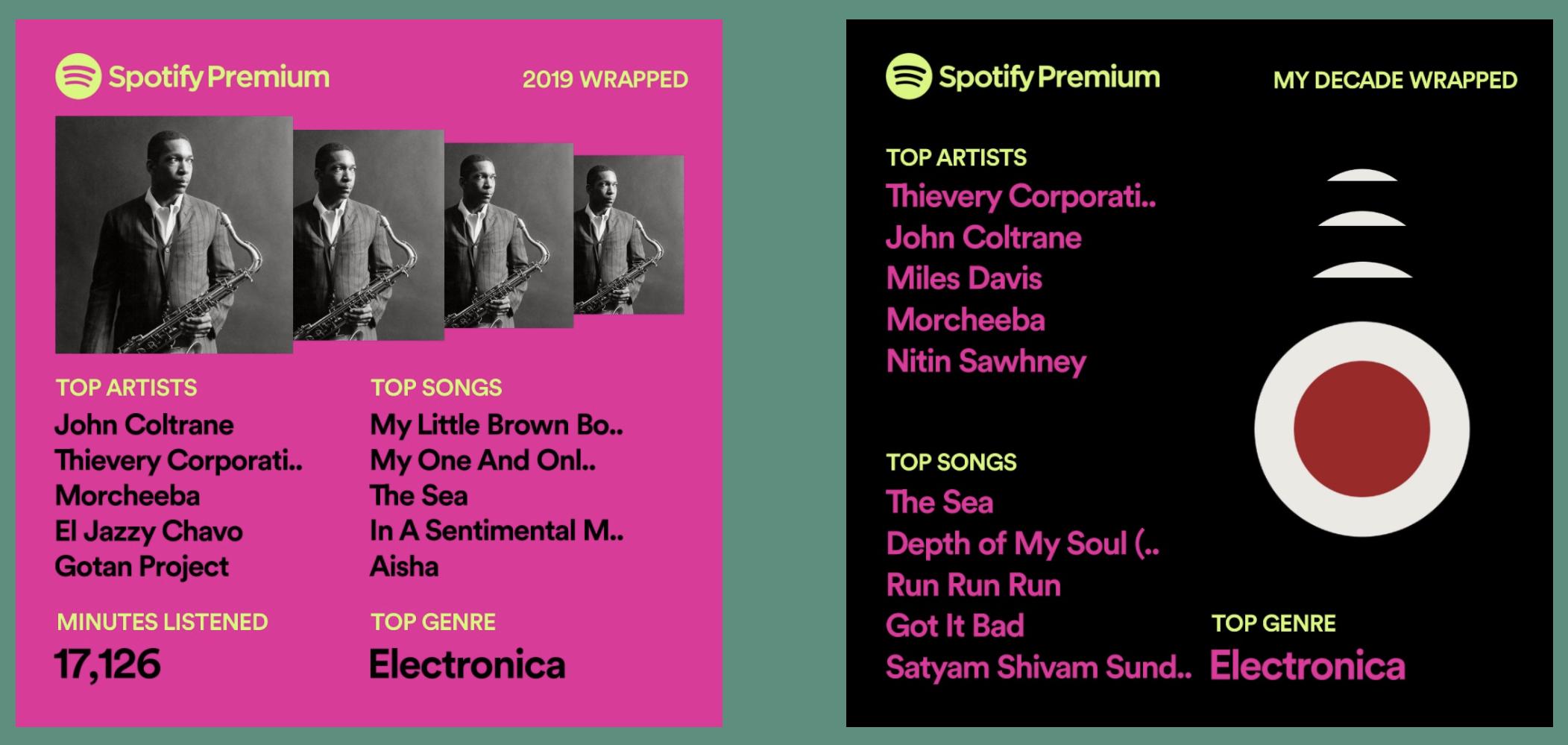
I am a long time Spotify customer, and over the years, I have appreciated their data-driven approach to surfacing the music I might like. However, what I absolutely love is their year-end wrap-ups about my listening habits. And this year, they have gone above and beyond and come up the decade long wrap up of my musical habits. I loved how personal and intimate the normally sterile data felt this time around. It is so perfectly designed and presented that I couldn’t help but share many of those facts as Instagram stories. Sharing was seamless as well. In case you were wondering

  • I listened to John Coltrane for 54 hours. Here is my favorite songs playlist for 2019. I spent about 17,126 minutes listening to music. I guess that isn’t a lot.
  • El Jazzy Chavo is my new artist of the year. Top among the 534 new artists I listened to


Music helps make memories

I don’t know why, but I like cold, desolate places. I like snow, ice and learning how humans survive in these tundra-like conditions. And that is why I was watching The Last Trapper, a documentary about a Canadian trapper called Norman Winther. It is an okay film — landscapes are hauntingly beautiful, the rest of it is meh. I hate killing of animals.

So maybe that is why I won’t move to Alaska or some such place. But I still love the mountains and the snow. The film had a great soundtrack though. One of the songs — By The Rivers Dark by Leonard Cohen. It is not even in the top ten songs of Cohen. Not even in the top twenty. But it was a song that got me back to listening to Cohen. I went to Spotify, looked up the song, created a playlist and before you know it, I was heading down the memory lane. 


Should Spotify buy Sonos

If some job listings are to be believed, then Spotify might be getting into the hardware business. I am not sure, how much of that is true, but it makes perfect sense. Spotify should be thinking about vertical integration — its content, its distribution and its own speakers — it wants to compete with Apple, Amazon, and Google. Those three companies are making their speakers, have their music services and have their distribution channels. 


Has music lost that loving feeling?

Over past few months, I have become strangely obsessed with reconnecting to music, listening, curating and most importantly experiencing it, much like I used to about a decade ago. In the years that intervened, like many, I too succumbed to the charms of streaming music…. the sheer ease of accessing music, anytime, anywhere on any device made perfect sense.

The downside of streaming was that the music was optimized to meet the vagaries of the broadband networks, and as such, we moved away from the idea of music from say a compact disc. But the end of our love affair with music began even before shitty headphones and low-resolution audio streams. Formats and devices have nothing to do with music, art, and creativity — what matters is the human relationship to creativity. 


The Om Show Podcast: w/guest Shakil Khan

7C2ACCC8-8ABB-4A5B-BD6A-4873333C9D4D.jpg

Shakil Khan, the head of special projects at Spotify and co-founder of Student.com is one of the fixtures in Internet circles. And connected as he is — is the guy who got many of my peers to support CharityWater — no one really knows him. These days he is Spotify’s special ambassador and a wellknown and beloved fixture in tech circles. He is “Shak,” not “Shaq.” It is hard to describe this tall, British-Pakistani guy who starts his Sunday by sharing some amazing desi songs from Spotify’s vast library of music with me and a handful of friends of South Asian heritage.  He is always there to help his friends, make impossible happen. He hides behind an easy smile, putting his rolodex towork for others and tweeting links to some of the best desi (aka South Asian) music. I met Shak ten years ago and we have become what is known as Internet