
Subscribe to discover Om’s fresh perspectives on the present and future.

Today is my 17th re-birthday. If you’ve been a longtime reader, you know why I call it my re-birthday. If you are new around here, well, here is a short recap. Just after I turned 41—17 years ago—a life of poor habits and family genetics caught up with me. I had a heart attack and was in the hospital for a few days. The doctors discovered all sorts of problems, and I ended up on the operating table. I came back home with a few new additions to my heart—the stent.
This morning, over my first cup of tea, I started to think about the past few years – things that have gone right – mostly right – since that heart attack. It was a terrible situation, but it changed the trajectory of my life.
After the surgery, the doctors told me to shape up. So in the years that have gone by, I’ve become obsessed with kicking all my bad habits. No red meat, no alcohol, and most importantly, no smoking. I quit smoking cold turkey 17 years ago. It was not an easy thing, but I am glad I did. At the time, the doctors told me I was type 2 diabetic, so I needed to get my diet under control. In short, with medication and major lifestyle changes, doctors said that I could improve my health.
Over the past 17 years, I have kept notes. I try to eat well, walk, and avoid everything that is not good for me – with an occasional exception. I am first to volunteer for new treatments. It is not that I want to live forever, it is just that I want to enjoy life I have – whether it is a day, a decade, or three. Either way, I want to give myself the best chance of doing that.
Lost in my reverie, I realized that one thing I had not thought about even once was the actual technology that set me on the right trajectory – the stent. It is ironic because both as a reporter and as an investor, my first instinct is learning about the who, why, and what of technology. And yet I never took the time to really learn about how a “stent” works, its origin, and how the technology has progressed since December 28, 2007.
All technologies come with obsolescence, and my doctors have consistently told me to be prepared for a day when I might need a retrofit. My lifestyle has changed but my genetics have not. South Asians as a group are most prone to cardiac diseases. I wanted to find out how far stents have come over the past decade and a half.
How much have they improved, should I need a new one? I have done the same for my diabetes and blood pressure. If I can obsess over an iPhone upgrade, it is prudent to know more about the latest in stent technology. So, off I went. And before I knew it, it was midday. The more I learned about the stent, the more fascinated I was by its history, its journey, its impact on society, and of course its future.
Just like the stent, another technology entered my life in 2007: the iPhone. I couldn’t help but think of coronary stents — one of medicine’s most significant technological advances — as akin to the revolutionary impact of the iPhone on consumer technology. It was a weird coincidence, but in a way, using the smartphone as a parable would be a good way to tell the story of the stent.
No, I am not saying they are the same thing – they are not even remotely the same – however, they have had an impact on society and have turned companies into financial giants. American Heart Association data shows that cardiovascular diseases accounted for 19.91 million deaths in 2021, making them the leading cause of death globally. Coronary artery disease (CAD) accounted for approximately 8.9 million deaths worldwide in 2015, representing 15.6% of all deaths. I use these numbers — dated as they might be — to underscore the importance of this technology. As someone who has benefited from it, I can’t overstate its significance.
The impact on heart disease treatment has been profound. Before stents, patients often faced open-heart bypass surgery as their only option. Today, over 2 million people annually receive stents in procedures that typically have patients home the next day. For companies like Abbott, Medtronic, and Boston Scientific, stents generate billions in annual revenue while driving continuous innovation toward “smarter” and eventually dissolvable devices.
The stent, much like the iPhone, is a great example of the ground truth of any technology with a big impact—it takes many steps, mostly in anonymity, several coincidences, quite a few guesses, and the convergence of multiple little breakthroughs to arrive at the big “aha” moment. Stents have evolved from basic mechanical scaffolds to sophisticated drug-delivery systems. This evolution continues with the integration of “smart” technologies and the emergence of bioresorbable platforms.

Let’s start with a simple question — what is a stent?
A stent is a small, tube-like device inserted into the body to keep a passageway open, usually within blood vessels. While stents have many uses, the colloquial use of the term describes a technology that helps treat blockages caused by atherosclerosis (plaque buildup), thus improving blood flow to the heart.
The term “stent” originated with Charles Thomas Stent, a 19th-century English dentist who developed a compound for dental impressions. While he never envisioned cardiovascular applications, his name became synonymous with supportive medical devices. Johannes Fredericus Esser, a Dutch plastic surgeon, used a version of stents for reconstructive surgery on soldiers who suffered facial wounds during World War I. The devices were later used to help with bile duct issues and other parts of human anatomy. (Read: “Stent: The Man and the Word Behind the Coronary Metal Prosthesis.”)
In 1977, Andreas Gruentzig performed the first coronary balloon angioplasty at University Hospital Zurich. This breakthrough procedure, while significant, faced numerous challenges, but it is widely viewed as the start of the modern era of stents in cardiovascular medicine. Eight years later, Julio Palmaz and Richard Schatz (of Johnson & Johnson) developed the first practical balloon-expandable stent. They created a stainless steel mesh tube that could keep the blood vessels open after angioplasty. The first such device was implanted in 1987, and in 1994, the U.S. Food and Drug Administration granted approval for the stent.
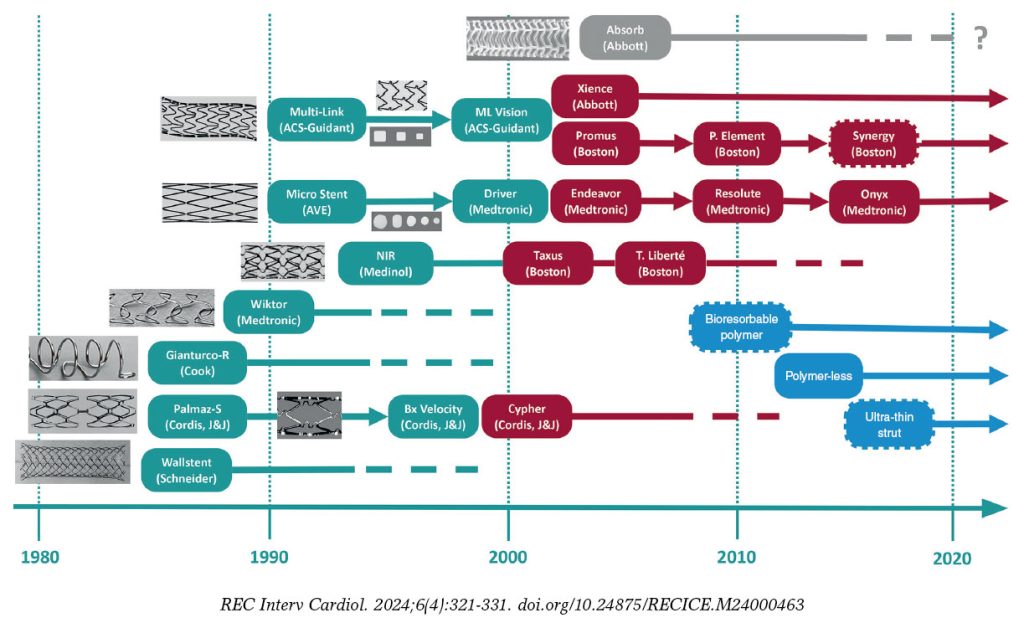
Things continued for a few years, but the next big and real game-changer came in the early 2000s with the development of drug-eluting stents (DES). By coating the metal scaffolds with medications that prevent re-narrowing, companies like Johnson & Johnson (Cypher) and Boston Scientific (Taxus) created stents that dramatically improved success rates. These advances turned stents into blockbuster products.
Think of everything before the emergence of DES as the pre-smartphone era. The early experiments and efforts of stents were akin to rotary phones. Just as early phones were used for basic voice calls, early stents were simple balloon angioplasties—functional but basic, and with limitations. The emergence of bare-metal stents in the 1980s would be like the emergence of Nokia 3310 at the dawn of the mobile era. Sure, they were reliable and basic like the Nokia 3310 phone, but they were still a significant advancement. However, they had issues. Restenosis, the re-narrowing or blockage of an artery at or near the site of a previous treatment, would recur in 20% to 30% of cases. Other complications also plagued these early devices.
I would compare the introduction of the first drug-eluting stents by Johnson & Johnson to the “BlackBerrys” of the stent world. Just as BlackBerry made email on the go easy, these new stents added medication to the metal scaffold. That was a massive game-changer. Sure, they had their issues, but they made a big impact. I feel that positive impact every day. My Taxus stents keep me ticking.
Since 2007, however, new versions of DES stents have come to market. They are sleeker, more reliable, and generally offer a better experience for the patient. Just as Apple’s iPhone provided a new, sleeker, and better user experience over its predecessors — Palm, BlackBerry, and Nokia — the second generation of DES stents came with better drug delivery and fewer complications. In the 17 years since I received my stents, stents have improved by leaps and bounds. Today’s stents are ultra-thin and highly sophisticated and come with advanced features such as bioabsorbable polymers and thinner struts.
A modern coronary stent uses a cobalt-chromium or platinum-chromium alloy platform with ultra-thin struts (60-65 micrometers), representing a significant reduction from both first-generation bare-metal stents and first-generation drug-eluting stents (130-140 micrometers). Despite thinner struts, modern alloys provide superior radial strength compared to the 316L stainless steel used in early stents.

Other improvements include designs with open-cell architecture and flexible links for better vessel conformability. The surface is electropolished to enhance biocompatibility and reduce thrombogenicity. The biodegradable polymer coating (5-8 micrometers thick) carries antiproliferative drugs (100 micrograms per square centimeter) and dissolves within 6-24 months. These improvements deliver better outcomes with restenosis rates of less than 5%, compared to 20-30% in bare-metal stents (BMS) and 5-10% in first-generation drug-eluting stents (DES). And the stent makers are not done yet. Future innovations include fully bioabsorbable platforms, smart monitoring capabilities, and personalized designs.
I am going to continue with torturous use of my smartphone analogy, so bear with me. Just as the iPhone is now facing future competition from an emerging class of AI-powered devices, stents and their innovation machine are starting to feel a whiff of headwind from GLP-1 drugs like Ozempic, Wegovy, and Mounjaro.
These GLP-1 drugs are helping improve cardiovascular health by aiding weight loss, reducing plaque buildup, improving vessel flexibility, and helping control blood pressure. They can induce metabolic changes such as decreased inflammation, improved lipid profiles, and enhanced glucose control. These factors together slow the progression of atherosclerosis, improve blood vessel function, and lower the risk of blood clots. I know these are less sensational aspects of Ozempic compared to writing hot takes about weight loss, celebrities, and all things tabloid.
According to some recent data, GLP-1 drugs will lead to a reduction in stent procedures, potentially decreasing the need for invasive interventions. Boston Scientific reported a 3% to 5% decline in procedures in the third quarter of 2023, while Medtronic said it is monitoring “potential headwinds.” No one wants to talk about it loudly – which is usually a sign that these drugs will have an impact on demand. Some analysts think there could be as much as 15% reduction in stent procedures by 2026.
All that doesn’t matter to me as someone who lives with cardiac disease. They are the Batman and Robin for me – I don’t care who is whom. For me, GLP can help control certain aspects of my life, and stents have already proved to extend my life. When it is time for me to get a new stent, I now know that stent technology has come a long way and is likely to help me live better. I think millions of others who are in the same boat will be grateful for one or both.
As for me—on my 17th rebirthday, I can’t live without the stents and am ever so grateful for the innovators and tinkerers who are helping improve them day by day. Thanks to them, I can live with this reality.
Time has a strange habit of slinking away. It does so quietly that we don’t notice it till it’s too late. And what you are left with are fragments, or what we grandiosely call memories. You remember some days, a few moments, and a handful of faces, and they all add up to become your past. Today is one of those red letter days — fifteen years ago, I faced mortality, and somehow I came out on the other side. Looking back, what seemed like a dark period in my life has turned out to be the best thing that has ever happened to me.
It taught me the lessons we learn late in life early: excess, perfection, and accumulation are fair-weather friends. I learned that by giving time to play its hand, I would stop being impatient. Life, as it turned out, has been much better than how I had planned it. And more importantly, you are better off finding comfort in the company of imperfection.
December 28, 2024. San Francisco.
Notes from (previous) Rebirthdays: #0, #1, #2, #3, #4, #5, #6, #7, #8, #9, #10, #11, #12, #13, #14, #15, #16.
Comments are closed.
Happy birthday, Om. What a wonderful gift your story is for all of us, full of fascinating information. Here’s to many more.
Hi Leslie – Thank you so much. And absolutely hoping that I am around for a little bit longer.
Happy Birthday!! 🎂🎉 😀
Thanks Jonnie
Thanks for this interesting post, Om. I like the idea of a rebirth day – I’m 5.5 years post heart transplant and 10.5 years post sudden cardiac death. Both events amounted to a rebirthing. Heart transplant survivors are prone to a level of plaque buildup and I’ve been wondering when I might need a stent. The advent of the GLPs may help prevent the need for one, which is great. I’ll be sure to discuss this option with my heart team. All the best and happy rebirth day!
Rand,
Congrats for still being here. And nothing like a Rebirthday. I bought myself a vintage fountain pen and used the rebirthday as an excuse to splurge.
Wishing you the best on rest of your journey.
Congratulations on your birthday. I love your posts about tech and I think your photography is superb. I’ve talk about you with friends more about your photos than about your tech career. Keep up both!
Thank you Jose. This means a lot. Happy new year to you and your loved ones!
Thank you, Om. Found it fascinating, and love your early life lessons. Together in imperfection.
Thank you Dave. I appreciate the encouragement. Wishing you a great year ahead.
Thank you!! Very encouraging for a 70 year-old closet smoker. I needed this!!!
Hi Mitchell,
Hopefully you can kick the habit. I was smoking 3-packs-a-day, when I went cold turkey. I wasn’t the best person to be around, but in the end worth it.
Hey Om, thank you very much for this informative rundown on Stents and your involvement with them. Personally, in my 80th year at the height of the Covid crisis I was diagnosed with major heart issues and scheduled for an open heart surgery coronary bypass graft (CABG). As luck would have it my age meant that my vein material wasn’t up to doing the conduit function for my cardiac arteries so the CABG procedure plan had to be abandoned. As an alternative approach I was implanted with a stent in the worst of the cardiac arteries and put under observation for possibly stenting the second one. As it turned out after six months or so that singled stent (plus a host of other drug treatments) had improved blood flow to my heart to the extent that it started pumping more enthusiastically producing a flow on effect in the unstented artery so that it in turn developed a more open path and the second round of stenting was rendered redundant The consequential effects of all this have been remarkable with my type 2 diabetes in much better shape as well.
Your article has given me valuable background to the whole stent thing. Thank you very much indeed
Hi Mike
First of all, congratulations. I am so happy you came back from the brink, and how the stent helped fix the issues. It is a miracle of this little tiny tube. I can’t wait to hear about your progress. Wonderful.
Thanks for sharing. Very interesting about the Stent. Even better that you are still around to celebrate your red-letter day!
Thanks Charles. I can’t believe how little we all know about this technology. I am looking forward to our adventures together in the new year.
This is the year of the Forbes.com reunion. No excuses!
100 percent.
I’m proud to say that the man whose studies showed how heart disease can be reversed by a combination fo diet and statins was Dr. David Blankenhorn of USC, who died in 1993 of cancer. https://www.latimes.com/archives/la-xpm-1993-05-11-mn-33844-story.html
No direct relation but Blankenhorns are thin on the ground so I’ll call him Uncle Dave.
Dana
Thanks for the heads up on Dr. David and his work. I enjoyed reading that story.
Om, this article really struck a chord in my heart, so to speak. My dad lived with heart disease for decades. Parts of his life traumatized me as a child, young adult, and as a grown woman, watching his unhealthy habits kill him. Quadruple bypass surgery was his story. I enjoyed learning the history of the scientific breakthroughs, as well as more insight into your life’s path. Take care my new friend…you are in my thoughts.
Hi Colleen,
Thank you for the comment and also sharing the story of your father. We all have our own paths and somehow I got the memo and changed my life. I am looking forward to seeing you soon and taking some photos in the wilderness.
Happy 2025 ahead.
Much appreciated from another stentee.
Anyway time sir. I might be digging into this even further.
I remember when that happened, Om. How young you deemed, to have had a heart attack. But it turned out to be such a “gift” to you because you had to learn things!
Thanks Francine. I really appreciate the kind words and how much of a supporter you have been of me and my writing with your attention.
Om – only just learned about your heart attack and stenting from this post, though I have seen many of your other posts through the years. Thanks for this post. It’s a subject of much personal interest to me.
I have literally been watching the development of stenting my entire life, since my dad was one of the first cardiologists to perform them. He performed the first angioplasty at UCSF in 1977 — and quite possibly put in your stent.
I remember following all the research in different stent types and the rates of restenosis as I made his slides for him. (This was the era in which one could make slides with PowerPoint, but had to send them off to the print shop to be made into 35mm slides. But I digress.) Drug-eluting stents were, of course, a very big deal when they were introduced.
One of the things that recently struck me was how, when he started his career, we weren’t far off from a time when there were no real treatments for a heart attack. CABG surgery itself wasn’t developed until the mid 60s (and even then was a lot more dangerous than it is today). Before that, treatment for a heart attack was only slightly removed from putting the patient in a quiet room and hoping they wouldn’t die.
Thinking about how much progress we’ve made in the last 50 years — and more recently with things like DES and GLP-1 inhibitors, and in other areas of medicine with things like mRNA vaccines — is one of the few causes for optimism for me these days!
Happy re-birthday!
I loved this more than some of your other posts, not that the others were bad, but, this was heartfelt. To you and many more years!
(I do miss being able to quickly email you my thoughts!)
Thanks – I guess it came from the “heart”
Pun intended 🤣
Side note, Julio Palmaz‘s winery is incredible you should check it out bc yr so close in proximity. Also his Porsche collection is superb…it’s at the winery, just ask.
Can you make an introduction, Stephen?
A story of Grace and Truth. As a famous singer once said, “You wear it well. ” Great article Om. Looking forward to seeing you soon and enjoying our conversations.
Brother David, Thank you so much and I hope to our adventures together and lots of conversations.
Happy ReBirthday, and thanks for the stent information.
I also had my first heart attack at age 41, although I had quit smoking 20 years prior to it and was very physically fit. Genes got me, inherited from my father. That was in 1990. My second heart attack was in 2000 almost exactly ten years later. My third was 2007 at age 56. The last one was when I got two stents–DES Cypher stents.
Now, 17+ years later, those stents are still keeping me healthy. I never expected to see my children (who were four when I had my first heart attack) graduate high school, or college, or get married, or have children. I have seen all of that.
Cardiology and stents saved my life as well. How fortunate we are to have access to such technology.
Hi Terry
Thank you so much for the comment and for sharing your story. I am so glad that you are here, and stents helped overcome some of the challenges and fight the genes for a little bit longer. Many more years to you as well.
Thanks for this article, Stent was something I always wanted to know more about but the opportunity never came. The level of detail is right for general audience.
I am glad I could help. Thanks for reading.
Thanks for sharing Om and happy rebirthday. Sometimes it’s easy to forget how big the impact is of inventions we easily take for granted once they are here. Only to realise the enormous impact they have after taking a moment to reflect on it.
Wilbert,
Indeed. We all do that and sometimes you just need the year end pause to really appreciate them.
Happy New Year,